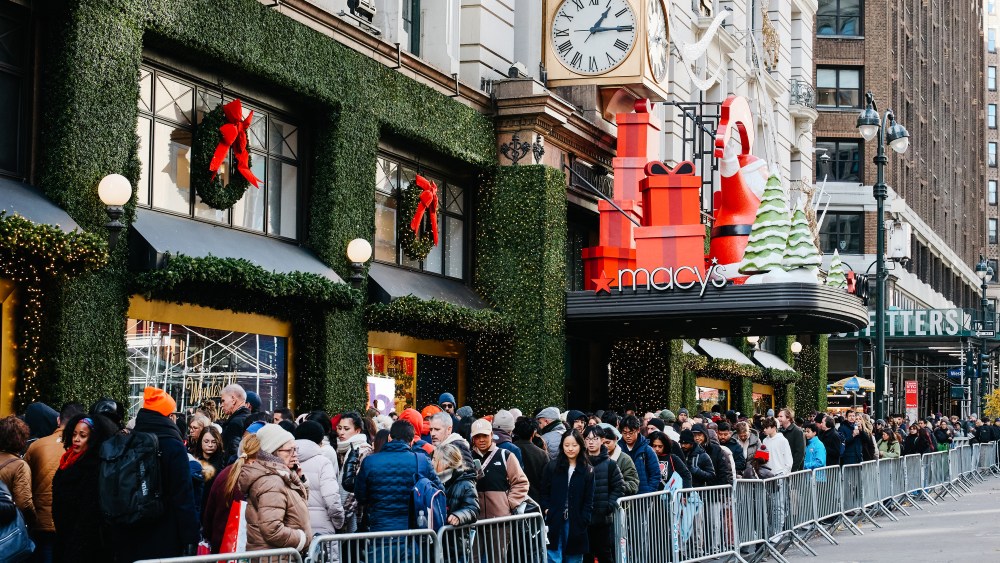
The scene at stores nationwide wasn’t as frenetic as years past, yet the turnout was good enough and the shopping vigorous enough over Black Friday weekend to reinforce hopes for low- to midsingle holiday sales gains.
Price promotions; cold and clear weather spurring outerwear, gloves, and sweater sales, and consumers sensing the most desired gift items could sell out quickly with retailers planning inventories cautiously this year lifted business over the Thanksgiving weekend. All the new tools available to make shopping easier, such as agentic commerce, chatbots, and buy now, pay later programs, also helped retailers, as did expectations that the discounting — most often seen in the 30 to 50 percent off range — won’t get much deeper, and certainly won’t be as wild and crazy as previous holiday seasons. That should help retailers achieve decent margins.

Walmart, Amazon, Gap, TJX and Ross Stores have raised guidance for the year, reflecting confidence in the fourth quarter. Other retailers that have been performing well this year — among them Aritzia, Vuori, Primark, Bloomingdale’s, Abercrombie & Fitch, Costco and Knitwell, the parent of Ann Taylor, Loft and Talbots — should emerge from the 2025 holiday season in decent shape.
You May Also Like
By many accounts retailers were pleased with their level of business Thanksgiving Day through Saturday, mollifying some concerns that higher prices and economic uncertainties would put a big dent in holiday spending.
Yet they remain guarded about how the holiday 2025 season might turn out.
Not the Total Season
For Michelle Wlazlo, chief executive officer of JCPenney, Black Friday weekend is not necessarily an accurate barometer for the rest of the season. “It’s a good first check to see what people are buying and what deals they like the best, but [the season] really depends on the customer psyche and where the calendar sits,” Wlazlo said. “What we do see, more than anything, are trends and the kinds of gifts families like, and we use that information to amp up later before Christmas.”
Wlazlo said she’s “mindful” of Penney’s customer base of working class families. “They are a little more strained this year, but we’re pleased with how we started out the season,” she said. “We just have to watch how the next few weeks play out for them. I am feeling optimistic.”
“These days are not the most indicative for us,” said Bob Mitchell, co-CEO of Mitchells Stores, which operates five luxury nameplates in the U.S. Mitchell did say his sales were good over the weekend, while the real rush always begins at his stores in the middle of December.
“The luxury customers know they can wait and still get a great selection,” he observed. That being said, Mitchells’ traffic was stronger than last year. “We’re feeling very positive that our trend of high-single-digit gains will continue. The stock market is at an all-time high and people are feeling good.”
Similarly, when asked if business over the Thanksgiving/Black Friday weekend portends the season’s results overall, Stephen Lebovitz, CEO of CBL Properties, said, “It’s always hard to tell, but there’s definitely been a good start. We were headed into the season with strong momentum so I think we should have a good season.”
He said the Black Friday and Saturday traffic at CBL properties started earlier this year, adding that “7:30 was the new 8:30. The parking lots were full by noon. Stores offering promotions had the best traffic.”
Athleisure and beauty stores drew the biggest crowds while Lego, Ugg, Gap, American Eagle, Victoria’s Secret, and Bath & Body Works were among the brands experiencing strong weekend business, Lebovitz said. Among CBL’s top properties are Cool Springs Galleria in Nashville; Fayette Mall in Lexington, Ky.; Hamilton Place in Chattanooga, Tenn., and West County Center in St. Louis.

Stephen Yalof, CEO of Tanger, said traffic was up 1.8 percent on Friday and Saturday, with Black Friday alone up 3.8 percent. Based on anecdotal evidence, he said Nike, Old Navy, Coach and American Eagle were the busiest stores Saturday with many of the locations experiencing long lines inside their stores. Toys R Us and Lego also fared well.
Yalof said more shopping incentives this season, including doorbusters; prizes; buy-one, get-one free deals, and stackable discounts for Tanger loyalty customers strengthened the value proposition across Tanger’s 30 outlet centers and three open-air lifestyle centers. “The stores they shop are important but the values are more important. It’s how much they got for how little they spent. This is so important for people, especially in inflationary times,” he said.
“There are some challenges in the overall economy and our business has been good since COVID, so we keep waiting for the music to stop and to have to look for a seat, but it hasn’t happened,” said Ken Giddon, president of Rothmans, which operates a flagship men’s store in New York City and two units in Westchester, N.Y. He said he was surprised by the strong kickoff to the season. “We had two really strong days that beat expectations.”
Ken Ohashi, CEO of Brooks Brothers, was “very, very pleased” with the kickoff of the season. “We had a great Black Friday in all channels. We’d been having a real good quarter and it just continued. We saw good traffic in the malls and in the outlets. It was a big volume day for us.”
Online Sees Boom
At luxury website Mytheresa, “Black Friday and the broader holiday period drove a significant surge in site traffic, reinforcing the strength and intent of our core customer base,” said Carly Rosenberg, president, North America. “Our customers are true wardrobe builders — they come to Mytheresa specifically for full-priced runway and ready-to-wear, which continues to be a key driver of our performance. Fine jewelry remains one of our highest-performing categories during this season, and we consistently see strong conversion across gifting segments such as women’s bags, scarves, shoes, and jewelry, as well as men’s hats, ties, gloves, shoes, and bags.”
Rosenberg also said that Mytheresa’s Life category for home decor, travel and lifestyle products has seen “a notable seasonal uplift.”
Nearly 90 percent of Target Corp.’s stores had a line of shoppers waiting to get in as soon as the doors opened, some lines forming as early as 3 a.m., according to the company. “On average, 150 shoppers were waiting at store openings for our in-store giveaway, with some locations seeing nearly 500 guests in line,” Target indicated in a statement. “All 100 complimentary gift bags at every participating store were claimed by the 6 a.m. opening, highlighting the strong excitement and momentum heading into the holiday season.”
Target’s deals included 50 percent off select toys and 40 percent off sweatshirts, sweatpants and denim. Target offered a free tote bag filled with various items to the first 100 guests in line at each store. The totes included a chance to win a prize ranging in value from $99 to $350.

A Trillion-dollar Holiday
The National Retail Federation predicts U.S. retail sales in November and December will grow between 3.7 percent and 4.2 percent over 2024, topping $1 trillion for the first time. Last year’s holiday sales rose 4.3 percent to $976.1 billion.
Mastercard reported that on Black Friday, U.S. retail sales rose 4.1 percent, with e-commerce up 10.4 percent compared to 2024. Apparel sales rose 5.7 percent, and jewelry rose 2.75 percent, making them the top two merchandise categories. Restaurants grew 4.5 percent, as more people chose dining out to celebrate the season.
Software giant Adobe reported that consumers spent $11.8 billion online on Black Friday, up 9.1 percent year-over-year and above Adobe’s initial forecast for an 8.3 percent rise to $11.7 billion. Additionally, 55.2 percent of online sales came through a mobile device, versus a desktop, representing $6.5 billion, or 10.2 percent more than a year ago, reflecting the increasing popularity of mobile shopping, and siphoning some traffic from brick-and-mortar stores.
“Black Friday 2025 didn’t kill the holiday; it changed how shoppers approached it,” said Joe Shasteen, global head of advanced analytics at RetailNext, which provides in-store analytics to help retailers understand shopper patterns. “Foot traffic was down 3.6 percent on Friday and 8.6 percent on Saturday, but that wasn’t disinterest, it was intention. Shoppers showed they’re done with the impulse-driven, one-day frenzy. Prices, tariffs, and tighter budgets pushed people to shop with discipline, not adrenaline, and they responded by turning Black Friday into a value calculation,” said Shasteen.
Still, the 3.6 percent drop on Black Friday was better than the 6.2 percent decline seen from Sunday, Nov. 23, through Wednesday, Nov. 26, according to RetailNext.
“It shows that even in a cautious year, shoppers are still willing to attend major promotional events; they’re simply being more selective about when those events are worth the trip,” said Shasteen. “Despite the declines, Black Friday again delivered the highest in-store traffic of any day this year, reaffirming its role as the anchor of the holiday shopping season, but the weekend’s performance was shaped more by real-world factors than waning interest. Consumers are still willing to shop, they’re just demanding proof it’s worth leaving the house. Retailers who treated November as a month-long build, rather than a single-day spectacle, saw the strongest in-store performance.”
Craig Johnson, president of Customer Growth Partners, characterized footfall on Black Friday as “nothing to write home about, in the 2 to 3 percent range. Transaction velocity, we think that was up about 3 percent. That’s fair to middling, not a disaster.”
He said the traffic at malls, outlets, and power and strip centers was dominated by women because many men stayed home to watch football games. He’s forecasting 4 to 5 percent nominal sales gains for the season.
Consumers Value Conscious
“There was none of the Black Friday craziness there once was,” Johnson said. “The one consistent thing we see is a focus on value. Walmart, Costco and Amazon are in the middle of an excellent season. The second [main] value source is the off-price sector, which is very strong. The consumer is really calling the shots here by switching to lower-price brands, house brands versus premium brands, and trading down,” to stores like Walmart.
Spot checks showed that the younger crowd can still put down their phones and hit stores. Michael Brown, Americas retail leader in Kearney’s consumer practice, was at the Garden State Plaza Mall in New Jersey and local big box stores on Black Friday. “Young shoppers ruled the morning,” Brown said. “The morning was won by retailers for tweens, teens and twentysomethings. The Gen Zers were out aggressively shopping deals that spanned 20 percent to 50 percent off. Customer purchasing was robust. I’d say that on average shoppers were walking away with two bags per person. Absent from this year’s promotions were last year’s pervasive ‘60 percent off’ as retailers try to save price and mitigate the impact of tariffs on their margins,” he said.
“We felt good about the lines,” Penney’s Wlazlo said. “What was unique to JCPenney was that it was families — grandparents, parents and their kids… “Some areas that are trending really well early on are fine jewelry, fashion jewelry and fragrance, handbags, accessories, kids and teens,” she said. She also singled out Nike, and Penney’s proprietary Liz Claiborne and Worthington brands.
Asked whether prices are higher this season due to inflation and tariffs, Wlazlo replied, “Probably 60 percent of our Black Friday offers held price,” including St. John’s Bay’s women’s cable knit sweaters, at $9.99, and men’s flannel shirts, priced $11.99.
Ohashi said Brooks is seeing particular strength in sportswear this fall, driven by merino and Shetland sweaters, quarter-zips and a variety of “preppy looks.” He said tailored clothing is also strong, with made-to-measure a highlight. Promotions were less than in the past, which he said should help gross margins for the year.
Looking ahead, he’s expecting a bit of a lull before a final rush (which happens every year) but he’s optimistic. “Brooks Brothers has experienced some nice brand momentum starting with our 125th anniversary campaign for the button-down shirt [in February], so we’re hoping to see the momentum continue.”

Mitchell said the men’s business is “particularly strong” with standout sales in both tailored clothing and sportswear. “They’re starting to buy things to dress up again — sport coats, tuxedo, real dress pants — as well as knitwear and outerwear which are running double-digits ahead. And when the men’s business is good, it’s the sign of a good economy.”
In women’s, Mitchell said apparel is the early winner, with Akris, Brunello Cucinelli and The Row among the top performers. “Going into true holiday, we expect handbags and jewelry to be huge,” he said. “Those are easy gift-giving items.” Top bag brands include The Row, Celine, Loewe, YSL and Bottega Veneta, he said. Miu Miu and Balenciaga are being added to the assortment.
In men’s, top brands include Zegna, Cucinelli, Canali, Paul & Shark and Fedeli.
Mitchell expects the momentum to continue to build as Christmas approaches. “This week represents less than 5 percent of our sales for the month. It really starts next weekend and runs through the 24th. The last week will be enormous.”
At Rothmans, Giddon said outerwear has been the most popular category so far this season from brands such as Eleventy, Parajumpers, Save the Duck and others. Regarding the current momentum, “We think it should keep going,” he said.
Pam Hochstin, co-owner of Pamela Robbins, an upscale women’s store in Scarsdale, N.Y., said her luxury assortment has really connected with customers in the past few months, after a challenging beginning of the year. For the holiday weekend, she said sweaters and leathers along with bags, led by The Row, were among the bestsellers.
Natalie Levy, CEO of Aeropostale, said strong sales experienced during back-to-school continued into holiday. “Our traffic was really outstanding,” she said. “The crowds really showed up for Black Friday.”
With 65 percent of Aeropostale’s store fleet situated in malls, there was a distinct trend toward teens hitting the centers for a “screen-free experience. It’s a sport,” Levy said.
The women’s category outperformed men’s for the holiday kickoff, continuing a trend that started earlier in the year. Overall, bestselling items were denim and fleece, or what Levy called “wardrobe staples. We saw that in back-to-school as well.” For girls, super low-rise jeans, baggy flares, Y2K trend items, logoed fleece and flared fleece pants were among the top sellers. For guys, it was SpongeBob pieces, fleece, camo, wide-leg fleece bottoms and collaboration products from Ford and Honda.
The stores stuck to their standard highly promotional stance — 60 to 70 percent off storewide — but average unit retail sales were higher this year, she said.
Looking ahead to the rest of the season, Levy said she anticipates the strong sales trend to continue, in stores and online. “We’re seeing more brand awareness, which is helping business.”
Richard Cox, chief merchandising officer of PacSun, said, “We had a record-breaking Black Friday this year — the best performance in PacSun’s history,” he said. “We are gratified by our community’s enthusiastic response to our merchandise assortment, led by PacSun denim, as we achieved all-time sales highs across all of our channels: stores, digital and social commerce.”
“The two biggest takeaways, are first, extreme budget consciousness, and the willingness to buy via AI,” said Greg Petro, CEO of First Insight. “Seventy-four percent of shoppers that responded to our outreach, which was close to 1,200 respondents, concluded they are spending the same or less than 2024, and price is the number-one driver. Eighty percent need to see a minimum offer of 15 off to buy.”
The other big takeaway from First Insight, a technology platform using AI and predictive analytics to advise brands and retailers, “Our data shows that 73 percent of GenZs, 71 percent of Millennials, 68 percent of Gen X, and 56 percent of Baby Boomers are will to buy via AI. It’s going to usurp all other shopping channels without a doubt. This ties to the extreme budget consciousness because AI has the capability for pricing data in real time,” Petro said.
HOLIDAY 2025 TRENDS
- Americans are more value conscious, choiceful and strategic in gift shopping.
- Online shopping continues to grow, with store visits down slightly.
- Discounting contained generally at 30 to 50 percent.
- Sweaters, outerwear, jewelry and gift cards were among the bestsellers.
- Sales gains for the season seen in the low-to-midsingle-digit range.

Masato Onoda/WWD