MILAN — No book would sum up The Sartorialist’s Scott Schuman’s last few years better than “Milano” — the sixth tome by the street-style photographer that is being published by Taschen with a foreword by Giorgio Armani.
Schuman has been a permanent Milan resident since 2022, seen on summer days at the crossroad between Corso Venezia and Via Senato, hands on camera, getting the perfect on-the-move shot of a lady riding around on her bike — incidentally the book’s cover image.
You May Also Like
Ahead of Tuesday’s book signing event at Armani/Libri, the fashion brand’s bookstore on Via Manzoni, Schuman sat down with WWD over coffee at Sant Ambroeus to discuss the genesis of the 248-page coffee table book, which chronicles his photographic love affair with Milanese and Italian style over the last 20 years.

“This year is the 20th anniversary of The Sartorialist… and when I started taking pictures, one of the things that I was specifically looking for in New York were the Italian textile sales guys,” Schuman said. “I started to get this Italy thing that was really driving me, my curiosity.”
Before the the mid-2000, Schuman had only been in Milan once, during his college years, as part of an educational trip abroad organized by his German fashion design professor, but had dreamed of the Italian city for a long time, not quite able to decipher its allure but intrigued by it.
Everything changed after his first professional trip to the city in 2005 as a photographer conscripted by U.S. publications to take street-style photographs.
“I think that what a lot of people just don’t realize is how much smaller Milan is than all the other big fashion design capitals. And so, what I say is there’s probably as many stylish people in Paris, but the number of people that live there is so big that you don’t see them as much. Here it’s so small that the population of style is so dense,” Schuman said.
“Also, [Milan] is like Hollywood, in the sense that Hollywood is all about the film industry and everybody is somehow touched by that. Everyone here is somehow touched by fashion or design, everyone is one or two steps away from this world.”
From the outset Schuman’s USP has been rooted in portraying real people in the streets, first in New York and later globally. Milan’s thoroughfares have consistently offered The Sartorialist the perfect playground.
“Italians in general and the Milanese especially are very vain. They really are very conscious… everyone looks considered, they look like they took a little effort, [even if they are] not super dressed up,” Schuman opined. “And people stay in the [style] game a lot longer, there’s a lot more respect for style of all different ages. You have these elegant older men… [or] the women here that are 80 and still look like they run the house,” he said. “America is so youth obsessed, and Paris is so sexy obsessed, that only here, and maybe in London, do people that are older still kind of dress up and still are eccentric, but not in a goofy way, in a serious way.
“[Style] is really done in that kind of old school way, of respect for others… The people I know, even the ones that are super well dressed, they don’t have a lot of clothes, but they mix them together really well. They take care of them… So I think those are a bunch of different reasons why the style here is different, because it’s just more important to the everyday life,” Schuman said.

Consistency in Milanese style has also always been a fascination.
“Milan still has very much a look, you know, and it’s getting more diverse. I used to say it was very narrow and deep,” he said. “There’s an element that keeps up with what’s happening with fashion on a global element. But then there’s kind of local Milanese — that are the upper 10 percent — who dress in a very Milan way, which doesn’t change that much… and it’s funny because I think they’re very proud of dressing like Italians,” he said.
“Milano” features real people, fashion and design figures and notables, from Miuccia Prada and the Sozzani sisters, the late Vogue Italia editor in chief Franca and Carla, the mastermind of the 10 Corso Como concept store currently running Fondazione Sozzani; the late fashion editor Anna Piaggi; Dimorestudio’s Emiliano Salci; the late couturier Lorenzo Riva; Luciano Barbera, as well as the young fencers at the Società del Giardino fencing club; a butler in a uniform on Corso Italia, and a chef from the Grand Hotel et De Milan during a break, among many others.
Schuman has also trained his lens on local architectural landmarks — or just nice spots of the city — from the canals of Naviglio Grande and the cobblestones of Via Brera to the glass roof of the Galleria Vittorio Emanuele II shopping arcade and the train station.
The juxtaposition of monuments and people shots is oftentimes color-driven, as in the picture of red leaves jutting out from a Milanese palazzo and the image of a young girl wearing a rusty red skirt, which share a spread. Ditto for the man in a perfectly tailored blue duster coat coupled with the picture of a newsstand on Via Battisti at dusk.
The color-themed sections are interspersed with black and white shots.

“It’s really great, because [people] say Milan is so industrial and so gray. But you look at the book, and there’s so much color,” Schuman said.
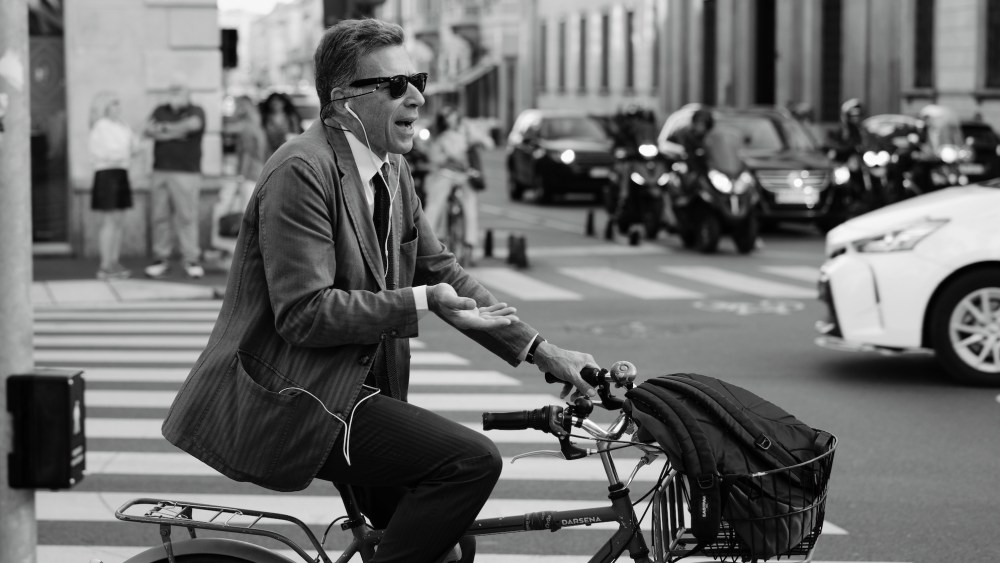
There’s a lot of movement involved, too. As of late Schuman has been shooting people on the move, aboard their bicycles and mopeds.
“This shooting on the bike thing is a great way to update the way I shoot, because usually they were very still portraits. Here they are super movement and when you have that kind of movement, it gives you a totally different feel of how people interact in their clothes,” Schuman said. “And there’s a sexiness to it in the summer.
“I love also that I’m subtly promoting this idea of Milan as a very sustainable [city]. So many people walk or go around on bikes. They take care of their clothes… it doesn’t sound like a sustainable place, but it really is,” he said.
Although many of these bike shots are more recent, fascination for the concept goes way back — and it’s again tied to Milan and Armani.
“I would see these pictures of Armani from a long time ago, and he’d be riding around Milan on a bicycle, like in a shirt and tie on a bicycle… and I just thought that was so cool. There are grown-ups here who look like they are having fun, riding around on bikes and dressed up in a fun way,” Schuman said.
Getting Armani to personally contribute to the book, penning his foreword, further energized the photographer.

“He was my hero growing up in fashion and you don’t have a lot of them typically, so I always kind of kept a little bit of a distance, because he was more important to me as a hero, than working for him or anything else… It was his work ethic, his commitment to what he did, his commitment to himself, to protecting himself and not being afraid to voice his opinion,” Schuman said about the designer.
“But as soon as Taschen said they’d do a book with me on Milan, right away I called people I knew from Armani [company],” Schuman said.
Opposite Armani’s preface stands a picture of the late designer taken in 2010 on Via Manzoni, next to the Baroque church San Francesco di Paola across from the Armani Hotel.
“I was going to a Bottega Veneta show on a Sunday morning, at like, 9.30 a.m. and there was no one on the streets… I saw him on the street, walking with some guy… and I start telling [the driver] to stop the car, I threw money at him, got out, and ran over. And Armani didn’t really know me, but I think he recognized me and I asked if I could do a fast picture,” Schuman recalled.
The book officially launches on Friday.
“I just hope the people that are from here see Milan the way I see it: Not perfect, but certainly beautiful. I don’t want to say elegant or chic, because that sounds too uptight. It’s just like everyone that lives here kind of chooses to play that game, whether you’re a worker in a house or you own the house,” Schuman said.
That point of view has certainly struck a chord with Armani, whose foreword reads: “What fascinates me about Scott’s gaze is his clarity: he gets straight to the point, playing with light and framing. Like me, he is Milanese by adoption, which is why he sees things that others may overlook.”