Chanel returned to New York on Tuesday with its annual Métiers d’Art collection show — the first for the house’s artistic director Matthieu Blazy. It was a cinematic experience that captivated the heart of the city, propelled Blazy’s continued strong vision for the house and displayed the expertise of the Chanel artisans.
Downtown, below 168 Bowery — literally in the abandoned train platform at the Bowery stop, where Tom Ford staged his spring 2020 show — guests including brand ambassadors A$AP Rocky and Margaret Qualley, Tilda Swinton, Kristen Stewart, Solange, G. Dragon, Jessie Buckley, Linda Evangelista, Dapper Dan, Charlotte Casiraghi, Rose Byrne, Riley Keough, Jon Bon Jovi, and many more hopped aboard the “C” train as subway sounds rumbled on.
“This is my stop, the Chanel stop,” quipped actress Jenny Slate, seated front row in a tweed jacket and khaki slacks.
You May Also Like
“I’m so happy to be here. I take the subway a decent amount and it was my fantasy of every outfit and every rendition of a woman that I am — sometimes I’m a mom, sometimes I’m fabulous in a ballgown, and I’m on the subway,” Emily Ratajkowski said of attending her first Chanel show. “I’m inspired to go home and try to copy the looks that were in it. The translucent raincoat with the sequin cheetah underneath — I loved the patterns and color.”
Above ground, Chanel clients dressed to the nines, celebrities and the fashion crowd weathered the pouring rain through multiple security checkpoints around the southwest corner of Kenmare Street and Bowery. Once inside and down the stairs, the underground Chanel platform mixed Paris, downtown New York and everything in between.
Ahead of the show, the subway also played an important role, alongside Qualley and A$AP Rocky, throughout Michel Gondry’s romantic comedy-tinged short film while the house’s custom “La Gazette” newspaper — featuring interviews with Blazy, profiles of the artisans within the Maison d’Art, puzzles and more — served as part of the invitation suite.
“I’ve been on the subway many times but I’ve never seen it like this. It was so glamorous, so New York and gorgeous,” Qualley told WWD post-show. She added that working with Gondry and A$AP Rocky on the show’s teaser short film was a cool way to be part of the show.
“The collection is very character-driven,” Blazy’s interview read — citing a ‘70s journalist and an ‘80s businesswoman as inspirations, along with when Gabrielle Chanel first traveled to America in 1931 to create costumes for the cinema plus contemporary personalities — spanning “from kids to students to world leaders,” ballgown-clad opera goers and a singular costumed “Spiderman” he’d come across during one of his subway rides downtown from Times Square during his years working in New York for Calvin Klein and Raf Simons from 2016 to 2019.
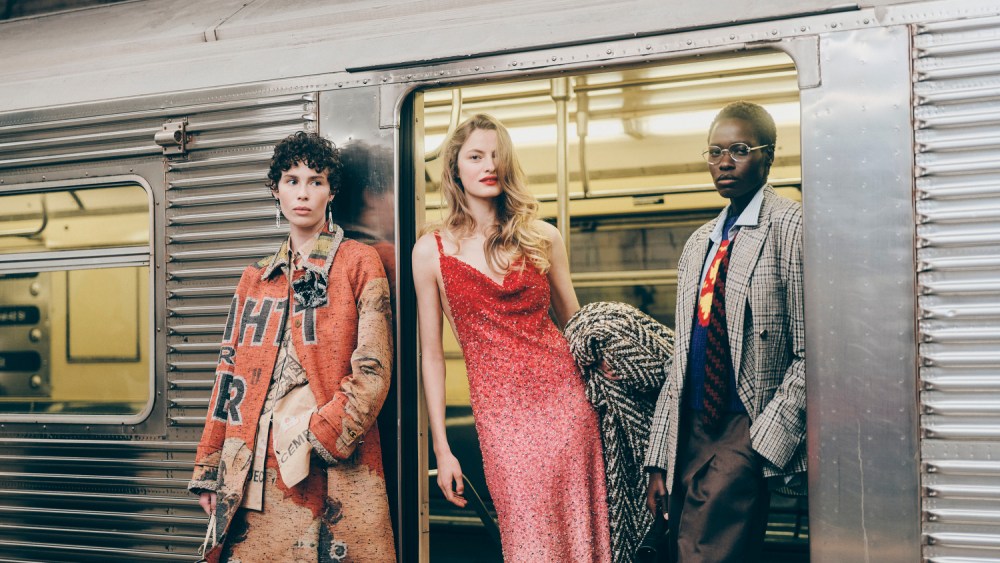
The collection also featured Chanel’s very own “Clark Kent,” with a blue, red and yellow graphic sweater peeking out beneath a strong-shouldered plaid blazer and brown slacks, as well as a stellar fringed skirt crafted from sparkling upside-down Empire State buildings.
“When [Chanel] went back to New York, she went downtown and saw women who were not from the higher class who had adopted the Chanel style — it was not Chanel, but it looked like Chanel. When she returned to Paris, suddenly she had energy again and continued to design,” Blazy said post-show. This inspired him to take on the artifice of a cinematic lens — slightly exaggerating or loosening up silhouettes, as done with costume wardrobes, but in an entirely modern, wearable way.
The show opened with models emerging from an incoming train car, making their way along the subway platform as any New Yorker would. Post-show, Blazy said he was interested in the city’s subway because it’s where every sector of society — from students to musicians to game changers — interacts. A one-of-a-kind place that displays no hierarchy and here, with loads of glam.
“I like the idea of doing a show where nothing is linear. I wanted to create a kind of happenstance — what we see every morning when we go to work and you don’t know what’s gonna be at the corner. Everyone is invited,” he said. “It’s directly playful, this show.”
The show spanned eras — from ‘20s beehive hairdos to ‘80s power suiting, with ample animal prints, inspired by the wardrobe of Gabrielle Chanel, in the mix. Here, striking tweed jacket and skirt sets came in hand-woven leopard motifs — noted to be a new technique — while silks were designed to resemble her admiration for Astrakhan fur. There was even an intricate tweed-ified version of the 1931 film poster for “Tonight or Never,” which Chanel designed the costumes for.
“It was also the idea of what Gabrielle made that would still be relevant for today,” he said of his “student,” clad in a light blue denim-looking set that was crafted out of silk using a technique from the ‘20s. The emphasis throughout the collection, especially the tweeds, was to make them light and airy — a quality that extended into his upped ante of occasionwear, which spanned from shimmering ombré dresses to floating ballgown skirts crafted out of giant, animalia frayed “petals,” worn with turtlenecks.
Luxed-up knits and American sportswear were front and center, too, while the idea of “introducing a new classic” stemmed from new bouclé check flannels with chains on the hemline — “the story of Pendleton in America — what would be that version of Gabrielle,” Blazy explained of his interest in the fabric.
“It was quite important to be back with another energy, another way to look at the city, another understanding than the one we had in December ’18. it was the end of something. It was important for Karl,” Bruno Pavlovsky, president of fashion and president of Chanel SAS, said of returning for its Métiers d’Art show after seven years, when Karl Lagerfeld held his Métiers d’Art show at the Metropolitan Museum of Art.
The annual collection celebrates the capabilities of Chanel’s specialty ateliers and artisans, from Rue Cambon ateliers to the le19M workshops — including feather workers, flower-makers, goldsmiths, shoemakers, milliners, glove-makers and tanners, embroiderers and more. Since its launch in 2002, the traveling show has globe-trotted annually, most recently to the likes of Hangzhou, China; Manchester, England, and Dakar, Senegal.
“Here with Matthieu, it’s the beginning. So the difference, it’s another way to look at the city. Now we’re in the Lower East Side and before, we were in the Upper East Side. Everything is opposite, and that’s part of New York,” Pavlovsky continued.
Blazy’s second show for the house proved successful with its balance of chic, stealth and aspirational dressing, with moments of playfulness seen through dramatic feather decorations, vibrant colors, coffee cup-accented handbags and a delightful shimmering set covered in dogs’ faces. “Because you have two accessories in New York: a dog and a coffee cup,” Blazy quipped, displaying his knack for bringing the polish of quintessential uptown Chanel to the vibrant energy of downtown.
“At Chanel, with Matthieu and before Matthieu, we love to travel,” Pavlovsky said. “I think it’s quite important to be able to go where our clients are. This idea of being connected daily, to go where they are, where they live, whatever happens, it’s something which is super important. And Chanel being a global brand, it’s part of our job to connect, to travel, to go everywhere.”
As seen by the insurgence of other global luxury players — Gucci, Louis Vuitton, Dior and Moncler — converging on the U.S. with runway shows planned Stateside in the coming year, it’s clear European brands are resonating with the U.S. consumer. Pavlovsky explained that of course, the U.S. “market is number one” for the brand, but if asked about Korea, China or Japan, “it’s the same.”
Pavlovsky said in the U.S, “ready-to-wear is flying.” Categories, too — specifically bags — are “strongly back,” and the company is benefiting from the strong economy, he said. As for price resistance, Pavlovsky said his view is about designing and manufacturing the right product at the highest level of luxury with the right “know-how” and artisanal teams, and imbued with desirability and emotional posture for their clients — selling products that reflect the work that is behind them.
“It’s quite interesting, as soon as the collection got stronger, we didn’t have questions about pricing. When you start to have questions about prices, for me, it’s about what do we do? Are we in the right direction? What do we have to change?” he explained. “The point is we need to continue to have the best product. It’s true for Chanel. It’s true for the luxury market because what is making the difference is the perceived quality, perception of this product, and that’s what is making the difference.”
Just two weeks ago, Chanel unveiled its new two-level boutique at Bloomingdale’s flagship, but Pavlovsky pointed out that the New York-set show is “so much bigger than that,” which also includes seeing and understanding ambassadors’ vision of the brand.
“We are a beholder, and we have to embrace the world and our clients everywhere. We are not going to New York to try to do or to duplicate some things that we can do in Paris or in Tokyo. We’re going to New York because we want to be part of the city, the vibe, the energy of the city. Everything we’re doing is linked with the city in a very free interpretation that’s Matthieu’s interpretation, Chanel’s interpretation,” he explained.