Can’t get over the Tom Ford era at Gucci? Demna feels you. The designer’s vision at the brand is gradually coming into focus — and it looks increasingly ‘90s-coded.
After the release of the “La Famiglia” look book and the buzz generated by the short film “The Tiger” that premiered during Milan Fashion Week, Demna’s exploration of the brand’s “Gucciness” continued in his first pre-collection for the Florentine house. He dubbed it “Generation Gucci” and considers it an extension of his initial concept of archetypal characters.
His sophomore effort offered more clarity on the direction he has in mind for the brand in the lead-up to the big reveal via his first runway show scheduled for February during Milan Fashion Week. While continuing to riff on the ‘70s and Gucci’s codes, such as the GG monogram and Web stripes here and there, Demna deepened his fascination with Ford’s Gucci and embraced a minimalist approach.
You May Also Like
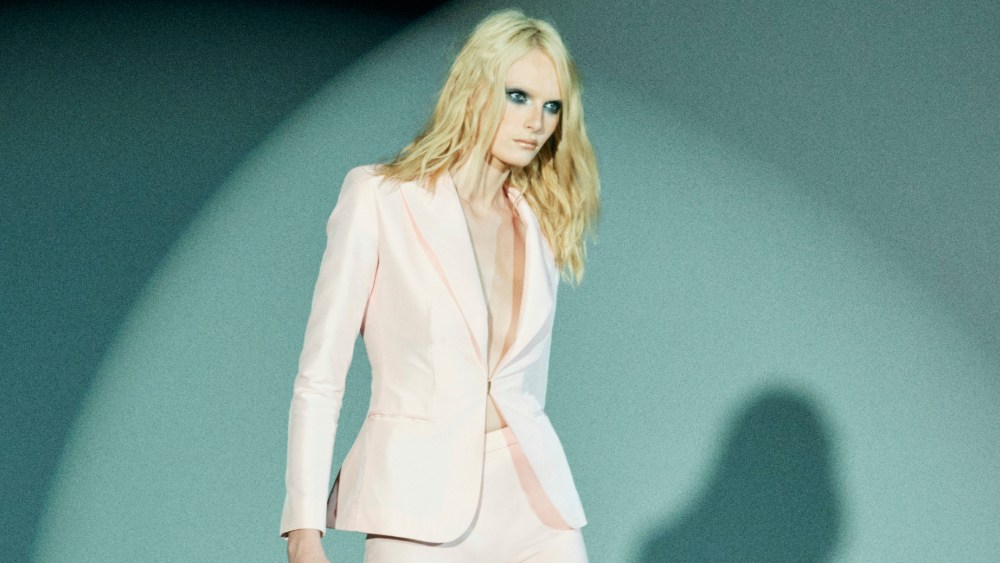
The pre-fall 2026 look book images Demna photographed himself clearly reference Ford’s tenure, from the lighting replicating the spotlight effect of Gucci’s 1996 shows down to the looks, some of which were based on archival pieces.
During an extensive walk-through, Demna defined the era as the most impactful for his generation and “so visually symbolic for the brand.”
“I admire it because it really was a starting point in my understanding fashion,” he said, praising Ford for his “intelligence and the way he created a style — this idea of Gucci and of himself. I find it very rare that we see that in this industry and it’s very fascinating.”
Demna looked to imbue that flirty, sexy and dynamic vibe of yore into the collection as well as the visuals, in which he wanted to capture “the Gucci show that we missed.”
This opened with a powder pink suit in silk faille, a prelude to the overall closer-to-the-body fit he’s increasingly embracing, a distinct departure from his previous work at Balenciaga and Vetements that was largely associated with oversized proportions.
For the first look, as well the following styles that switched the legging-like pants for pencil skirts, Demna reached out to the manufacturer of the archival design, only to discover that technology had changed over the past three decades and the fabric resulted in a slightly different, lived-in effect.
In the same vein, his investigation into materials resulted in him using options ranging from canvas to rich suedes in his quest to set the building blocks of his lexicon going forward.
Cue silk and cashmere to craft more relaxed tailoring, like jogging suits targeting a more elevated approach to airport dressing; denim cut in seamless and minimal separates; devoré velvet for see-through pants, and, of course, leather, which he deployed for biker jackets with the Web motif and scuba-inspired attire with a sexy energy.
Even the more ‘70s-leaning pieces, like pussy-bow blouses, floral pleated skirts and equestrian silk scarf dresses, had a sensual undercurrent via side slits, for example. Bolder numbers inevitably stood out, including a hard-to-miss leopard coat bonded with leather that could double as a dress; the glitzy evening gowns, and Demna’s take on furry textures, namely coats that mixed shearling, feathers and muslin strips but that remained extra light.
“To me, this is luxury,” he said, inviting a visitor to weigh the pieces. Lightness was indeed a priority for the designer in both apparel and accessories, which included new versions of the Jackie 1961 bag; a sleeker, more geometric interpretation of the Dionysus style introduced by predecessor Alessandro Michele, and pointy ballet flats “that I always wanted to have, so we made them in a men’s size,” said Demna.
“Looking at the ‘90s archives of Tom Ford’s era, I noticed how everything was much lighter and more refined. In a way, you had more desire to wear or hold the products, so I’m trying to get back there,” he said. “In my idea of luxury today, heaviness and stiffness is not really a sign of durability like it used to be a century ago… Luxury is about comfort. If you pay so much money for a product, you don’t want to carry five kilos of a jacket on you. It’s really a consumer-focused mentality that I’ve always had, but at Gucci it’s even more natural to do that.”
His approach comes from personal experience. “My challenge and my mission as a designer is to create product that triggers desire. I want people to have FOMO about the product, like I do because I’m a consumer myself,” said Demna. “’Commercial’ is a good saying actually… it means you succeeded. But it doesn’t mean that you have to channel or project on the customer’s current desire. My mission is to create a new desire for a customer… And the desire can be created through identity, vision, and very intelligent product design. Because today storytelling is not enough.”