Birkenstock Holding Plc shareholders were disappointed with the brand’s fiscal 2026 targets, which were lower than 2025 results due to a combination of tariff headwinds, foreign exchange, and the brand’s own production capabilities.
Birkenstock CEO Oliver Reichert said the company posted “very strong fiscal 2025 results,” but investors — for better or worse — tend to focus just on future guidance.
For the fiscal year ending Sept. 30, 2026, the company said it expects revenue at between 2.30 billion euros to 2.35 billion euros, with adjusted earnings per share at between 1.90 euros to 2.05 euros.
The brand’s revenue target is lower than Wall Street’s projection of 2.39 billion euros. And its revenue growth rate in constant currency is about 13 to 15 percent. That represents a deceleration of the 18 percent growth in fiscal 2025, according to William Blair analyst Sharon Zackfia. She expects sales over the next few years to be bolstered by ramping production, DTC expansion, and white-space categories and geographies that could see growth, as well as a favorable product mix on premiumization and an expanded closed-toe assortment.
You May Also Like
Shareholders responded by sending shares of Birkenstock down 8.6 percent, or $4.00, to $42.40 in mid-afternoon trading on the Big Board Thursday.
“These are unusual times,” Reichert told investors during a conference call after posting the fourth-quarter report. He said the company generated significant cash flow and invested over 150 million euros into its production capacity against the backdrop of “global tariff and international trade, a war in the Ukraine and energy crisis and a significant decline in the U.S. dollar.” The CEO also noted that Birkenstock’s healthy brand momentum continued in the fourth quarter, and that the brand is winning in both B2B and B2C, gaining shelf space and taking share.
He also noted a strong back-to-school season with retail sales “at our top 10 partners increasing over 20 percent year-over-year,” adding that the momentum is expected to continue through the holiday season, with over 90 percent of the growth in B2B from within existing doors. “Full price realization, the ultimate indicator for brand health and demand remains over 90 percent,” Reichert said.
While he noted that strong wholesale growth is driven by the younger demographic, that trend also “requires us to produce more pairs in a situation where we are already capacity constrained.” The CEO explained that the strongest demand is for Birkenstock’s premium styles, which require even more production units. “The combination of more wholesale and more premium execution is creating additional pressure on our vertically integrated supply chain,” he said. “We need to manage growth in our production responsibly. This is why we are steering towards a mid-teens pace of growth for fiscal ’26.”
There was nothing in Reichert’s remarks that suggested a slowdown in consumer demand. If anything, the constraints to growth were more limited to the brand’s production capacity. But the brand does have to deal with tough foreign exchange headwinds, as well as incremental U.S. tariffs, and that accounts for some of the pullback in guidance.
As for tariffs, the company said in May when it reported second-quarter results that it had taken actions to mitigate the tariff impacts and that there were still multiple levers it could pull, helped by the fact that the German brand is vertically integrated and had at its disposal efficiencies in production, vendor negotiations and the ability to allocate products between different regions.
Company executives said Thursday Birkenstock was able to offset most of the 2025 tariff impact through targeted price increases, including one implemented in July.
The one difference between 2026 and 2025 is that this past year benefited from shipments prior to the increase in tariffs. That means 2026 will see some impact from tariffs in the cost of goods sold, which is expected to result in a decline in margins.
Price reviews are done each season, with adjustments on a store-by-store basis. Over the longer term, growth in the brand’s Asia-Pacific business is expected to reduce its exposure to the U.S. dollar and to U.S. tariff impact. And while price increases — which are dollar neutral but not margin neutral — will offset much of the incremental tariff impact, Birkenstock executives gave the impression that higher prices would not rise to the level where they would capture the same margin rate as in 2025.
“We believe the guidance level sets expectations for the year, and the top-line outlook reflects continued strength in underlying demand for the brand against an uncertain macro outlook,” Telsey Advisory Group’s chief investment office Dana Telsey said. “As consumers remain more intentional with their purchases, we see Birkenstock as a brand that can continue to win in the marketplace through its competitive advantage of a high-end lifestyle positioning. As such, we maintain our Outperform rating.”
Back in August when the firm posted third-quarter results, Reichert said the shift to in-person shopping amplifies the brand and favors its B2B channel over DTC. He reiterated that during Thursday’s fourth-quarter call.
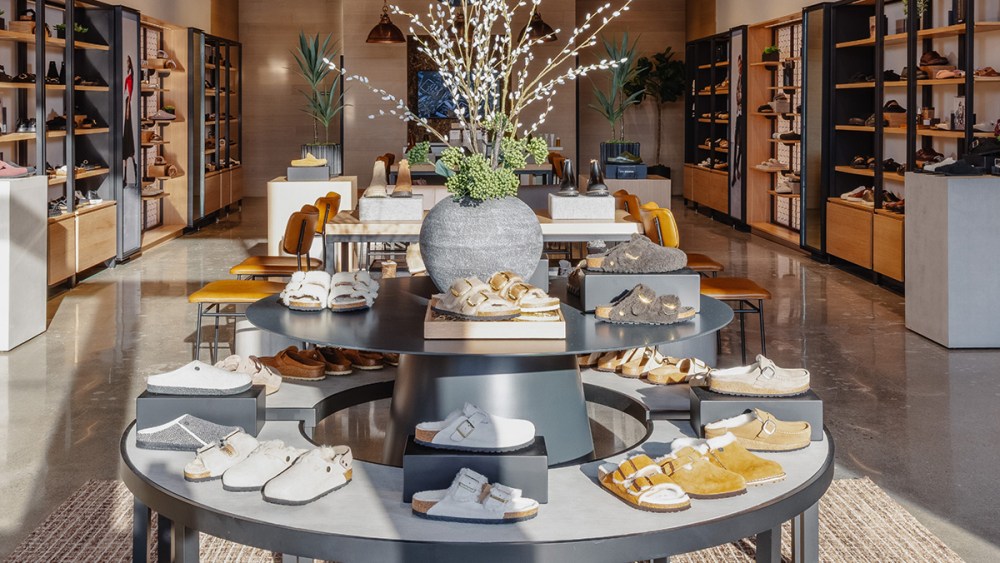
That’s one reason why the brand also plans to open about 40 new company-owned retail stores globally in fiscal 2026, about 10 more than the doors it’s opened this year. It ended the year with 97 doors, with Reichert noting that the new stores “are performing ahead of our expectations in terms of productivity and return of CapEx,” adding that the brand is “on track” to reach its 150-store target ahead of schedule. Meanwhile, the brand just opened its seventh company-owned retail store in the U.S. in Boston, in the city’s Back Bay neighborhood.
For the fourth quarter ended Sept. 30, the brand reported a 78.9 percent gain in profits to 93.9 million euros, or 0.51 euros a diluted share, from 52.5 million euros or 0.28 euros. Revenue rose 15.5 percent to 526.3 million euros from 455.8 million euros.
Wall Street was expecting adjusted diluted earnings per share of 0.25 euros on revenue of $407.09 million.
For the year, profits rose 81.8 percent to 348.3 million euros, or 1.87 euros a diluted share, from 191.6 million euros, or 1.02 euros. Revenue rose 16.2 percent to nearly 2.1 billion euros from 1.80 billion euros.