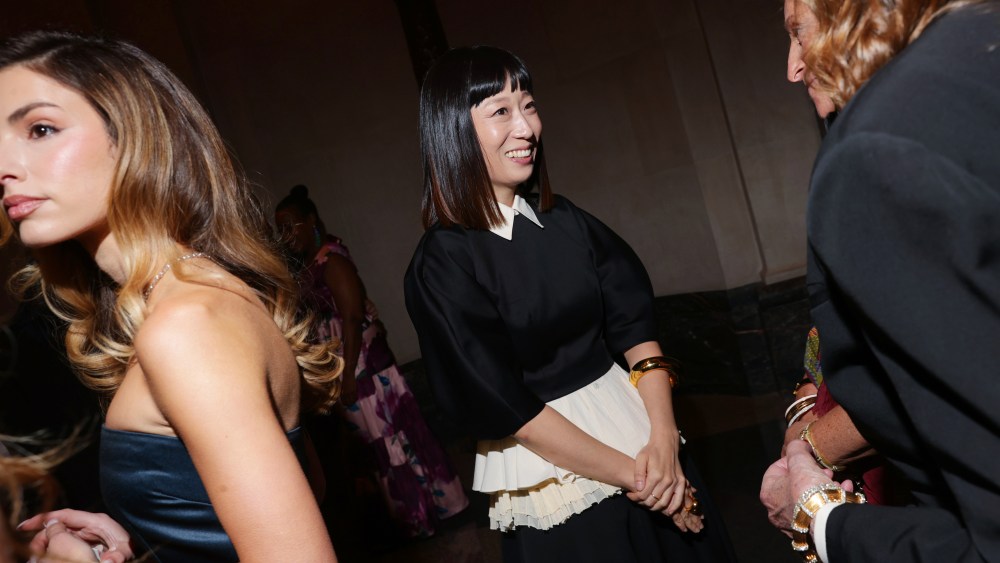
If anything, winning this year’s CFDA/Vogue Fashion Fund and the CFDA’s Emerging Designer of the Year Award has made Ashlynn Park more intentional about how she can contribute to American fashion beyond her design talents.
During an interview in her West 38th Street studio last week, the founder of the Ashlyn label spoke thoughtfully about how she wound up in the nucleus of the industry’s emerging talent. In some ways, her approach to design is very studied and methodical. Having fine-tuned her patternmaking and design skills by working at leading houses like Yohji Yamamoto and Calvin Klein in the Raf Simons era, she values the construction of garments and the roles that each individual plays in production. As a married mother of two daughters, she has organized her work day so that she and her coworkers can complete what they need to do, and still get home at a reasonable hour to cook dinner for her family.
During an interview in her West 38th Street studio, she said, “I often say, ’This is the game.’ The reason is that I live in New Jersey, surrounded by all the greenery and animals. But whenever I cross the Hudson River, I feel like I am going to be a warrior — going into the game.”
Her game is not one of chance though. Completely self-funded, her company is advancing with measured steps rather than expand too quickly or pursue new categories. Part of her mission is to teach productivity and efficiency to her small team. She said, “I am not owning these awards. It is more like a stewardship that we can all share as a brand. Rather than think of this as a personal success, I would rather think of it as a team and a house that we will build a code and a philosophy around.”
Even just using the word “house,” in the designer sense, is something that she has only started to get used to recently. But Park wants to share fundamental skills that will then be passed on to others. She is not a fan of how quickly some designer companies replace talents or the lack of archives that some designers have. With two contractors still in the training stage and one production manager, her aim is to build an ecosystem.
You May Also Like
The fund’s $300,00 monetary prize enabled her to hire a new employee, whose work ethic (due partially from growing up on a farm) was appealing. “I’m not hiring people [solely] for talent. Their personality, passion and how they engage with a person is just as important. We have to find someone’s inner beauty and nature,” she said.
“I really love this journey. I love my work,” she said, welling up slightly. “I am very happy about retailers buying my clothes so that I can continue another season and another season [crossing her arms across her chest.]”
At Ewha Womans University in Seoul, Park was a home science major. Encompassing clothing, cooking and other domestic skills, that path is one taken by prestigious women like South Korea’s former First Lady Kim Noon-ok. “It is a different culture. Maybe people cannot understand that major these days. But back then my father wanted me to become a really nice housewife, caring for children and other things,” Park said.
Architecture piqued her interest, due partially to the fact that her father founded and ran a construction company. After recognizing that architecture was a male-dominated field, she considered fashion design as an alternative. She interned for the late Korean designer Lee Kyurye, an important force behind the Korea Fashion Association, who encouraged her to pursue fashion as a career.
She won a one-year scholarship at Mode Gakuen, and then transferred to Bunka Fashion Graduate University in Japan. In 2009, Park won the 82nd edition of the So-en award which led to interviews at Junya Watanabe, Commes des Garçons, Issey Miyake, and Yohji Yamamoto. During her interview at the latter’s company, she said she told the interviewer, “’I am a blank canvas. You can dye me in your color. I am ready,’”

Working “in the universe of Yohji” helped to define her and her design ethos, she said. How to hold a pencil, how to use the cutter, how to cut patterns, how to clean the bathroom and how to sweep the floor were among the things that she learned. “They taught everything. I became a different person. They taught how to engage with a person and how to listen and to then be ready for someone’s request,” Park said.
No time for any chitchat, the “work, work, work” culture involved stitching everything. Without any sample makers, “everyone was a patternmaker,” and once their skills advanced after a few years, they edged into design. An appreciation for process, archives and respect for all individuals’ roles were among the takeaways. While part of the designer’s Y-3 team, Park said an Adidas colleague suggested that she find a job outside of Japan and helped her to create a résumé.
During a three-year run at Alexander Wang, she got married and had her first child, which made the job more challenging. Park later started working for Nili Lotan, who has six children and understands the demands of motherhood. After two years, Park switched to freelance to do more patternmaking and started with Dion Lee. Proenza Schouler and Khaite were other clients. When a full-time senior patternmaker post at Calvin Klein was offered, Park accepted — eager to work with the then creative director Raf Simons.
During that time, she wanted to brush up her patternmaking skills so she started creating an archive of her own designs. While enjoying a pre-holidays after-work drink at a local bar, Park and her Calvin Klein colleagues learned via a WWD post that Simons was leaving the company. The following week she was gone too. During the pandemic, she decided to restart her career in the family’s basement to set an example for her two daughters. She did her first fashion shoot virtually with a friend in Berlin.
After meeting Johanne Siff, who is now the managing director of Ashlynn Park, Siff compared her work to Martin Margiela, according to Park, who was thankful but in disbelief. She said, “I am not a positive person. I would rather take the negative side, when it comes to myself.”

But together they are building Ashlynn Park with accounts like Susan in San Francisco, Des Kohan in Los Angeles and Bergdorf Goodman in New York. Exacting about fit, Park said with a laugh, “I am making pieces to run off the racks and to hug the wearers. Once they experience that hugging fit, they will not be able to explore other brands.”
Next season’s design inspiration is rooted in American vernacular art, which culls from this country’s melting pot culture, the aforementioned “game” and the history of America sportswear. The latter was unfamiliar to Park, who grew up in Seoul and first studied and trained in Japan. Eager to contribute to American fashion in a significant way that extends beyond her creations, Park said she spends a good deal of time thinking and writing about “What are the meaningful things? What’s the purpose?” She is also intrigued by how humans and objects interact and share creativity. “Maybe my creativity comes from emotions and clarity. I’m still figuring out what I want to do as a designer but it’s not just about fashion. It’s more than that,” Park said.

She wants employees and shoppers to understand the value of a well-constructed garment that hopefully will be treasured. There’s also the question of ownership of fashion. While some designers use clothing as their canvas, or as a presentation of themselves, Park thinks fashion is a shared medium. “Certain parts I manage, but the other parts are judged by wearers. As patternmakers, we think of these designs as our babies that we carry very carefully. We hope and dream that someone will take them home,” she said.
As for whether she is the future of American fashion, Park said, “If people give me the chance to become that, then I am willing to take that opportunity and challenge myself.”
She will be able to do that in February at her show, during the next installment of New York Fashion Week.