With most of America’s department store chains now stabilized — excluding Saks Fifth Avenue and Neiman Marcus — the outlook for 2026 appears to be good.
The sector is positioned to replicate the modest growth it saw in 2025, which was attained organically rather than through expansion, and through improved inventory management, better product curation, and restrained discounting. Department store retailers are also beefing up their best private brands with greater style and differentiation. While not seeing the level of gains that mass merchants and off-pricers have been enjoying, department stores — there are just a handful of remaining nameplates after decades of consolidation — are maintaining their ground.
Meanwhile, Americans for two years have been demonstrating a renewed interest in visiting malls and spending time in physical stores. Shopper traffic isn’t back to pre-pandemic levels, but it’s getting better. Store executives believe the specter of tariffs has for the most part waned, and are enthusiastic that low- and middle-income consumers may have more money in their pockets with President Trump’s proposed $2,000 stimulus checks and the $1,776 “warrior dividends” being issued to military personnel.
You May Also Like
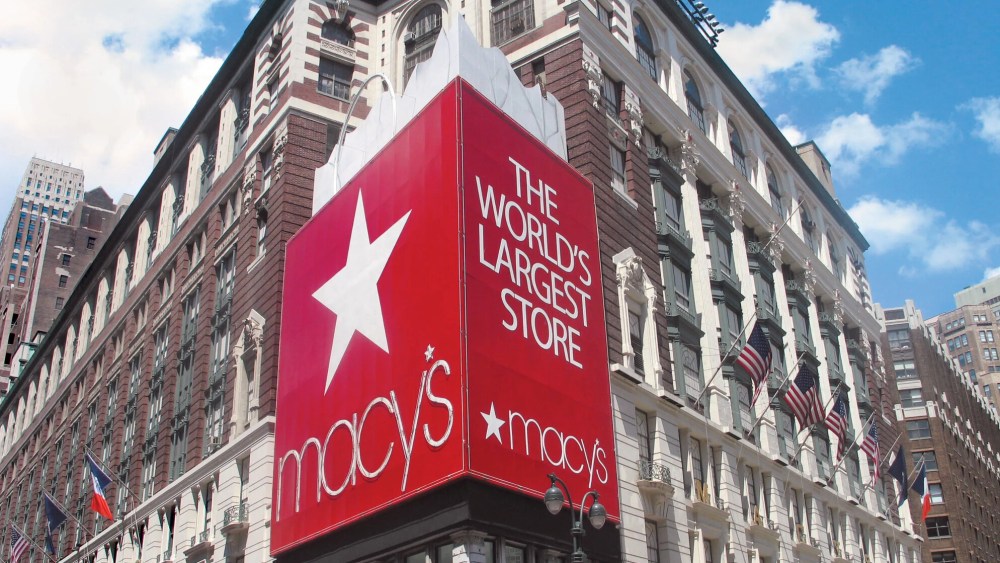
The streamlining at Macy’s will continue until the department store count is down to 350, which is expected by the end of 2026. The focus is on the best-performing 125 doors, which are receiving significant investments for increased staffing in high-traffic areas such as women’s shoes and fitting room areas, fresher products, and improved visuals. The 125 doors have been outperforming the overall Macy’s department store chain.
The Bloomingdale’s division under CEO Olivier Bron is “hitting its stride,” said Tony Spring, chairman and chief executive officer of Macy’s Inc. He said the upscale department store has opportunities for organic growth and will provide brands with additional points of distribution. He also said there are opportunities to open additional Bloomies and Bloomingdale’s outlets. Among the brands recently launched at Bloomingdale’s are Toteme, the DWP clothing line by Gwen Stefani, Zimmermann, Victoria Beckham, Christian Louboutin and Roger Vivier. Bloomies are contemporary-oriented, scaled-down, specialized versions of full-line Bloomingdale’s stores. The group also is investing heavily in the Bloomingdale’s flagship on 59th Street in Manhattan.
Nordstrom enters 2026 with a new approach to the business, having turned private and now owned by the Nordstrom family and Mexico’s Liverpool retail chain. Going private, explained co-chief executive officer Pete Nordstrom during the WWD Apparel & Retail CEO Summit in October, enables “a much longer perspective. It helps with focus and clarity. And from where we sit, that creates value, certainly over time. I think it eliminates distraction. It just feels like we have the ability to invest time and energy to what this is all about. There’s a lot of rigor that is good and accountability through the public process, and we’ve learned that. We want to maintain that urgency and that accountability, but we also wanted to create more focus on what we’re doing.”
Public companies have larger, more diversified boards of directors, whereas a private company has a smaller board so decisions can be made quicker. “We get into subjects very quickly,” said Erik Nordstrom, co-CEO. “Liverpool is dealing with a lot of the same things we’re dealing with, and they’re really good. So we’re curious about what they have to say, and curious how they run the business…When we talk about use of cash with Liverpool, their reaction has always been ‘the most important thing is to invest in the business. We believe that long-term value comes from investing in the business.’ They never lead with ‘we need to get the return on our investment.’”
One issue the Nordstroms dealt with as a public company was how Wall Street evaluated their company. “We got viewed as a department store. And that has its own negative connotations to it, but it’s an anachronistic way of thinking of the business,” said Pete Nordstrom. “Everything’s changed. We have a very big online business. It’s about 40 percent of our business. We have a very big off-price business, which is a very hot commodity in retail but we didn’t get a lot of credit for that.”

Another privately owned, family-run department store chain, Von Maur, plans to open an anchor store at the Freehold Raceway Mall in Freehold, N.J., in the fall. The new location will be Von Maur’s first store in New Jersey and 40th in the chain. It reflects the Davenport, Iowa-based retailer’s ongoing expansion strategy, particularly in the northern region of the U.S. In 2024, Von Maur opened a department store in South Hills Village in Pittsburgh, marking the company’s entry into Pennsylvania. Last spring, Von Maur opened its first location in North Dakota at the West Acres Mall in Fargo, N.D.
While Von Maur slowly opens stores, certain other department store operators, namely Macy’s, Saks Global and Nordstrom, have recently closed some locations.
Von Maur has a five-year, $100 million plan to renovate its department stores underway and will also be opening additional Dry Goods locations. The Von Maur-owned Dry Goods is a women’s specialty chain with about 90 doors.
Dillard’s will close its 240,000-square-foot store at The Shops at Willow Bend in Plano, Texas, this month, but the 272-unit chain has been a steady performer. For the third quarter, Dillard’s reported a 4.2 percent gain in net income and comparable-store sales up 3 percent.
“The numbers continue to demarcate the department store as one of the few in its sector that’s driving growth,” Neil Saunders, managing director of GlobalData, wrote in a recent report on Dillard’s. Praising Dillard’s merchandising and execution, Saunders indicated that the results should serve as a primer to other retailers, adding that the quarter’s level of revenue growth wasn’t blockbuster, but still respectable, with a rise in margins, profitability, and comparable sales gains. “Dillard’s has a good grip on operations and is very well managed,” he wrote.
JCPenney’s long-term viability continues to be an industry debate. However, for the second quarter, Penney’s was in the black, with $110 million in net income, compared to a $33 million loss in the year-ago period. Executives have cited momentum entering the fourth quarter, largely due to improved family offerings and strong values appealing to its working class, middle American target audience, and characterized 2025 as “a year of resurgence.” Penney’s was brought out of bankruptcy in September 2020 by new owners Simon Property Group and Brookfield Asset Management. As part of the restructuring, a separate entity called the Copper Property CTL Pass Through Trust was created to manage and eventually sell off store properties and distribution centers to pay back creditors, but a deal to sell 199 locations for $947 million to private equity firm Onyx Partners fell through in December 2025. Penney’s is part of Catalyst Brands, which also includeds Brooks Brothers, Aéropostale, Eddie Bauer, Lucky Brand and Nautica, and is a partnership of Authentic Brands Group, Simon Property Group and Brookfield.