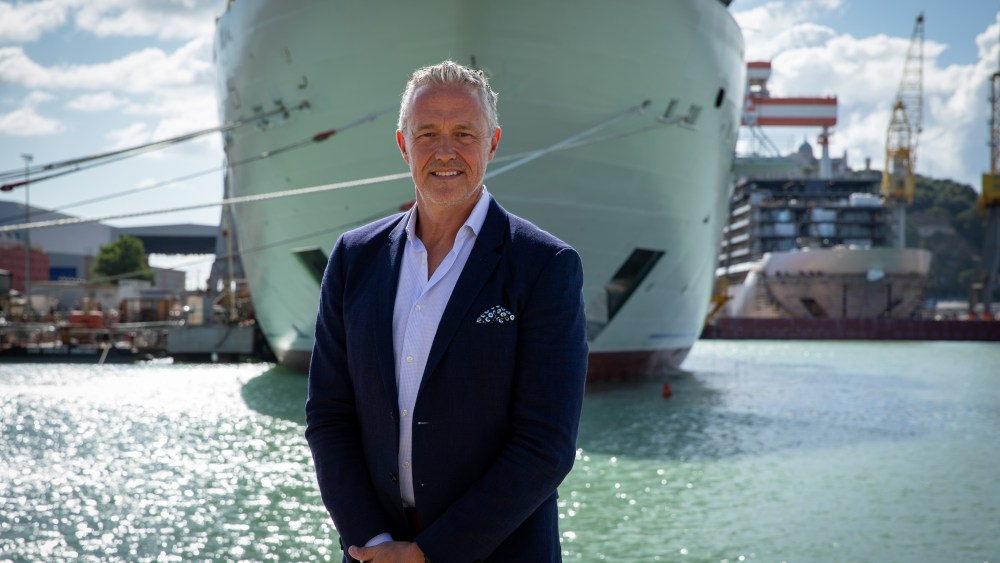
Just under two years ago in a shipyard in Ancona, Italy, a steel keel was laid. This week, the vessel it became — Four Seasons 1, the brand’s first yacht — departs on its maiden voyage.
“It’s almost like sending your child out,” said Ben Trodd, chief executive officer of Marc-Henry Cruise Holdings, joint owner and operator of Four Seasons Yachts, speaking exclusively to WWD. It is also the moment a bet on the future of ultra-luxury hospitality is finally put to sea.
“It’s really an extension of the places and the behaviors that our guests, both now and in the future, said they wanted to be,” said Trodd, a longtime Four Seasons executive who spent two years as chief operating officer of Aman Resorts before leading this new venture. If the last decade was about guests wanting to live with the brand in its residences and fly with the brand via the Four Seasons jet, the next chapter, he said, is clear: They want to sail with it, too.
Competing With Birkin Bags and Private Jets
Trodd explains the competitive landscape has less to do with other yachts and more to do with how ultra-high-net-worth individuals choose to mark life’s milestone moments.
You May Also Like
A 50th birthday, for example, might be celebrated in myriad ways: chartering a private jet to Napa, Calif., buying a rare Hermès Birkin, hosting a weekend at a house in the Hamptons — or booking a week on the new Four Seasons yacht. The real competition, Trodd suggested, “is not just for a share of wallet, but for a share of time.”

“For this guest, it’s not that they’re choosing this experience instead of another way to spend $50,000 or $70,000,” he noted. “The real gift they’re giving us is five, seven or nine nights of their very limited time.”
The obligation, as he sees it, is to deliver something that justifies that investment not only financially, but emotionally: memories, relationships with staff and a sense of once-in-a-lifetime access. That access is aimed at a changing ultra-luxury customer base. Four Seasons is seeing the age of ultra-high-net-worth guests drop, he said, with a growing Millennial cohort that insists on flexibility, personalization and control. For them, the brand has extended its traditional hotel footprint into a more fluid “live, play, fly, sail” ecosystem.
A Boutique Resort at Sea
If most cruise ships are designed to maximize capacity, the Four Seasons yacht is built around deliberate restraint. Stretching 207 meters and 15 decks, it houses just 95 suites and notably no interior cabins. Every accommodation has generous outdoor space, with a minimum of around 550 square feet of combined living space, 50 percent more per guest than any competitor currently at sea.

From a real estate perspective, Trodd pointed out, the ship has an enormous footprint. But the decision was to resist the temptation to fill it. Instead, the yacht is planned like one of the brand’s flagship resorts: non-dense, light-filled and offering guests multiple ways to move through space, or not move at all.
A large, resort-style pool deck with a 20-meter saltwater pool anchors the public areas. The yacht offers 11 food and beverage outlets, the L’Oceana Spa — a full-scale wellness sanctuary with treatments developed in partnership with La Mer, Margy’s Monte Carlo, Ignae and Rossano Ferretti — and a fitness offering created with Technogym, whose equipment has been completely bespoke-designed for the yacht.
The ship is engineered so that a guest who wants a near-private-yacht experience can essentially live within their suite and chosen spaces, without feeling forced into social areas or scheduled programming. “You can have your entire yachting experience almost like a private yacht,” Trodd says. “You don’t have to interact with different parts of the infrastructure if you don’t choose to.”
A marina spanning both sides of the vessel expands to more than 676 square meters of dedicated waterfront space for watersports, wellness, dining and sea-level swimming — an amenity more typical of a private superyacht than any hotel vessel at this scale.
Future ships will be smaller, not bigger. The second and third yachts now in the pipeline are being designed with even greater intimacy in mind — an early, telling insight into what this segment actually wants from luxury at sea.
Redefining What Luxury Yachts Can Do and Go
If space is the visible expression of luxury on the yacht, service is the invisible one. A maximum of about 200 guests will be matched by more than 200 crew members, for a one-to-one ratio. Every member of staff, including marine and engineering crew whose primary roles are technical or safety-related, has been through the same Four Seasons service training as a front desk agent in a flagship property.
And if there is one area where Trodd says guests were uncompromising from the start, it was food and beverage. They did not want to compare the yacht’s culinary offering to other ships; they wanted to compare it to the best hotels and restaurants on land. Four Seasons leaned into its existing strength — the brand operates more than 600 restaurants globally and holds more Michelin stars than any other hotel group. For the yacht’s chef-in-residence program, the team has effectively gone “shopping” within that portfolio and beyond, curating a rotation of Michelin-starred chefs from marquee properties such as the George V in Paris, Capri and Athens.
Equally significant is what Four Seasons has not done: The yacht is not all-inclusive. Trodd said that too is by direct request of its guests, who associate true luxury with choice, not bundling. Many ultra-high-net-worth travelers do not want to feel compelled to dine on board simply because they’ve paid for it in advance.
Instead, a typical evening might see a couple have a pre-dinner drink at Bar O, the yacht’s more traditional bar, then head ashore in Capri for a late dinner, only to return for a nightcap at the Horizon Lounge as the lights of the port recede into the distance. Because of the ship’s size and scale, it can often remain in port until midnight — a sharp contrast to larger cruise vessels, which must typically depart in early evening.

The itinerary strategy underscores the private-yacht, owner-style experience in terms of access. The first season at sea includes the expected icons — the Greek Isles, the French Riviera, Capri, Istanbul. But layered into those are smaller, high-end yachting towns and ports that big ships either rarely visit or cannot access at all. “The team has focused on places that offer a sense of discovery and, above all, access,” said Trodd, underscoring the point that for the ultra-wealthy, being able to go where others can’t is highly coveted. “Time is a definitive luxury. Choice is a definitive luxury,” Trodd said. “Access is the next one.”
Behind the Scenes
Behind this highly polished guest proposition sits a split structure that largely stays invisible to the traveler. Marc-Henry Cruise Holdings owns the yacht and manages all marine operations, itinerary planning and the commercial side of bookings. Four Seasons is engaged to operate the hospitality experience and, critically, to provide direct insight into how current and future guests want to travel — including where they want to go next.
On the design and build side, the project taps some of the most respected names in the industry: Tillberg Design of Sweden, led by creative director Fredrik Johansson, one of the world’s preeminent private yacht designers; Italian shipbuilder Fincantieri, and creative director Prosper Assouline, whose eye for detail extends from interior design to the yacht’s retail concept and finishing touches.
Demand as Proof of Concept
If early numbers are any indication, the ultra-luxury market has already answered the question of whether the Four Seasons yacht is an idea it was waiting for.
Trodd said roughly 80 percent of 2026 inventory has already been sold, with bookings flowing from the top down. The largest, highest-priced suites are the first to go. It’s a familiar pattern in the brand’s world — the most premium room categories in its hotels, he noted, are consistently among the earliest to sell out.
By the end of 2027, a second Four Seasons yacht will join the fleet, with a third in active planning and expected to follow by the end of the decade. But even before the first sets sail, there is a clear message about where the future of ultra-luxury hospitality is headed: ever more intimate, ever more flexible and never far from the water.