Despite an uncertain economy, the impact of tariffs, rising fabric prices and a war in the Middle East, bridal designers are a resilient group.
The wedding industry remains healthy, contributing to more than $100 billion in total wedding-related spending in 2025, on par to 2024, according to the Knot’s Real Wedding Study 2026.
Importers are dealing with increased fabric prices and tariffs, while those who manufacture in the U.S. face the challenge of finding a skilled workforce to handle their production. And those who are based in Israel are facing their own set of problems due to the war against Iran.
Sareh Nouri, the luxury bridalwear company which makes everything in the U.S., said her eveningwear and bridalwear have grown tremendously over the past few years, and that bridal “is our primary focus right now.”
You May Also Like
“While domestic production comes with its challenges, it helps us with the level of quality that the brides and the clients expect,” she said. Since her start 13 years ago, she has produced everything in Rutherford, N.J., where her factory is located.

“In today’s market where so much is produced overseas, being made in America is probably one of our greatest strengths. The moms and the buyers absolutely love that. It’s helped us through COVID and it helped us through tariffs,” said Nouri.
That said, it does come with its challenges, such as higher labor costs and the costs of sourcing materials. “It allows us control over quality so the trade-off is worth it. One of the biggest challenges for manufacturing here is finding skilled dressmakers and that level of workmanship requires constant investment because it’s an old trade,” said Nouri.
“A luxury wedding dress takes days and weeks to be made. You know when they’re paying $12,000 to $15,000 for a dress, it needs to look really good,” she said.
Nouri employs more than 50 people. She said she’s been able to find sewers from a few companies that closed down. Her workers come from New York, Brooklyn, Queens and Staten Island, but the majority are from New Jersey. Most of the bridal salons the company sells to have their own alterations, but they also offer VIP alternations for people who want to come to them. Nouri has two flagships in Livingston, N.J. and Chevy Chase, Md.
Rising Costs, and Prices
Over the last two years prices have gone up, mostly due to fabric and tariffs. Obviously labor’s gone up, too. She said that she tries not to raise prices too much, “because then you’re going to lose out on the sale.”
Nouri sources the majority of her fabrics from Europe and Italy, and those prices have gone up. “I deal with some from Asia, and prices have gone up, so that was a challenge the last two years.” She said she barely touched the prices but because of tariffs, they’ve gone up 15, sometimes 20 percent, and also shipping costs have increased. “Our margins are slimmer. I tried not to really touch our retail price points too much because then it gets very difficult,” she said.
Nouri’s gowns start at $5,500 and go up to $20,000, with an average price between $6,000 and $10,000. Before, the average price point was $3,000 to $4,000. “And this is without a veil. People walking out of our flagship with a veil, they’re spending like $12,000,” she said.
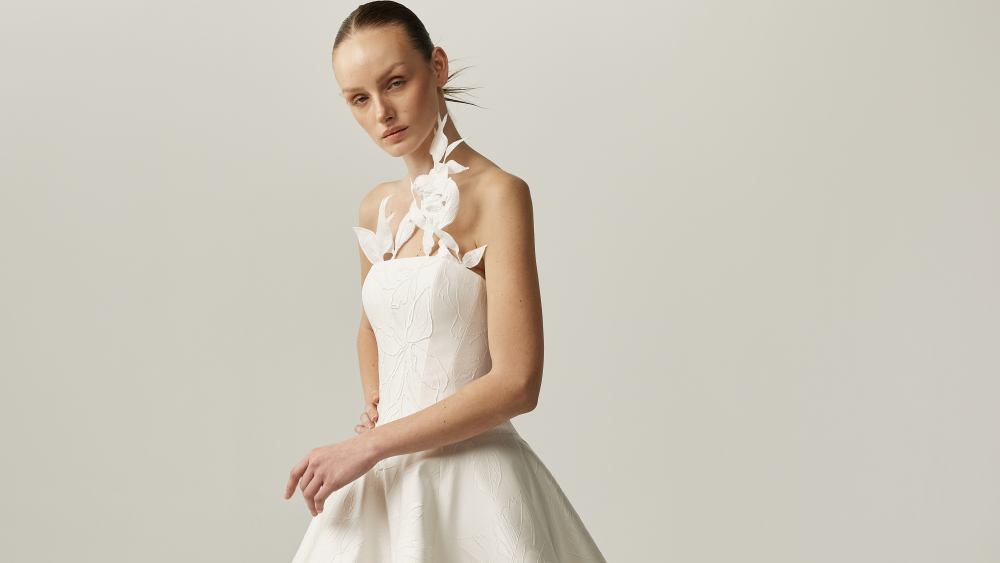
Nouri said her aesthetic is the classic, timeless girl who’s fashion-forward. “We do a lot of bows, clean and then we do a lot of luxury laces. Our bride is that Grace Kelly, Lauren Bacall [look],” she said. “Girls love long sleeves and the Basque waist that has stuck. It goes in like a V, like in the ’80s,” said Nouri.
Asked why she thinks long sleeves are taking off, she said, “It photographs beautifully.” She also does well with high-neck boleros, which are detachable. Brides wear them to the ceremony and then take them off for the reception.
“The girls love the high necks. We really do well with those. And they’re detachable for the ceremony, so they can wear it for the ceremony and then take it off for the reception. We have two different looks with one dress. So they also save money, because a lot of girls want a second look,” said Nouri. She also does short minidresses if women want a second dress to change into during the reception.
“Wholesale has been very strong for us, extremely strong. It’s a big business and has such a high price point, and they’re willing to pay anything. You can charge, like $4,000 for a veil,” she said.
Nouri will be showing in April at the former London Hotels called the Luxury Collection.
She said influencers are more important than celebrities for her business. “Because it’s such a specific niche, it’s hard to get an influencer that is strong as well as getting married. So it’s different than sportswear and ready-to-wear and makeup.”
But she had one influencer who changed Nouri’s business this year. “We did a tremendous amount of business, and she was a classic girl who has a lot of followers. She didn’t ask for anything. She came to my flagship and she bought a dress. After she got married, she was gracious enough to tag us, and we just got a world of requests. After that, we did collaborate with her.” She said women would come into the stores and ask for that look. The influencer wore a Basque waist (Park View) and wore a bolero. “Everybody wanted it,” said Nouri.
Justin Warshaw, chief executive officer and creative director of Justin Alexander, which is celebrating 80 years in business, has been riding a strong wave with his gowns that are made overseas. He said 2025 was his best year to date.
A New Brand
Justin Alexander has a series of bridal collections that start at more moderate price points and go all the way up to the couture level in production and price points with some of its luxury collections. The highest priced labels are Viktor & Rolf Mariage, Savannah Miller and Justin Alexander Signature, which he’ll be showing during bridal week. They are launching a new collection in the luxury space called Poeza.
He said Justin Alexander Signature is a little edgier, fashion-forward product. Poeza will be more romantic with a feminine edge. He said it’s higher-priced than Justin Alexander Signature but a little lower than Viktor & Rolf. They will launch with 19 styles, which will retail between $4,000 and $8,000.
The group manufacturers its bridal gowns in countries such as China, Vietnam and Myanmar.

When asked about the tariff situation, he said, “Obviously, we’re doing as best we can, trying to be stable for our partners. The mom-and-pop retailers really need a stable partner that they know what price you can deliver the product for and what to communicate to the bride. We just tried to do our best to partner with them in a way that’s transparent and clear in what they expect,” said Warshaw.
In the initial days, tariffs were extremely high on places like China. China went to a lower number than Myanmar, which was sitting at 40 percent the entire time. Myanmar was actually higher than China and Vietnam. But now with the IEEPA tariffs being struck down, things have changed again, and now we’re sitting at plus-10 percent on everything. This is excluding obviously the duties that are category-based. You have the plus-10 percent on top of those duties and the 301 tariff for China. We know it’s obviously great for today, but we know the administration is hoping to raise that potentially to 15 percent, instead of 10, and then also try to introduce Section 301 tariffs to increase their tariff income.”
He said China was at 30 percent, but then it went down to 20 percent, but you have to add the 301 tariffs, which are 7.5 percent, and then there are the duties, which are 16 percent. So the total was 53.5 percent and it is presently 33.5 percent.
He said the year started off a little slower than expected “but we’re hoping that it continues to build as the year goes on,” he said.
Waistlines Key
“The big trend right now is waistline differentiation. For so long brides were seeking out natural waists, and now we’re moving toward alternate waistlines like asymmetric, or dropped or Basque. Basque is all we’re hearing about. Brides just want something different from what we’ve been seeing for so many years. There’s also a circular moment with the style of laces the brides are doing. They’re really loving classic laces.”
Sleeves and jackets are both happening. “Whether that be a jewel neck or a high-neck classic jacket,” he said.
His prices are on average $2,500 at retail. “It certainly has increased a bit for sure. The average price point in America is $1,800 to $2,000, which has increased significantly,” he said. For the Justin Alexander gown, it typically averages between $2,000 and $3,250. That’s the largest percentage of its business. Justin Alexander Signature retails for $3.500.
Neil Brown, CEO of Amsale, said, “I think the industry has really evolved in many ways. It’s become increasingly diverse, increasingly fragmented. There’s a lot more involvement from around the globe.”
He said that discovery for brides has become more democratic. Historically, they would look in the media space for discovery, and now it’s dispersed across social media. He said Amsale tries to be very active in social media.
He said Amsale is focused on helping meet the bride where she is now, which is becoming much more of a curator or author of her own look, more than someone who follows prescribed norms and trends.
Amsale has a 5,000-square-foot flagship space at 150 Wooster Street in New York that provides both the brand experience and supports the wedding in a much broader way. The company has expanded into cocktail wear, eveningwear, and supporting every member of the wedding party, be they the bride, bridesmaids or moms, as well as every event connected to the wedding, such as engagement parties, after brunch, the rehearsal dinner and welcome party. There used to be a time where the wedding dress was everything. Now they see the event as having chapters, said Brown.

The brand has Amsale Couture, which is made in New York City, and Amsale Nouvelle Collection, which is produced overseas. He noted that Amsale Couture goes from $6,000 to $15,000 while Nouvelle goes from $2,800 to $4,500.
Amsale will be presenting a full spring 2027 collection of Amsale Couture gowns during this April market. The collection reflects a continued focus on craftsmanship and its New York City atelier, with new elements including nontraditional lace treatments using raffia, more extensive couture hand draping, softer jacquards, and styles with dimensional chiffon appliqué.

He said sourcing costs have gone up , but at their SoHo boutique, there’s been an increase in the total transaction value of dresses and additional items.
Mira Zwillinger, the Israeli bridal designer, said, “Like many businesses, we have experienced certain challenges, particularly in logistics and timelines. However, as an atelier-based couture house, our production remains highly controlled and continues to operate with great care and dedication.”
She said their team has shown “incredible resilience, and they have been able to maintain their standards and commitments to their brides and retail partners worldwide. This period has reinforced the strength of our in-house processes and the importance of close, hands-on craftsmanship,” she said.
“One of the biggest challenges this year is navigating the broader changes in our key markets, particularly in the U.S., including new tariffs and currency fluctuations. These shifts require us to stay flexible while maintaining consistency and reliability across global operations,” said Zwillinger.
She said they are continuing to expand into new international markets, while strengthening their relationships with their existing retail partners.
Cleaner Silhouettes
In terms of design, she is seeing a shift toward pieces that balance timeless elegance with a more fashion-forward and expressive approach. “We are exploring cleaner silhouettes alongside more sculptural and dimensional designs, as well as intricate handcrafted textiles that bring depth, individuality, and a sense of movement to each gown,” she said. At the same time, she said they are drawing inspiration from historical couture elements, “reinterpreting classic forms such as corsetry and structured silhouettes through a modern lens, giving them a fresh and contemporary twist,’ she said.
Reem Acra, the bridal and eveningwear manufacturer, said she is taking a break this season, and skipping a fashion show.
“For many years, everybody said you need to do only one collection a year, and everybody was pushing for two. So I decided to just take a break for the first time just to understand the market. I want to understand what’s going on myself. I’ve been a leader for so many years, along with Vera [Wang], and we pushed the bridal industry to its height. We changed it to luxe, and now I think there’s a little bit of confusion maybe from the price points. There are so many designers coming into the territory. It’s a little bit different than before and I’m trying to understand it. I want to stay in luxury. I’m someone who understands the brides very, very well. I’ve followed them for so many years. Yes, they’re changing, but I see them here constantly. I go in and check on the brides and see what they want.”
Even though she won’t have a show or a huge collection, she said brides come to her showroom all the time, and she does a lot of custom. “I still do a lot of royals overseas and we’re continuing. I decided to stay in luxury. I don’t want to dilute my brand and do competitive pricing.”
She said she’ll stay at the $15,000-and-up price point. She makes everything in New York. She said brides are coming straight to her studio. “At this time, it’s all customizing. You come to me and I’m really an expert at telling you who you are. I’m capable of looking at the customer or a bride, and maybe she’s confused and telling her what she should be wearing. It’s very emotional. It’s very personal. I will make for her, I will guide her and I will make sure she is the most important person at her wedding.”
Dawn Bromander, CEO of Mark Ingram, the multilabel retailer in New York, said over the last three years they had the situation in Israel, then the tariffs last summer, and now there are closed skies [in the Middle East] due to the war with Iran. “Nobody can ship something out of Israel or Lebanon or Dubai, and most of us have representation from that part of the world because it’s a very specific look that’s still a really viable part of what it is that we do, and represents a large number of brides.”
Asked what happens with brides who have ordered from Israeli designers, or those from Dubai, or elsewhere in the Middle East, she said, “We leave ourselves quite a lot of room from a shipping standpoint. And the thing is, we try to get the dresses in six to eight weeks before the wedding. What we’ve done to prepare for it, if something is late or we do need a rapid turnaround on it, we’ve secured a secondary alteration team. It’s a woman who’s worked for us in the past and has a great team. So she’s coming in-house for the summer, just to make sure we’ve got our arms wrapped around everybody.”
She said one of the things about Israel, they’ve historically been able to get planes in and out. She said her biggest Israeli designers are Mira Zillinger and Dana Harel, and Elie Saab comes out of Lebanon, and a new designer they’re working with, Marmar Halim, comes out of Dubai.
One of the benefits of being at Mark Ingram is that designers do come frequently. “And so it allows us to do some fun things — cocktail parties and have designers come in and talk about their beginnings, who they see the bride as,” she said.
“When you have a multi-designer store, it’s one of balance and filling sort of spaces that we have holes in.” She said Ingram’s own line that is produced in Italy has done well.
She said women are spending more than they did pre-pandemic. “What we’re finding is the brides are willing to do the spend to get the fabrics, to get the workmanship, to get the quality, to get all the things that go into some of these upper-end gowns that run between $10,000 and $15,000,” she said.
Mark Ingram has the one Madison Avenue multibrand store and wholesales its own Mark Ingram line at better stores, as well.
Discussing the biggest trends right now, she pointed to satin, which they saw a little bit of last market and are going to see more of. “Basically it’s a satin movement, it’s much richer. The gown has a great deal of substance. It’s got a different weight, it’s got a different feel. It moves differently.”
She said the Basque waist is near its peak; there’s a little bit left of it, probably another year. Plain, clean, classic dresses are especially relevant now. “We’re still seeing a demand for quality lace. It’s important that it’s not crunch. It’s important that it has a real heirloom feel to it, and then brides really respond to it,” she said.
On Ingram’s pieces, the lace comes from Italy and France. Embroideries are coming out of Asian countries.
She said they’ve seen increases in fabric prices. What they did last July is pass the tariff item off as a separate line item. “We absorbed it for six months and said we couldn’t do it any longer. Not with New York rents and New York payrolls,” she said.
Creative director and founder Mark Ingram added that overall business for 2025 was very good. “Everything is affected by world events. We talk about the the financial problems we have with Saks Global. All these things affect people’s mindsets about how they shop and what they’re shopping for. It affects everything we do, even in bridal. In my store, we’re dealing with the 1 percent of the 1 percent. They’re not as affected financially, but they do worry about their portfolios, and that affects the size of weddings and dollars spent on weddings,” said Ingram.

He said what they’re seeing is a bigger spend, which is the good news. While units might be down for the year, the dollars are up because fabrics prices went up.
As far as the dress, he said brides may be buying a convertible dress, which goes from big to narrow by taking something off. “And even how I’m designing, I’m thinking of convertible pieces, and adding more toppers and jackets and overskirts or underskirts, of things I can make the design more adaptable, which does add on the cost of the dress. They’re more expensive because they’re more intricate now,” he said. He said their average prices have gone up; if it had been $8,000, it’s now $10,000.
He’s seeing a decrease in their minis collection because that kind of dress is more available online.
As far as styles, “it’s more of a mixed trend. A few years ago the trend was corsetry and Basque, and now it’s stabilized.” He said the Basque waist, which was very important in the ’90s but went away for a very long time, is now one of the waistlines that’s accepted.
He said he hasn’t seen the bias-cut trend being popular today, despite all the hype about Carolyn Bessette Kennedy. “That’s a certain body type and a certain type of wedding. That’s a low-key wedding,” he said.
As far as sleeves, he said longer sleeves, three-quarter sleeves, anything but strapless. He said strapless is a forever classic and looks good on everybody. “But there are now more options that we’re showing with the sleeve or a halter neckline. We’re selling the tank neckline and square necklines, as opposed to strapless,” said Ingram.
Discussing his namesake brand, he said, “My look was to fill a need that I did not have in my store, and that is contemporary, updated, classic American style. It’s made in Italy, but it’s very American style. I’m not trying to be super sexy, I’m not trying to be super trendy, and I’m not trying to be high fashion.” He said his dresses are in the middle to high range of what he carries. His brand is in the $7,000 to $12,000 price range.
“My line was never designed to be the primary line sold in my store. I treat all my vendors fairly and give them equal store space, equal time, equal trunk shows. I can’t be a multivendor store and not be fair. I can’t be partial to my line,” he said. He sells about 15 bridal brands in the store, which is marking 25 years in business.