Johan Lindeberg had already made his mark in the fashion industry, serving as marketing director at Diesel and helping to build the business in the U.S., when he decided to leave the denim company to create his own brand. That was in 1996, and that brand, J.Lindeberg, was one of the first to bring a modern twist to the staid golfwear market.
Fast forward 30 years and the brand he founded continues to be a viable business. Lindeberg left his namesake company in 2007, and since 2012, it has been owned by Anders Holch Povlsen, Dan Friis and Allan Warburg of the Bestseller group, a family-owned Danish fashion company. There is also a separate Chinese division that operates under license.
For the past six years the Stockholm-based brand has been run by Hans-Christian Meyer, the one-time president of retail for Ralph Lauren’s European operations. J.Lindeberg offers both sport and fashion products, and Meyer has been working to tighten the offering, moving away from pure fashion to focus on collections that blend trend-right offerings with performance attributes.
You May Also Like
“The biggest share of the business is still golf — that is the DNA of the brand. We were born 30 years ago as this fashion brand on the golf course and that’s also how it’s evolved,” he said. “But people today are far more active, hence those active elements are found now in all our concepts.”
Sport product represents around 60 percent of sales, which were $130 million in 2022, the last figures the private company has released.

Meyer said that over the past two years the company has been “working on the brand DNA, and in our fashion lines, we have said goodbye to things that we don’t see aligned with the brand strategy going forward.”
That includes what he called “very fashionable” pieces such as hand-painted white boots, leather biker jackets, tuxedos for the red carpet and other items that were a far cry from the brand’s heritage. “We’re really narrowing it down to reflect being sporty and fashionable in everything we do,” he said.
Since 2020, the brand has been designed by Neil Lewty, who cut his teeth at Hugo Boss and Tommy Hilfiger before joining J.Lindeberg.
In the States, about half of sales come from online. “We’ve taken our e-comm in-house, and that is our flagship,” Meyer said. “We’re showcasing the width of the entire product portfolio: lifestyle, ski, golf. And we are adapting it to the U.S. commercial calendar. We have a team based out of the showroom office in New York that works very closely with the Stockholm team to come across as one brand that is global, but acts local.”
Wholesale distribution in the U.S. is still predominantly centered on golf and ski product, but Meyer said the brand is currently in talks with Nordstrom to add lifestyle product for fall.
Womenswear is also gaining in importance for the brand. In addition to its sports product, the company created a women’s ready-to-wear collection for spring that it is selling online and in its European stores.
“Over the last three to four years, we’ve seen growth in our women’s sport [product],” he said. “There’s something happening in the game of golf. Female players are more aware of being fashionable on the golf course. So we’ve seen a disproportionately healthy development in our womenswear business and that gave us confidence to come across as a lifestyle brand.”
Overall, Meyer said that while the brand is not immune to the macroeconomic challenges in today’s global environment, J.Lindeberg is weathering the storm by being “very alert and very agile.” Although for the first 23 years of its existence, the brand only managed to make money two years, it is profitable today.
“We have seen a tough climate in the U.S. over the last 18 months,” he said. “The U.S. used to be our biggest market and it’s in line with our European market from an e-comm perspective, but there’s been a decline in wholesale because we have been proactively closing some of our accounts that were not brand appropriate.”
In addition to the U.S., its main markets are the U.K., Germany, Austria, Switzerland and Scandinavia.
Meyer said that the brand’s owners have a “long-term view” of the business, remain supportive and are willing to invest in the company.

In Scandinavia, J.Lindeberg operates 14 of its own stores and last April it opened a flagship in Seoul with a distribution partner. “We’re calling it a clubhouse,” he said. “It’s approximately 10,000 feet on the main street and is a beautiful store.”
In February, it opened a 2,000-square-foot store in Stockholm that highlights the new brand identity, and it is outperforming the rest of the fleet. As a result, the other stores are being given a facelift to showcase that concept as well.
This new brand identity is all about “clarity,” Meyer said, and highlighting hero products. “In our Scandinavian stores, 30 percent of our yearly revenue came out of tailoring. But it was traditional tailoring, not sporty, and should not be part of the brand.” So the plan is to replace that volume by focusing on five categories: outerwear, knitwear, pants, hybrids and jerseys for both men and women. Black and white will continue to be the primary colors but each season, there will be accent colors to update the offering.
For the 30th anniversary, the company created a capsule that it debuted at the PGA golf show earlier this year that will hit the market in June. A special collection was also developed for NK, a luxury department store in Stockholm, which devoted its windows to J.Lindeberg. A celebration in Seoul is planned for April 28.
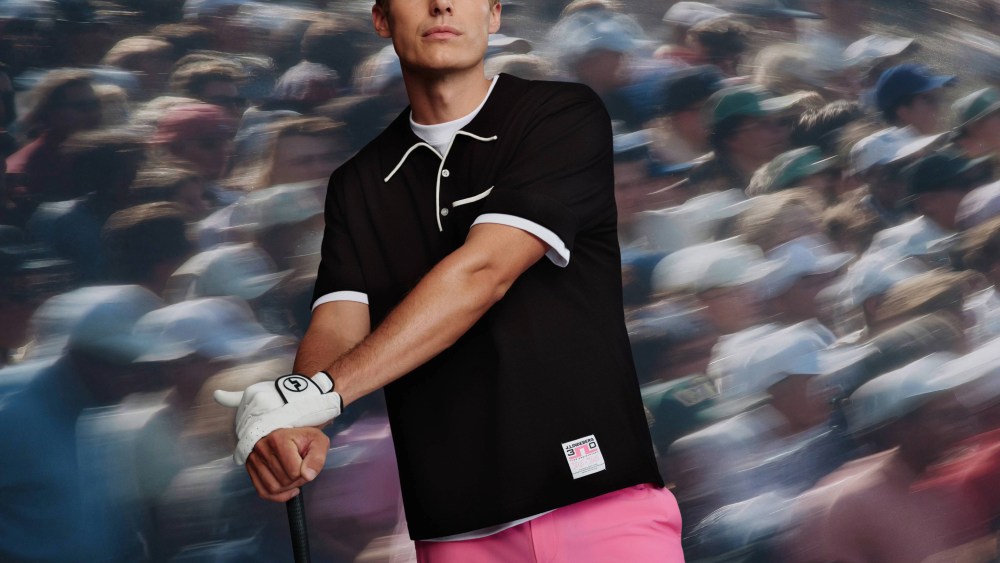
The 30th anniversary capsule was inspired by the early days of the brand and the looks worn by its longtime ambassador Jesper Parnevik and what he wore at The Masters in 1998. “It’s a black and white capsule with our signature pink that our current ambassador Viktor Hovland will wear at the U.S. Open in June.”
Looking ahead to the next 30 years, Meyer said he hopes the work he and the team have done over the past few years will position J.Lindeberg for a bright future. He pointed to Ralph Lauren, Apple, Coca-Cola and other brands as role models. “The more clarity there is around a brand, the more easy it is to understand and the more limitless the opportunities are going to be.”