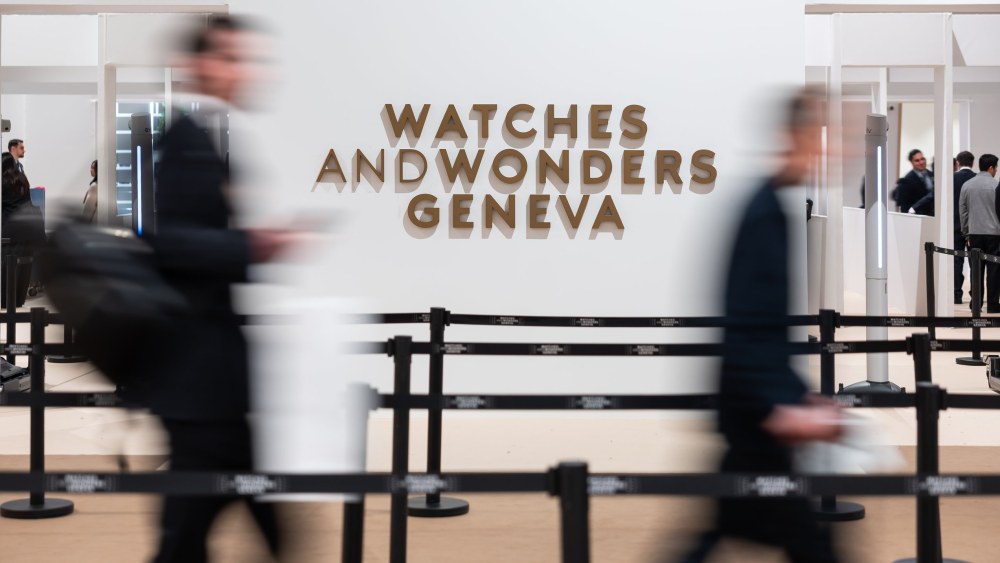
Watchmakers are full of optimism, preparing to unveil a slew of sophisticated timekeepers and headline-grabbing innovations at Watches and Wonders despite a volatile geopolitical backdrop and ongoing cost and trade pressures.
The message from the industry remains unchanged. There is strength in numbers and the fair is not only a time for business, but also an opportunity to futureproof by welcoming a variety of brands and makers.
This year’s Watches and Wonders is set to be a bumper edition that will host 66 brands across 905,000 square feet — up from 810,000 in 2025 — between April 14 and 20, with the final three days open to the public.
There is no denying the power of speaking with one loud voice. Last year’s edition had an estimated read of 700 million across various platforms, according to the organizers.
You May Also Like
The Newcomers
Leading the cohort of 11 newcomers to the 2026 edition is Audemars Piguet. Its chief executive officer Ilaria Resta told WWD that the watchmaker from Le Brassus, Switzerland, “needed to be part of that moment of sharing for the industry.”
“It’s important to stay close to other brands, and also to the small independent brands that use Watches and Wonders as a pillar to showcase their expertise and innovation,” she continued. “It’s really a big [celebration], and it’s important to be there.”

Joining the roster for the first time are clockmaker L’Épée, acquired by LVMH Moët Hennessy Louis Vuitton in 2024, and watchmakers Behrens, Bianchet, B.R.M Chronographes, Charles Girardier, Corum, Credor, Favre Leuba, March LA.B and Sinn Spezialuhren.
Some hail from France, Japan and China, a sign that the watchmaking ecosystem is global, although it remains centered on Switzerland.
Brands are coming together as the industry hopes for recovery after “a year of significant uncertainty and increasingly demanding market conditions for the Swiss watch industry,” said the Federation of the Swiss Watch Industry’s president Yves Bugmann when the industry body published its annual export figures.
Last year was beset by the ongoing slump in the Greater Chinese market, a strong Swiss franc, skyrocketing gold prices and, crucially, the U.S. tariffs roller coaster that put an end to steady growth for the largest market for Swiss watches.
In February, the U.S. Supreme Court ruled that the tariffs should not have been applied without a Congressional vote, suggesting that the ride may not be over.
“As of today, even though the Supreme Court has ruled and ordered the [American] government to pay back the unjustified tariffs, we still don’t know what is going to happen next because the negotiations between Switzerland and the U.S. meant to be concluded by the end of March are still ongoing,” said Oliver R. Müller, watch adviser, analyst and founder of consulting firm LuxeConsult.
Encouraging Signs
Still, there have been encouraging signs for the industry.
Despite the soaring price of gold — over the past 12 months the metal has risen nearly 60 percent to more than $4,800 per ounce — consumers are still hungry for it.
Müller said titanium “doesn’t carry the same perceived value as a watch with a gold case or a gold bracelet,” and there are still top-end customers who are looking for a good investment.
Brian Duffy, CEO of Watches of Switzerland group, would agree. In the U.S., he said sales of gold watches have been “unaffected,” due partly to the inherent value of the metal.
“I do think there’s a safe haven element in buying watches. People see what’s happening to the value of gold — and that increases the attraction of gold,” he said.
December shipments to the U.S. returned to positive territory and annualized sales figures for the U.S. potentially pointed to “a consolidation in Swiss watch demand after a roller coaster year,” said Bernstein analyst Luca Solca at the time.
Industry experts also forecast that Chinese consumer sentiment would bounce back, as the country targeted 5 percent economic growth this year. Both territories are expected to be the twin engines behind a recover in luxury watch sales.

In February, watch exports returned to growth, with a 9.2 percent increase to 2.2 billion Swiss francs, buoyed by the U.S., Japan and France, according to figures published on March 20.
The big luxury groups, which are expected to report earnings for the first three months of 2026 mid-April, also showed improvement. The watches and jewelry division of LVMH was up 8 percent in full-year results published in January.
In the third-quarter results of Compagnie Financière Richemont, published in mid-January, sales at its specialist watchmakers made an unexpected 7 percent leap to 872 million euros. It was the second consecutive positive quarter for watches, with growth across all regions, powered by double-digit performances in the Americas and the Middle East and Africa.
Hermès’ watchmaking division, meanwhile, remained under pressure amid exposure to China and increased competition from the secondary market, though it rebounded slightly in the second half of the year.
War Disruption
But these encouraging signs of recovery are being put to the test by fresh geopolitical turmoil in the Middle East, following the onset of war in Iran on Feb. 28. While the Trump administration and the Iranian government on April 8 agreed to a two-week ceasefire while they continue negotiations seeking an end to the war, there continues to be immense uncertainty as the two sides remain far apart in their demands.
The region, which accounted for 10 percent of Swiss watch exports in 2025, is driven by domestic consumption and tourism. Müller estimates the share of sales coming from tourists is around 50 percent overall and more than 60 percent in ultra-high net worth pockets such as Dubai.
Business “has been substantially reduced” and may not restart immediately at the end of the conflict, he added.
While this will have a direct impact on the bottom line for watchmakers, it also risks spilling over onto the industry’s labor force.
After employment figures in the industry fell 1.3 percent last year for the first time since the COVID-19 pandemic, the Swiss Watch Industry Employers’ Association took a cautious outlook for 2026, highlighting that the end of state-supported worktime reduction schemes could result in added pressure.
“Should current conditions continue, it is likely that some companies may be forced to resize their production tool, despite efforts to adapt to an increasingly demanding economic environment,” the organization said in December.
Industry insiders have long pointed out the risk of know-how being lost as a result of job cuts.
Groups big and small have in recent years invested in their suppliers — or noted independents. Most recently, Audemars Piguet took a majority stake in precision manufacturer Inhotec, while LVMH Watches took a minority one in La Joux-Perret, a Swiss designer and producer of high-quality watch movements.
Faced with this particularly shaky terrain, high-end watchmakers are doubling down on their strongest levers to lure clients back into boutiques: pushing innovation across materials and complications, sharpening the emphasis on artisanal craftsmanship and scarcity — perhaps an antidote to the ubiquity of AI-generated design — and sustaining robust marketing investments.
Jaeger-LeCoultre’s CEO Jérôme Lambert told WWD in an interview ahead of Watches and Wonders that some limited-edition watches and grand complication timekeepers had “interestingly not only an economic impact but also a very important impact on the reputation of the brand equity of the maison” as examples of its inventiveness and “radical creativity.”
Plus, with consumers increasingly knowlegeable and a growing number of players, the onus is on brands to bring clear “elements of proof and differentiation,” he added.

Müller pointed out a shift toward a “new normal” for dial sizes under 40mm and more colorful products, both in terms of dials as well as new techniques livening up other parts.
There are also opportunities yet to be fully tapped, such as female collectors. Lambert characterized them as a still-developing demographic with “fewer and fewer boundaries” such as case size. Addressing women also offers new opportunities to unfurl “craftsmanship, history and cultural ground.”
Younger demographics, such as Gen Z consumers, could also create a shift with their interests in heritage brands and historic styles.
New Ambassadors
Meanwhile, brands are bolstering their ambassador rosters, no longer content with tapping an appealing face for one-off occasions.
In a “fiercely competitive landscape” where “much of a brand’s value resides in its identity,” Tag Heuer’s chief marketing officer George Ciz highlighted the pivotal position of ambassadors.
“A timepiece is, by nature, an intimate and highly personal object,” he told WWD. “It therefore requires individuals who can embody its essence, interpret its character and demonstrate how it integrates seamlessly into one’s life.”
As such, ambassadors become “living expressions of that identity, articulating its values enriching its narrative and lending it a distinctive personality,” while amplifying visibility through public appearances, creative projects or broader cultural presence.
A case in point is Ryan Gosling, who has lent his image to the brand but also imagined “The Chase for Carrera” campaign, and worn its timepieces in his films, most recently “Project Hail Mary.”

Brand equity also has a long tail that extends well into the secondhand market, now a prime concern for brands.
“Certified pre-owned programs really became a game changer as soon as Rolex entered the field because it was the missing last-mile between the brands and the end consumer,” Müller said.
He forecast more brands jumping into the fray, despite the organizational changes brought on by extensive logistics, authentication and serving needs. “But I dare say that if Rolex, which is selling more than [1 million] watches a year, achieved it then other brands should be capable of doing it as well,” he added. “And it’s in the interest of an industry always claiming to manufacture objects which are meant to last for eternity.”
– With contributions from Samantha Conti (London) and Martino Carrera (Milan)