
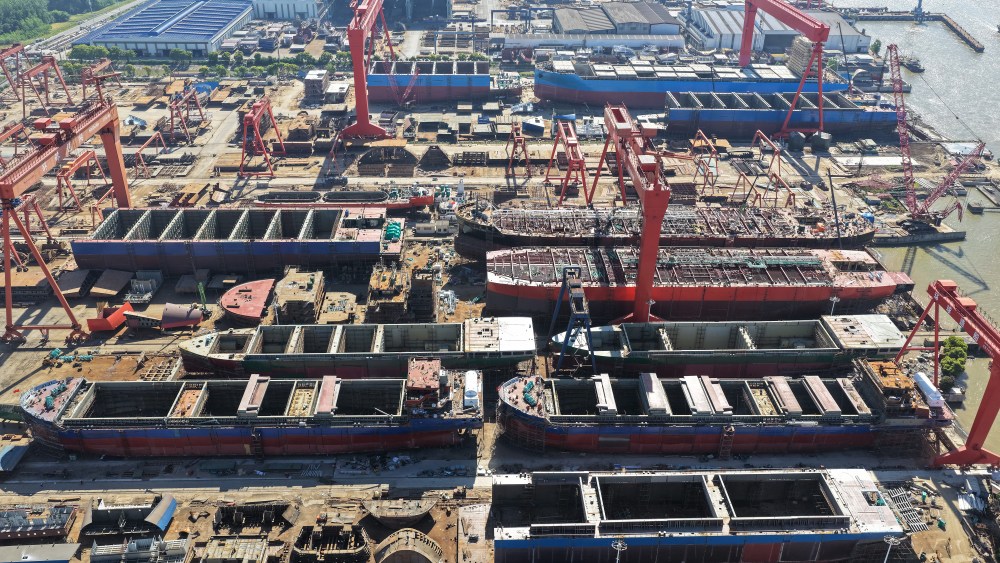
Sens. Elizabeth Warren (D-Mass.) and Mark Kelly (D-Ariz.) are calling on the Trump administration to bring back the port fees on China-affiliated vessels it briefly implemented for two weeks last October.
In a letter to U.S. Trade Representative (USTR) Jamieson Greer on Sunday, the two lawmakers said the port docking fees and restrictions were critical to revitalizing American shipbuilding. The sector has sorely fallen behind China, as well as other countries like South Korea and Japan, in recent decades.
While Kelly has been one of the masterminds behind the bipartisan SHIPS for America Act, which is aimed at establishing national oversight and consistent funding for U.S. maritime and shipbuilding efforts, the wider effort to bolster the domestic industry has largely remained dormant.
“At the same time, demand for commercial vessels from China’s state-owned shipbuilding company, China State Shipbuilding Corporation (CSSC), which produces both commercial and naval ships, has exploded,” said Warren and Kelly in the joint letter. “The demand for Chinese-built commercial ships—the majority of which are sold to foreign buyers—augments CSSC’s capabilities and effectively subsidizes their defense production.”
Last year, the USTR sought to impose the fees after an eight-month probe into China’s shipbuilding practices found that the country’s dominance over the sector was “unreasonable” and harmed U.S. commerce. Leveraging Section 301 of the Trade Act of 1974, the U.S. can penalize foreign countries for acts under this label, with Presidents Donald Trump and Joe Biden both imposing tariffs on Chinese goods.
The measures first went into effect Oct. 14, and required Chinese vessel operators to pay surcharges of $50 per net ton for every individual voyage that stops at U.S. ports. Chinese-built ships owned by other carriers also were charged $18 per net ton fee. At the time, both fees were set to see annual increases over the same period.
These fees were lucrative for the U.S. in the short time they were imposed. Chinese carriers including Cosco Shipping and subsidiary Orient Overseas Container Line (OOCL) paid nearly $43 million combined in fees the first week alone, while China United Lines paid a $1.3 million fee to make one port call.
“Even the prospect of impending fees had a major impact,” said Warren and Kelly. “Within months of the [February] announcement, orders at Chinese shipyards had dropped precipitously; orders were down 23.5 percent in the first nine months of 2025.”
The senators said Trump’s “ill-conceived trade war” soon forced a reversal of the progress, with the lawmakers noting China’s tariff’s on minerals used in military technology and semiconductors.
The U.S. postponed the fees for one year after the landmark meeting between Trump and China’s President Xi Jinping, which resulted in the U.S. slightly cutting its tariffs on Chinese exports. China also suspended countermeasure fees that it had slapped on American-operated and built vessels in retaliation for the U.S.-levied fees.
“Within five days of the announced suspension of fees, shipping giant Maersk awarded a $2.3 billion contract to a Chinese company, eschewing the South Korean shipbuilder they had considered for the project, and the backlog of orders on hand at Chinese shipyards rose 25 percent,” the lawmakers said.
Various detractors including retailers, ports, manufacturers, ocean carriers and farmers had spoken out against the fees, with concerns of lengthier lead times, increased freight rates and potential job losses.
However, a coalition of unions that had initially inspired the USTR’s Section 301 probe and recently backed the SHIPS for America Act was critical of the administration for going back on the surcharges. The United Steelworkers and its labor allies said in November that the decision gave China “a free pass on its predatory behavior.”
Port fees in some form still appear to be on the table when the one-year postponement lifts in late October.
Upon releasing its Maritime Action Plan in February, the Trump administration floated the idea of a universal fee on all foreign-built commercial vessels docking at U.S. ports regardless of their origin country.
Those charges would be framed as an “infrastructure or security fee” to be assessed on the weight of the imported tonnage arriving on the vessel. The plan estimated that a 1-cent-per-kilogram fee on foreign-built ships would generate about $66 billion in revenue over 10 years.
When the projection ticks up to as much as 25 cents per kilogram would yield close to $1.5 trillion in revenue, which could be used for a newly established Maritime Security Trust Fund aimed at ensuring long-term investments into American shipbuilding.