For Jason Wu, “Fashioning Chinese Women: Empire to Modernity” is more than a museum collaboration. It’s a return to a passion that first shaped his work.
“I started my career when I was 17, and I had designed dolls,” Wu said, explaining he got his start designing collectible dolls for Integrity Toys in New York. “It’s something that I kept doing the last 30 years, and so that allowed me to really understand how to sculpt figures and how to work in 3D.”
The exhibition — opening at the Los Angeles County Museum of Art on Sunday and running through Oct. 12 — explores the evolution of Chinese women’s dress across decades of social transformation. Wu customized the faces, hairstyles and finishes of the exhibition’s original 3D-printed mannequins for about 50 of its more than 70 historic looks.
But it’s also a deeply personal project.
You May Also Like
“I’m 43, but I feel like I’m finally mature enough to really tackle my own background,” said Wu, who was born in Taiwan and is of Chinese heritage. “I was always really afraid to do it. Would I be too literal? How do I translate my culture in a way that still feels modern, and also incorporates my international training? It’s always been a really big topic for me, and a little daunting. So right now, it just feels like I’m finally ready to do it.”
The project bridges the worlds of art, fashion, collectible design and technology. Drawing inspiration from Art Deco, Wu said he wanted the figures “to feel less like regular mannequins” and more sculptural, with a sophisticated, uniform look that connected garments spanning decades. From the embroidered robes of the late Qing Dynasty to the sleek silhouettes of the qipao and cheongsam, the exhibition explores how changing styles reflected ideas of femininity and identity.

Made in cities spanning Shanghai and Hong Kong to San Francisco and New York, the garments reveal how imported materials and techniques — from jacquard ribbons and synthetic dyes to rayon and machine-made lace — were adapted through Chinese craftsmanship.
Accuracy in the mannequins’ proportions was essential, Wu said, noting how dramatically body sizes shifted across eras.
“The body change was the biggest thing,” he said of the research process. “When we’re doing something from the 1900s, people then were so much smaller. We were actually using the proportion of today’s teenage girl.”
The exhibition was guest curated by Michaela Hansen, with support from LACMA curators Clarissa M. Esguerra and Nicole LaBouff. Sharon S. Takeda, senior curator and department head of Costume and Textiles and Japanese Art at LACMA, also supported the exhibition and contributed to the catalogue.
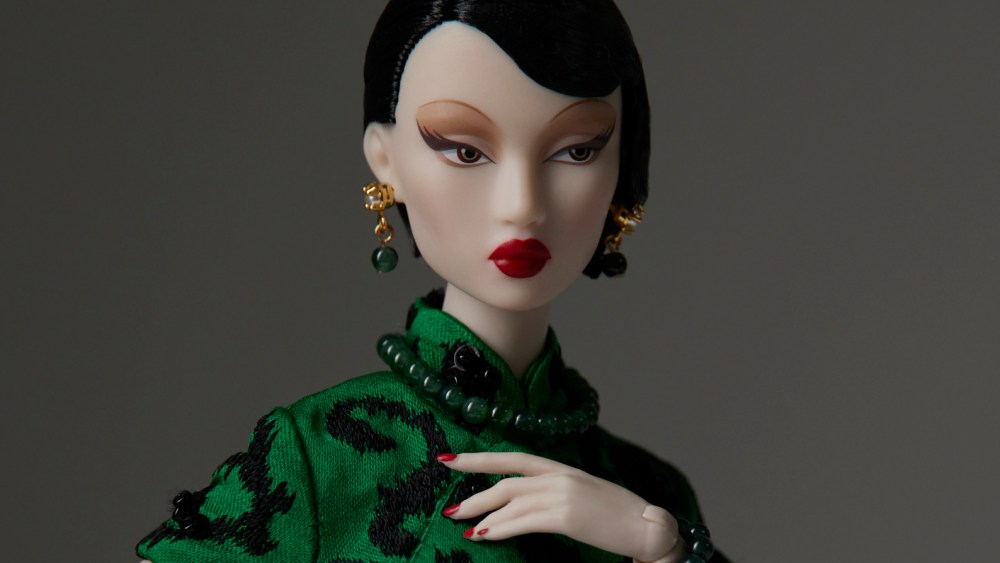
The show highlights Wu’s new venture, Atomic Lab, a platform for limited-edition collectible dolls inspired by fashion and pop culture. Created alongside the exhibition, the LACMA x Atomic Lab Museum Edition serves as the inaugural release in The Vault Series, introducing a 12-inch collectible doll limited to 250 pieces worldwide, priced at $250 and shipping Nov. 1. Inspired by the glamour of 1950s Shanghai, it is dressed in an emerald-green qipao and finished with genuine jade jewelry.
“I thought it was really interesting to create something that could be purchased that represented this particular show,” Wu said.