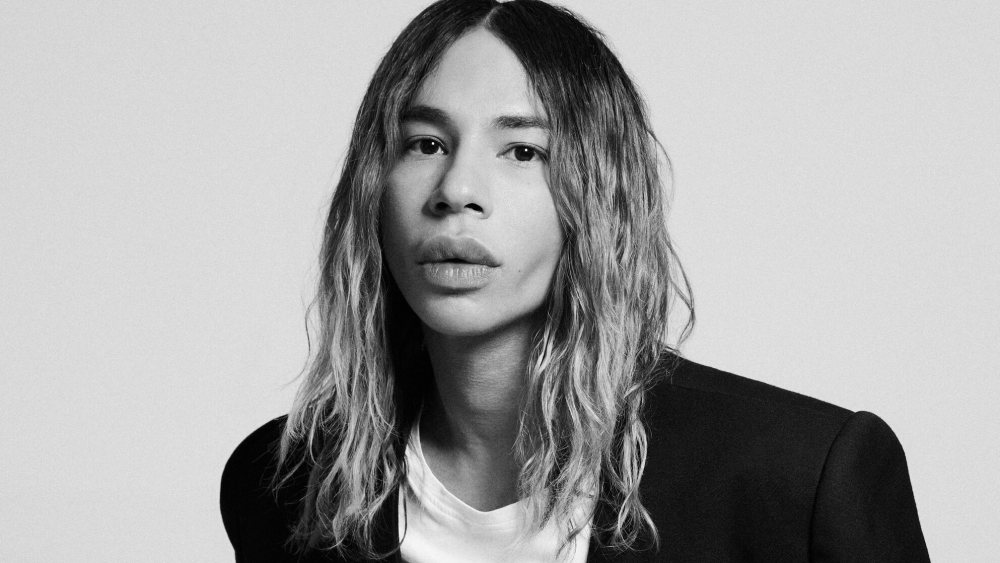
Olivier Rousteing first became aware of Paco Rabanne when he was about 12 years old and joined his grandparents in their living room in Bordeaux, France, to watch a TV documentary about the Spanish fashion legend, which flashed images of Françoise Hardy, Brigitte Bardot and Audrey Hepburn wearing his shiny, Space Age designs.
“I remember thinking, ‘Are these dresses, or are they superheroes?’” Rousteing related in an exclusive interview about his appointment as Rabanne’s new creative director, mimicking how his eyes widened with wonder back then. “You know how much I love superheroes.”
Rousteing officially started at Rabanne on July 6, and is to present a pre-fall collection in November, with the first runway show during Paris Fashion Week in March 2027.
You May Also Like
Asked if he already knows where he wants to take the Puig-owned house, he paused for a moment, and then declared with a grin: “To the moon!”
While the 40-year-old French designer is nearly synonymous with Balmain, where he logged an illustrious 16-year career, 14 of them as creative director, he described Paco Rabanne as a kindred fashion spirit.
“You know about my love for craft. I always try to see fashion as a laboratory. I always try to push boundaries. I always loved finding creativity in materials and fabrics,” said the designer, who famously put singer Tyla in a dress made of sand for the 2024 Met Gala. “What is most impressive about Paco Rabanne is that in the ’60s and ’70s, he was pushing boundaries. Everybody at that time was doing gowns, so it was a revolution to actually think metal could be a dress, that PVC could be a dress.
“He’s always been part of my mood board,” he added. “Paco Rabanne is a legend as a man, as someone known for his craft, and as a couturier who really embraced pop culture.
“He was a dreamer,” Rousteing continued. “He was resilient, and an outsider. He never tried to be part of the box.”
Needless to say, when Rousteing told his family he would be carrying on his legacy at the helm of the Paris-based house, they were nearly as ecstatic as he was.
“It was emotional. I was like, ‘Wow, I’m gonna touch the archives, the heritage, the incredible legacy of Monsieur Paco Rabanne.’”
Rousteing hastened to add that he felt pride and responsibility in succeeding Julian Dossena, who recently wound up an acclaimed, eventful 13-year tenure at Rabanne.
“I always followed his work and his talent, and I’m really proud to keep thinking of his legacy, too,” Rousteing said, seated in his new office at Rabanne on Rue François-1er, which also offers a bird’s-eye view of Avenue Montaigne, one of the city’s most famous luxury streets.
In a brief statement, Rabanne confirmed Rousteing’s appointment and said the house would “continue to expand its universe through new product categories, further shaping a comprehensive ecosystem where fashion, beauty and innovation exist in constant dialogue.”
Ana Trias, president of prestige and fashion brands at Puig, lauded Rousteing’s vision as “bold, magnetic and deeply connected to the energy of today.”
“He has a remarkable ability to create fashion that celebrates confidence, individuality and self-expression, while building a strong cultural dialogue with new generations,” she told WWD. “At the same time, he has an instinctive understanding of the power of heritage and knows how to maintain the identity of an iconic house while shaking it and making it feel relevant for today.
“Rabanne has always been a brand that challenged conventions and pushed creative boundaries. Olivier shares that same fearless spirit, making him a natural choice to lead this next chapter,” she added.
Trias said the designer enters the house “from a position of strength. The house has been shaped by years of thoughtful leadership, and we are deeply appreciative of everything that has built its success to date.”
The executive described a “steady and sustainable” long-term approach to the Rabanne business.
“We are supported by a loyal network of longstanding wholesale partners while continuing to strengthen our retail presence in a thoughtful and measured way,” she said. “We believe there is still significant opportunity for the house. Rabanne has a unique position, with the strength of both its fashion and beauty businesses creating meaningful synergies, while there is still considerable room for international expansion and further development of our product categories for fashion.”
Puig’s holdings also include Carolina Herrera, Dries Van Noten, Jean Paul Gaultier and Nina Ricci.
“Our fashion houses are the lighthouse of our creativity, shaping the identity of our brands and inspiring innovation across the business. Because we own them, we can nurture their creative vision over the long term and create a genuine dialogue between fashion and beauty,” she said. “That gives us the freedom to take creative risks, build lasting desirability and innovate with authenticity — something that is a real competitive advantage for Puig.
“With Olivier’s creative leadership, we want to reinforce what makes Rabanne so distinctive, deepen its connection with clients around the world and continue growing the maison with a long-term vision,” she added.
Interviewed on Thursday, Rousteing was still familiarizing himself with the teams at Rabanne, contemplating a redesign of his office — “I’m thinking of black carpeting,” he mused — and relishing the chance to soon visit the Rabanne archives.
Paco Rabanne, who died in 2023 at age 88, famously launched his house in 1966 with a collection titled “12 Experimental and Unwearable Dresses in Contemporary Materials.” He quickly became synonymous with a futuristic vision and the use of nonconventional materials.

Barcelona-based Puig acquired Paco Rabanne in 1987, and relaunched fashion there in 2011 after a four-year pause, initially signing on Indian designer Manish Arora. Before that, Patrick Robinson, Christophe Decarnin, Aurelien Tremblay and Rosemary Rodriguez had worked in its ready-to-wear studio over the years.
Puig shortened the brand name to Rabanne in 2023 as part of a feminization and elevation drive, and to unify its fashion and fragrance activities. The latter are the engine of the house thanks to hit scents like 1 Million, Invictus, Black XS and Phantom.
Among the key codes of the brand that now appear across fashion, accessories and beauty products are metal mesh, silver and gold in combination, square chain links, and round and hole-punched metallic discs.
Bits of all those materials could be seen last week scattered over Rousteing’s desk, along with a rack of metal-mesh dresses glinting just behind him.
Rousteing said among his favorite quotes from Rabanne is one about him being a trendsetter, rather than someone who followed trends, and another about “dressing my women with armors to fight and to be protected when they go out on the street. He was dressing women with power, with glamour.”
While Rabanne was designing amid a period of social upheaval in France, including the fight for women’s rights, Rousteing has in the past employed similar language of female empowerment when he spoke of his “Balmain army” storming out on the runway in his bold, strong-shouldered, designs.
“Rabanne is obviously a world where there is a lot of inclusivity, there is a love of diversity, and a love of pop culture connected to the world of today, while thinking of what’s going to be the world of tomorrow,” he said.
Rousteing, who had already scented his work space with a yet-to-be-released Rabanne perfume, said he’s excited to ply his creativity into beauty products, too.
“There will be one story line: Fashion and beauty meets each other, that’s gonna be my role,” he said. “You know about my love for fragrance.”
Indeed, among his last mega projects at Balmain, in late 2024, was the launch of Les Éternels de Balmain, a collection of eight fragrances produced under license by the Estée Lauder Cos. that channeled both that brand’s historic strength in fragrance and Rousteing’s lifelong love of the category.
In last week’s interview, he related that his grandfather wore Rabanne’s XS fragrance, first released in 1994, and it still triggers powerful memories. “I remember I actually stole it from my granddad because I loved the smell,” he said.
“What’s exciting is the high quality that Rabanne beauty is capable of, talking to new generations and seeing what is going to be the future,” he added.
Bordeaux-born Rousteing, who briefly attended Paris’ ESMOD school, began his fashion career at Roberto Cavalli, moving over to Balmain as head of the studio under Decarnin, who was Balmain’s creative director then.
In 2011, Rousteing made history when he was promoted to the top job at the age of 25. Not only was he the youngest designer to step into such a role, but he was then the only Black womenswear designer at the helm of a French fashion house.
He went on to shape a transformative chapter for Balmain, catapulting it to new heights of cultural relevance, heat, currency — and sales.
A pioneer in embracing and leveraging social media — he counts 9.4 million followers on Instagram — Rousteing opened his Balmain shows to the public, embraced technologies such as NFTs and linked the heritage house to pop culture while also putting diversity and inclusivity at the top of the industry agenda.
He considers Balmain’s high-low hookup with high street retailer H&M in 2015, which had a 99 percent sell-through, a career highlight.
Since exiting Balmain last November, Rousteing has kept a low profile — and then made a surprise return to the fashion spotlight last May by dressing Beyoncé Knowles-Carter in a sparkly, skull-inspired gown for the Met Gala in New York.

“She’s someone who has always been supportive from the beginning, and there’s no end, which is perfect,” he said, his eyes suddenly a little misty. “She called me. She asked me, and we started to build that story together over four months, back and forth from L.A. to Paris, and then spending time together when I was in New York.”
He said the music star helped him pull together an atelier in her New York City studio, and assemble an incredible team that produced several spectacular dresses.
“It gave me a lot of strength to come back to Paris, knowing that I can make it,” he said. “It’s what we call once in a lifetime, because you never know if it can happen again.”
Asked if his time away from the spotlight, while brief, brought him any epiphanies, he paused again for a moment before saying: “The beauty of the fashion industry is that it’s about dreaming. I came back serene, and full of hope. I feel I’m back being a kid, dreaming again.”