Both the Chinese government and a prominent industry association lashed out at the Trump administration on Saturday over an expanded import blacklist targeting companies tied to the persecution of Muslim minorities in China’s Xinjiang region, calling it a “classic act of economic coercion.”
Speaking through state-run media such as The Global Times and Xinhua, China’s Ministry of Commerce said Friday’s addition of 43 names to the Uyghur Forced Labor Prevention Act Entity List “seriously infringed upon the lawful rights and interests of the companies concerned” and “severely undermined the stability of global industrial and supply chains.”
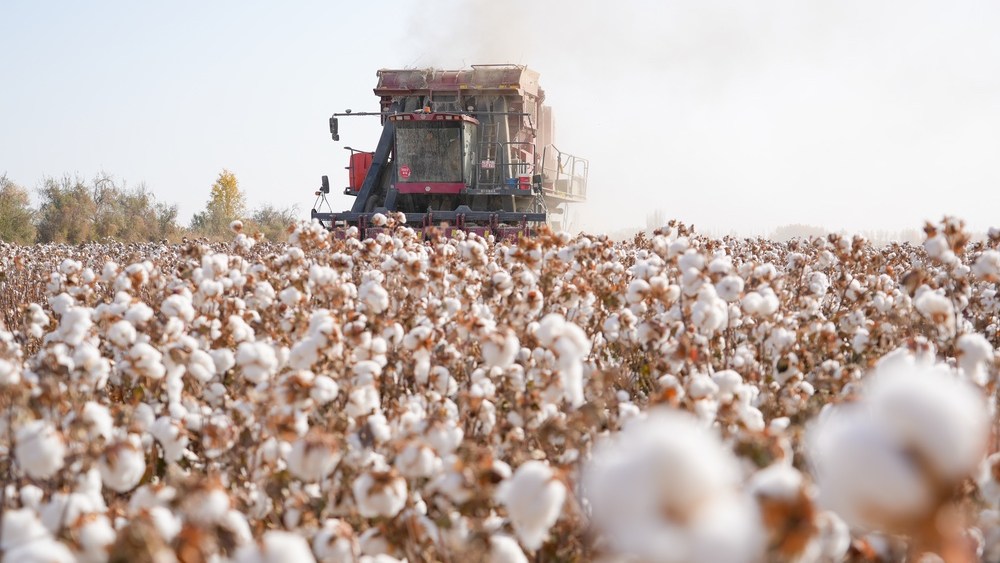
It was joined by the China Cotton Association, which released its own statement saying that the United States’ forced labor allegations “lack factual and legal basis” and that China’s cotton industry has “consistently followed a market-oriented and modern development path,” with mechanized harvesting now accounting for more than 90 percent of cotton production in Xinjiang.
Echoing the ministry’s insistence that “there is no so-called ‘forced labor,’” the trade group said the “true intent behind such a move is to politicize and weaponize human rights issues in an attempt to contain the development of China’s cotton and textile industries.”
The ministry also pointed to a video call between Chinese Vice-Premier He Lifeng, U.S. Treasury Secretary Scott Bessent and U.S. Trade Representative Jamieson Greer the day before, saying the two sides had “candid, in-depth and constructive exchanges on maintaining the stability of bilateral economic and trade relations” ahead of an expected September summit between President Donald Trump and Chinese leader Xi Jinping.
“Just one day later, the U.S. introduced egregious measures that undermine China’s interests, seriously deviating from the consensus reached by the two heads of state,” the spokesperson said. “China strongly condemns and firmly opposes such actions.”
The updated list, the first under the second Trump administration, marks a 30 percent increase—the roster’s largest yet. It covers companies in high-priority enforcement sectors such as aluminum, apparel, copper, cotton, tomatoes and their downstream products, including Fujian Septwolves Industry Co., which runs one of China’s biggest men’s wear brands, and Henan Tongzhou Cotton Industry Co., a major processor and trader of cotton fiber, yarn and garments.
Uyghur advocates and China hawks in the United States have praised the list’s expansion as a “welcome and necessary step toward ensuring that goods produced through Uyghur forced labour are kept out of global supply chains.”
“China’s ability to manufacture artificially low-cost products is built, in part, on the exploitation of Uyghur forced labor, distorting fair competition and placing law-abiding businesses at a disadvantage,” Abdulhakim Idris, executive director of the Center for Uyghur Studies, said on Monday. Strong enforcement of the UFLPA is essential to protecting both human rights and a level playing field for responsible businesses.”
John Moolenaar, the Michigan Republican who chairs the House Select Committee on the Strategic Competition Between the United States and the Chinese Communist Party, said on Friday that the Trump administration’s action “strengthens America’s economy against products made with slave labor and sends a message to the Chinese Communist Party that we will not look the other way on its genocide and human rights abuses.”
Beijing’s response to President Trump’s new 12.5 percent tariff, issued under Section 301 of the 1974 Trade Act and replacing an expiring 10 percent global tariff, has been more muted. By contrast, the Ministry of Commerce said China “will take necessary measures to firmly safeguard the lawful rights and interests of Chinese enterprises” in response to the expanded UFLPA Entity List.
Meanwhile, China’s Cotton Association downplayed the list’s impact, saying China’s cotton industry is “confident in and capable of overcoming challenges posed by external pressure,” and noting that the country has “the world’s most complete cotton and textile industrial chains, a vast domestic consumer market, and an increasingly diversified international market layout.”
It, too, however, said that it will continue to defend the “legitimate rights and interests” of Chinese cotton and textile enterprises.
The Trump administration is also expected to move ahead with tariffs tied to a separate Section 301 probe into alleged excess capacity in China and other economies, another long-running flashpoint in Washington’s trade fight with Beijing. Chinese officials have similarly rejected the claim, arguing that the United States has no authority to police global manufacturing by unilaterally imposing penalties on trading partners for surplus production.