
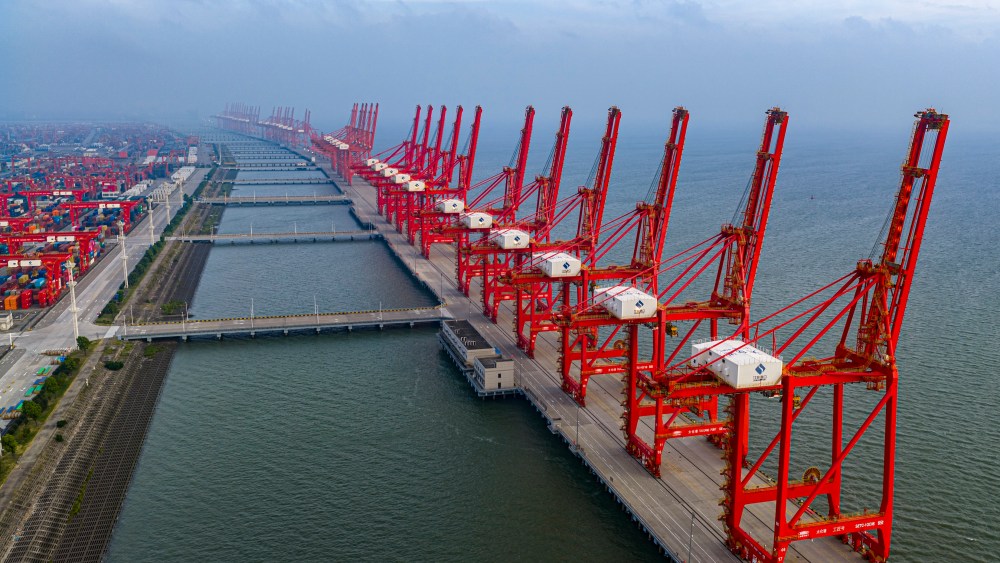
China endured its strongest storm of the season over the weekend, with ports in Shanghai and Ningbo experiencing three-day closures across multiple container terminals.
Typhoon Dolphin was the third tropical storm to hit China’s east coast in the past five weeks, with heavy rain and 90-mile-per-hour winds forcing ships to take shelter and leading airports to cancel hundreds of flights on Sunday and Monday.
According to data from container shipping market research firm Linerlytica, more than 2.4 million 20-foot equivalent units (TEUs) of container capacity were stranded across North Asia as of Monday.
Prolonged vessel delays are expected after terminal operations were reopened at the Ningbo-Zhoushan port on Monday afternoon and the Port of Shanghai on Tuesday morning. Ningbo shuttered all its terminals and container yards on Thursday in anticipation of the typhoon, while operations at Shanghai’s Yangshan and Waigaoqiao terminals were suspended on Friday.
With port congestion spreading toward southern China to hubs like Qingdao and Shenzhen, Linerlytica estimates it will take a few weeks to clear the vessel backlog.
Congestion has been a problem in the area for weeks, with Typhoon Bavi and Typhoon Noul leading to several port closures on the country’s east coast across July. This has ultimately led to longer waiting times to dock at the port, further exacerbating shipping delays. The situation has also provided further support to freight rates on the trans-Pacific trade lane due to the constrained container capacity, according to Drewry.
As of Saturday, there were 67 vessels at anchorage at the Shanghai and Ningbo ports, along with 19 ships berthed at the hubs—amounting to more than 687,500 20-foot equivalent units (TEUs) in queue, compared to just above 96,500 TEUs at the ports.
The queue-to-berth ratio for vessels was 3.5, which is the highest ratio across all global ports with at least 20 ships at anchorage.
Seko Logistics, which has monitored the impacts of Typhoon Dolphin, said Tuesday that post-reopening vessel bunching at the Port of Shanghai is expected to keep berth waiting times elevated at five to eight days over the coming week.
U.K.-based freight forwarder Beckchoice said vessel waiting times at some Yangshan berths are currently reaching up to 12 days, while availability for container gate-in appointments remains limited.
“The congestion is also increasing the risk of vessel omissions, rolled cargo and containers being bumped from scheduled sailings. In some cases, shipping lines may choose to omit Shanghai from their schedules depending on operational conditions and individual carrier arrangements,” said Beckchoice. “This could result in further shipment delays and potentially missed onward connections, as well as additional storage or related charges in some circumstances.”
Yard density remains high between 75 percent and 90 percent as queued import/export containers move through the gates, according to Seko.
Access roads surrounding Waigaoqiao and Yangshan are experiencing heavy truck queuing, Seko said. The company is advising drivers to schedule gate appointments during off-peak windows.
At the Port of Ningbo, over 800 commercial vessels anchored during the storm are re-entering pilotage channels, the logistics provider told clients. Berth waiting times at the hub are expected to range from three to five days as terminals clear the backlog.
Regional drayage between the Shanghai and Ningbo ports and their inland factories is “actively recovering,” Seko said. The firm noted that major bridges like the Donghai Bridge and the Hangzhou Bay Bridge, as well as regional expressways, have reopened with standard speed limits restored.
Additionally, high-speed rail connections have resumed regular schedules. Yangtze River feeder connections will experience two to four days of lingering transit delay as mother vessels re-sequence at main ports.
Typhoon Dolphin’s impacts have extended to cargo movement in the air.
Air export space out of east China remains tight through Tuesday due to rolled cargo from cancelled flights over the prior two days, Seko says.
Shanghai’s Hongqiao and Pudong airports canceled more than 900 flights Monday, or about 40 percent of those expected, after about 1,300 were canceled the day before, according to Shanghai Airport Group.
Flight operations are normalizing as weather clears on Tuesday. Ground handling and tarmac loading have fully resumed, though flight schedules will require another 24-to-48 hours to clear passenger and freighter backlogs.
At other major airports in the region including Hangzhou Xiaoshan and Ningbo Lishe, departures and arrivals have resumed normal operations following weekend suspensions.