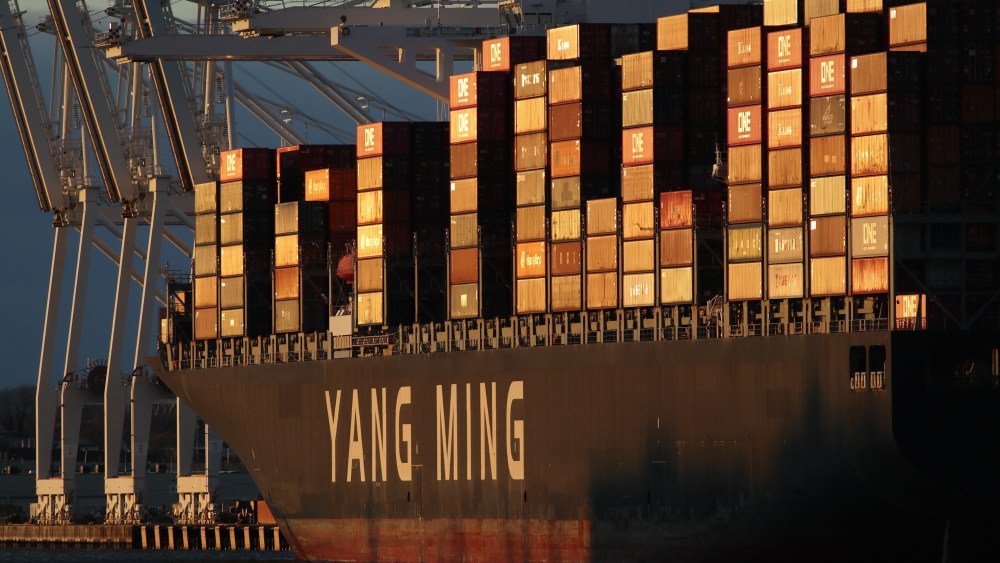
President Donald Trump’s differentiated tariff actions over the court of 2025 and 2026—which have targeted America’s trading partners on an often individual basis based on their trade imbalances with the United States—have “significantly” increased the need for effective transshipment enforcement, the White House wrote in a report earlier this month.
Titled “The Great Transshipment Scam,” the white paper details the rise of the illegal transshipment of goods through third countries as a means of skirting tariffs and penalties. Over the past year and a half, bad actors across as many as 40 global economies have upped their game when it comes to the relabeling, repackaging and re-invoicing of goods to evade Trump’s heightened duties, the administration wrote in a 25-page missive.
According to the report, China represents the nucleus of the transshipment issue—an assertion China’s Commerce Ministry said Thursday “disregards facts and distorts the truth.”
Trump began trying to address the momentous and persistent trade imbalance between the U.S. and the sourcing superpower during his first term, saddling the country with hefty Section 301 tariffs in 2018. Over the ensuing years, the Biden administration maintained and added to those duties, and in Trump’s second term, China has remained a focus of tariff action.
As a result, bilateral trade with China has fallen precipitously, with the added consequence of shrinking America’s trade deficit with the nation.
Those benefits have come at a cost, though, according to the White House, as “the overall success of these tariffs co-exists with the abuse, by exporters, of the tariff differentials that they contribute to.” To rephrase the issue in plain English: Chinese suppliers and China-dependent importers began rerouting China-made goods through countries that weren’t subject to tariffs (or those that faced duties that were comparably lower).
The need for a more robust ecosystem, or a “global network” of “production hubs, logistics platforms, freetrade zones, bonded warehouses, processing corridors, and re-export centers” grew, allowing China to maintain its influence on the U.S. market even as that influence shifted in appearance and execution.
The government and the private sector have released estimates of the economic impact of transshipment ranging from about $40 billion to $303 billion per year. The report also estimates the costs associated with displaced domestic production; under a “central case” of $75 billion in illegal transshipment, about 450,000 jobs would be lost while annual gross domestic product would be reduced by $113 billion to $150 billion and federal revenue loss from unpaid tariffs would amount to between $19 billion and $26 billion, the report said.
It also categorized America’s trade partners into tiers based on perceived risk. Tier 1 includes countries and blocs that deal in large volumes of goods tied to China, but also maintain diversified industrial bases. It includes Canada, the European Union, India, Israel, Japan, Mexico, South Korea, and Taiwan.
Meanwhile, Tier 2 includes countries with “significant economic integration with China” through their supply chains, and Brazil, Indonesia, Malaysia, Thailand, Turkey, and Vietnam are included in this grouping. “These countries possess sufficient industrial scale, port capacity, supplier infrastructure, manufacturing depth, or logistics capacity to move significant volumes of China-linked goods into U.S.-bound trade flows,” the report said.
Vietnam, Thailand, Malaysia, and Indonesia were among the Tier 2 targets called out for being “closely integrated into China-adjacent manufacturing networks” for products like electronics, machinery, plastics, footwear, apparel and more.
Finally, Tier 3 consists of smaller economies with lower transshipment volumes but other advantages to China, like low-cost labor, free zones, port or border access, bonded warehousing and preferential access to the U.S. market, like Cambodia, Laos, Myanmar, Panama, Costa Rica, Azerbaijan, Georgia and Jordan, among others.
Not surprisingly, China, at the center of the accusations, took issue with the report.
At a press conference on Thursday, China Commerce Ministry spokesperson He Yadong said the transshipment white paper “labels normal international trade and investment a ‘scam’ and fabricates a false narrative about a so-called ‘shadow transshipment network.’”
Espousing skepticism about the allegations of a vast conspiracy, He said the report represents another act of unilateralism and protectionism by the U.S. The spokesman also characterized the Trump administration’s tariffs as the underlying cause for supply chain insecurity, not the antidote to it. Blaming America’s economic woes on trading partners won’t solve them, he added, urging the U.S. to stop undermining the trade relationship.
In the meantime, he said, “China will continue to abide by international trade rules and work with all parties to build a trade network based on equality, mutual benefit and win-win cooperation.”
Vietnam also responded to the report, published last week, on Thursday, with Foreign Ministry spokesperson Pham Thu Hang telling reporters at a regular press conference in Hanoi that the country “will continue to engage in dialogue regarding the U.S. concern in a constructive manner and consistent with the Vietnam-U.S. Comprehensive Strategic Partnership.”
“This will help to sustain the stable, mutually beneficial growth of economic and trade relations between the two countries, and at the same time contribute to a transparent, wealthy investment and business environment in Vietnam,” she said.
Responding to a question about the U.S. allegations, Singapore’s Ministry of Trade and Industry (MTI) told the Straits Times that it “takes trade compliance seriously.”
Trump senior counselor for trade and manufacturing Peter Navarro authored an op-ed in the New York Times speaking to the necessity of the report’s release and attempting to illustrate the scope of the problem.
If an importer ships $1 billion in China-made goods directly to a U.S. port, the duties could cost several hundred million dollars. “Send the identical goods through Vietnam, Malaysia or Thailand, and most of that bill disappears,” he said. “Send them through Mexico wearing U.S.-Mexico-Canada Agreement paperwork that they have not earned, and the bill can disappear entirely.”
According to Navarro, the report is part of a larger effort by the Trump administration to address what it perceives as a scourge of transshipping. In July, the president signed an executive order aimed at “strengthening customs enforcement” through reforms to existing customs laws and procedures.
He wrote that effective enforcement should keep dangerous and unlawful goods out of the country, ensure that importers of record are correctly identified, and that imports should be in compliance with the numerous federal laws that exist surrounding forced labor, rules of origin, origin marking, intellectual property, revenue collection and product safety. The order targets organizations like shell companies that operate under opaque ownership structures as well as persistent violators that dissolve and reopen companies under new names once they’re caught flouting the law.
Navarro also said Customs and Border Protection plans to launch a new, AI-enabled inspection system dubbed “Detective Border” that will “soon” have the capability to assess transshipment risks in each ship that leaves a port destined for the U.S.