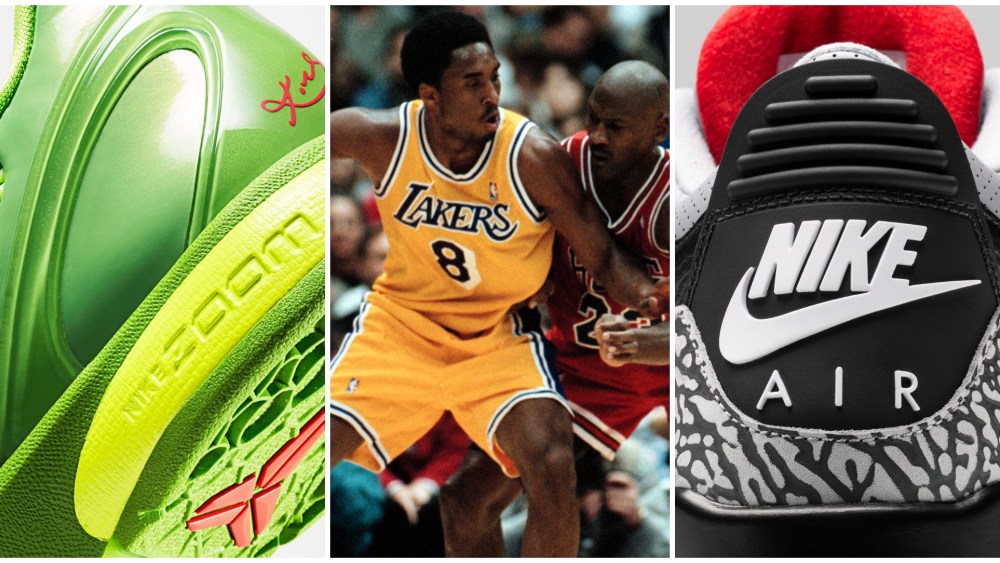
Without Michael Jordan’s industry-shaping Air Jordan line, many of the leading signature sneaker franchises we know today wouldn’t exist at all. This even includes the beloved sneakers of Kobe Bryant, a once peer of Jordan’s whose shoe line had yet to begin taking shape when their on-court careers briefly overlapped.
And now, more than four decades after Nike Inc.’s Air Jordans first hit retail, their status as leading on-court performance shoes has not only been challenged, but usurped.
You May Also Like
Aside from the latest Air Jordan legacy model, people just aren’t playing in Air Jordans the way they used to, particularly when it comes to the brand’s retro footwear. Next time a game is on, scan the court for sights of an Air Jordan 3, Air Jordan 6 or Air Jordan 12 and unless it’s P.J. Tucker pulling out a rare relic, it’s unlikely that you’ll catch a glimpse of the retro models.
Meanwhile, a clear on-court favorite has emerged amongst NBA, WNBA and collegiate players: Bryant’s Nike sneakers. But rather than wear the most recent entry into the Kobe line, 2018’s Kobe AD, star players such as Jalen Brunson — and prior to receiving their own signature lines, Caitlin Clark and Devin Booker — frequently lace up Bryant’s late 2000s and early 2010s sneakers, namely the Kobe 4, Kobe 5 and Kobe 6. This phenomenon can be traced back to February 2018, when Nike and Bryant introduced the Kobe Protro line.
Short for “performance retro,” Bryant envisioned a sneaker line that wouldn’t just reproduce his past designs, but upgrade them with Nike’s latest technologies, materials and manufacturing concepts to improve the shoe’s on-court capabilities. The idea, likened to restomodding a classic car, was to maintain the external look of the original models while subtly adding under-the-hood updates to make the shoes play even better on court.
“We’re doing as much innovation as we can on the inside rather than the outside and making sure that we’re offering that same aesthetic and fit that the consumer once had,” Bronson Yim, former lead product line manager of Kobe footwear at Nike, said in an explainer for the Protro concept.

Less than a decade into the Protro line’s lifespan, it’s safe to say the concept has been a massive success, perhaps even more so than the late Bryant himself could have envisioned.
Colendri, a website which specializes in basketball shoe data and ranks sneakers by total minutes worn on-court, has found a Nike Kobe Protro atop the NBA rankings each season since it began tracking in 2019-20. It’s a similar story for the WNBA, where Kobe Protros frequently land among the most-worn pairs. The data’s all-time numbers show the Kobe 6 as the most-worn pair, with more than 704 players wearing it for more than 400,000 on-court minutes. The Kobe 5 Protro comes in at number two with nearly half the total time, while the Kobe 4 Protro is the third most-worn sneaker across all leagues since 2019.
The Air Jordan line doesn’t show up until number 25 in the all-time on-court rankings, with just 48 players wearing 2024’s Air Jordan 39. The franchise is also seen at number 28 with the Air Jordan 36 but doesn’t appear again until the Air Jordan 35 at number 45. The line, which belongs to the near-unanimous greatest player of all time and is still widely considered to be the pinnacle of signature athletic footwear, has fallen out of favor with hoopers, and the data backs it up.
The main thing that propels Jordan Brand’s retro business is the unique look of its classic sneakers, many of which introduced industry-first designs. The elephant print and sleek shape of the Air Jordan 3. The reflective tongue and flame graphics seen on the Air Jordan 5. The Air Jordan 8’s chenille tongue and abstract patterns. The Air Jordan 11’s dressy patent leather mudguard.
It’s these elements that helped make the shoes iconic, but it’s also allowed designers to rest on their laurels for years without giving the shoes a runway for the modern consumer, one who’s far more comfort-minded than the sneaker buyer of the past.
This means that when you buy an Air Jordan 3, which originally came out in 1988, you’re getting more or less the same tech and engineering that was found in athletic footwear in the late ‘80s. And in many cases, the brand’s modern reissues are actually downgraded with less cushioning and lower quality materials as cost-cutting measures. Since the shoes predominantly target casual consumers and are not intended for serious on-court use, it’s an area the company has been willing to compromise on. What if it could all be turned around by borrowing the same ideology that has made the Kobe line such a hit?

Chris Chase, owner and founder of the performance footwear review outlet WearTesters, told Footwear News that while the Air Jordan line features many timeless designs, it’s being overshadowed by modern shoes that offer more comfort. Chase says today’s basketball consumer is willing to overlook a sneaker’s looks in favor of something that doesn’t feel heavy or restrictive on the court.
“Getting the Jordan Brand and Jumpman logo back on the hardwood with the younger generation could help bring the brand back to prominence in a place where it makes the most sense,” Chris Chase, owner and founder of the performance footwear review outlet WearTesters, tells Footwear News. “The new game shoes and signature models do not resonate with the current generation in the same way the annual Air Jordan did with ’80s and ’90s kids. Without Jordan wearing the products it’s unfortunately turned the ‘performance brand of excellence’ into a lifestyle brand that can’t keep up with the ‘comfort is king’ era of streetwear.”

The idea of upgrading Air Jordans isn’t a totally novel one. Jordan Brand has in the past experimented with adding new technologies to some of its classic sneakers including 2010’s Air Jordan 1 Alpha and 2011’s Air Jordan 8.0. However, while they featured modern upgrades, both of those models also included considerable design changes from their original inspirations. The shoes were too different compared to the originals and thus were all but ignored by everyday casual shoppers — another demographic who Chase theorizes would accept the Protro updates.
Marvin Barias, a longtime sneaker collector who specializes in Air Jordans, told FN that he thinks consumers would be more willing to pay higher retail prices if the sneakers received performance upgrades that justified the cost.
“The concept of Protro to the Jordan line would benefit a great deal,” Marvin Barias, a longtime sneaker collector who specializes in Air Jordans, tells FN. “We’d be able to see a lot more Jordan retros being worn on court instead of the flagship or player signed exclusives. Sales are hurting for Jordan at the moment and part of the reason I feel is that they aren’t up to par with their high retail prices. Many would rather wait for sales. Honestly, with as much as these retail prices are, we should be getting product that matches performance in today’s game.”

There are, of course, plausible reasons that Jordan Brand hasn’t — and may not ever — fully embrace the Protro vision. Between research and development, design and the cost of raw materials, the process could end being a costly one for Nike Inc.
Chase says that during a call with a former Jordan Brand manager in the 2010s, he pitched the idea of updating older Jordan models but was told the brand wouldn’t go through with it because it would diminish its aura.
He said he was told that keeping the products to as close to the same specifications as those worn by Jordan was the best way to maintain the brand’s legacy. And while he disagrees, he does admit that forcing buyers to choose between the latest flagship model, like the Air Jordan 41, and an upgraded classic such as an Air Jordan 4 Protro, would put the brand and consumer in a “tough spot.”
“We’re always looking to build on things that we’ve done in the past and try to improve them,” Bryant said of the Protro concept upon its 2018 announcement.
Four decades into the Air Jordan line, now could be an opportune time for Jordan Brand to borrow from Bryant’s Nike line and re-cement its own legacy.