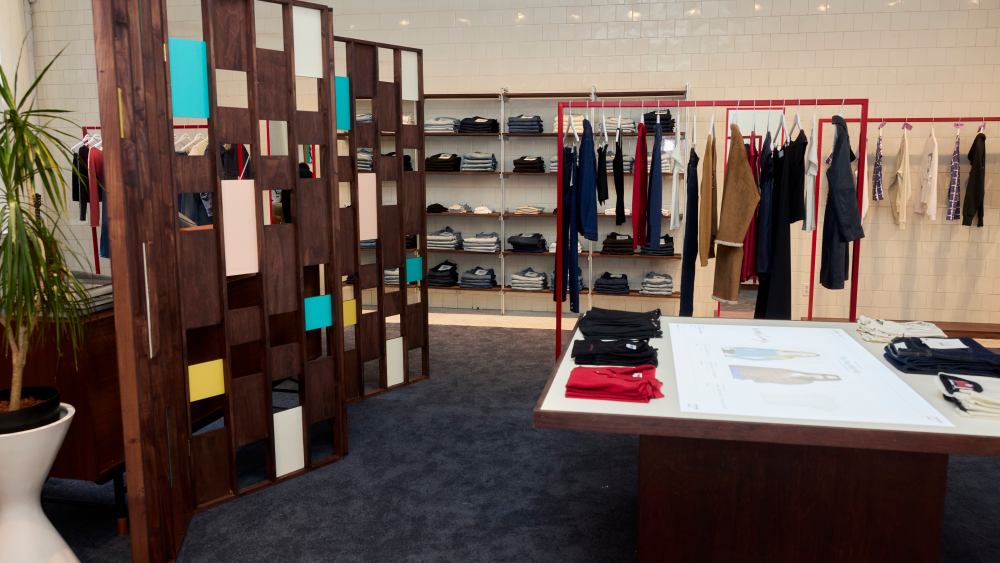
A vintage piece of furniture sits in the corner of Re/Done’s first retail space in SoHo, New York. At first glance, it’s a table with a warm reddish-brown tone, almost like mahogany. But in this particular store, it also doubles as a checkout counter, except there is no cash register or any handheld RFID scanner.
A shopper simply places the garments on the table, and the system detects the items—even if they are folded on top of each other—and adds them to the shopper’s mobile cart.
This is made possible by a RFID scanner subtly installed beneath the furniture. Meanwhile, large RFID readers on the ceiling blend into the white décor. Together, the scanners map out every product in the store in real time.
These installations reflect the theme for the entire store: it’s nostalgic, evoking old-world New York, yet modern with AI-powered scanners hidden behind the analogue. They also mirror what Re/Done does best: finding new purpose for vintage denim.
“I had seen locations all around, and there was nothing that sort of evoked the character and the nostalgia of SoHo and the era of New York that really spoke to the artist community that I felt was an interesting parallel for us as a fashion brand,” Phillip Prado, CEO of Re/Done, told Sourcing Journal after a tour of the store. “This idea of taking something old and making it new again—I felt like this space allowed us to really do that.”
Shoppers who come to the store at 475 Broome Street will find themselves in a so-called retail innovation lab co-developed with N4XT, a global experiential media platform, and enterprise tech firm SAP. It will run from Sept. 11-30, offering Kaia Volume 1, Re/Done’s first fashion collection with investor and model Kaia Gerber before its global release.
It’s an experiment that turns physical retail into a valuable source of real-time data, which allows Re/Done to better understand why customers gravitate toward certain items more than others.
“It’s all about data,” Andre Bechtold, SAP’s industries and experiences president and chief revenue officer for industry AI, told Sourcing Journal. “In past times, you had a lot of information from digital channels like commerce, so you know your buyers and you know your customers. But the store has very often been disconnected.”
In traditional spaces, data is captured at the point of sale. However, Bechtold said more information can be traced, from the real-time location of a specific garment to the sizes and variants customers ask for in the fitting room. While SAP provides the software, Bechtold said the RFID readers were supplied by Spain-based Keonn Technologies.
Despite the extra layer of technology in the space, Bechtold said shopping is still ultimately a personal experience, which is why it will still need sales associates to ground the interaction.
“AI, from my perspective, can support in [giving] recommendations. It can support in helping you style yourself, but still I think the personal connection—what someone in the store does—is part of the overall customer experience,” he said.
Among its features, the lab will also have AI-enabled styling, wherein shoppers can see themselves in an interactive mirror for a virtual try-on experience. Two out of three fitting rooms will also have a small screen that identifies the garments and can be used to request an associate for other available sizes or other relevant items.
This is part of an ongoing collaboration between N4XT and SAP, wherein they explore how enterprise technology can be integrated and experienced by customers in retail stores. Previously, they partnered with Public School New York, when the independent fashion brand returned to the fashion scene after a seven-year absence.
“At the core of what we believe in is that we really want to build a business and a platform that helps and supports emerging independent designers and brands by leveraging the access and the network that we have available to us,” Imad Izemrane, founder and CEO of N4XT, told Sourcing Journal. “Re/Done is a perfect example. Re/Done would have never connected with SAP and thought of ‘let’s create a store like this together.’”
Prado, who has been heading Re/Done since being appointed last year, said the experience of its SoHo store will inform whether this technology can be replicated elsewhere for the Los Angeles-based denim brand, which currently has nine stores in the U.S., France, and South Korea.
“Is it right for what we’re doing? That’s the starting point,” he said. “And if it is, if the learning allows us, and I know they will because I’ve seen what it’s able to provide, we would continue for sure, wanting to build on the tech stack that we’ve already started here.”