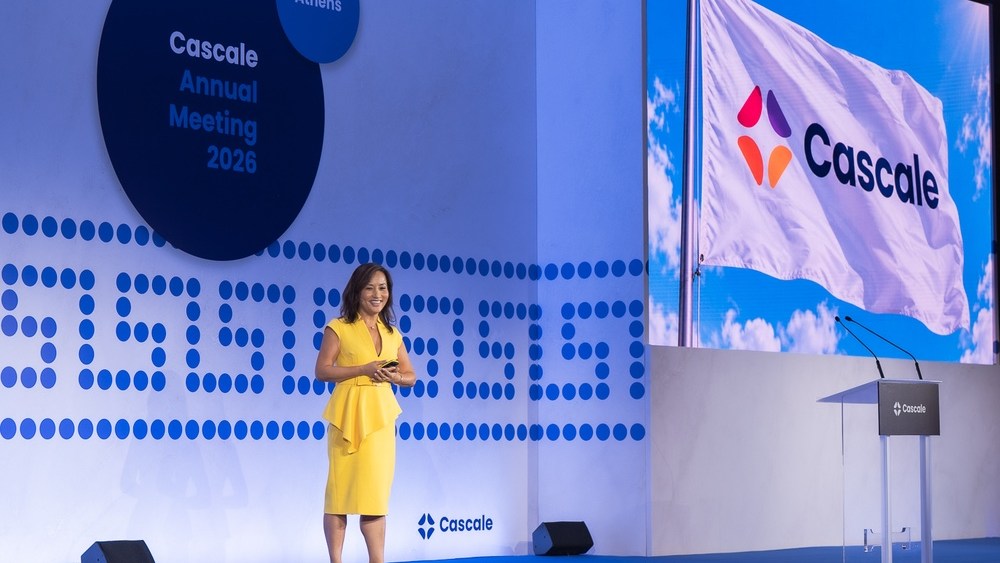
Cascale opened its annual meeting in Athens on Tuesday with a pointed set of questions: Who pays, who profits and what changes?
The focus is no longer on whether transformation happens, said Isabelle Kumar, the former journalist and news anchor facilitating the event, but on how responsibility is shared, investment is aligned and value is created across the supply chain. These are the issues, she said, that the conference will return to throughout its three days.
When Ying McGuire joined the convening organization formerly known as the Sustainable Apparel Coalition as CEO in June, she, too, had questions. Speaking to 150 of the organization’s brand, retailer, manufacturer and trade group members during the first 90 days of her tenure, she wanted to know what was working, what was getting in the way and what they would change if they had a magic wand.
There was no mistaking the answers she received, she said during her opening address. While those she spoke to valued Cascale’s ability to draw together a community that spans the entire consumer goods value chain, along with the shared sustainability-measurement tools powered by Worldly, they were equally clear on what wasn’t working: too much fragmentation, too many siloed initiatives and too much data without enough action to back it up.
“Manufacturers told me, ‘Don’t just measure us; treat us like partners,’” McGuire said. “And the brands and retailers told me, ‘Not only give us the data we can trust, but also help us act on it together. Give us a definitive strategy and a clear value proposition.’”
To tackle those concerns, Cascale will query its audience frequently during what Kumar described as a “highly interactive” event. Beyond the usual polls and word clouds that will serve as live talking points—even leading entire sessions—the conference will host open-seat debates on issues such as what fair cost sharing for decarbonization looks like. It will also run so-called “human libraries,” where experts will respond directly to questions, and workshops based on the Chatham House Rule to encourage candid discussion. Other hot topics include “Decent Work in an Indecent Climate,” “Building an Aligned Industry Response to Heat Stress” and “Responsible Purchasing Under Pressure: What Changes in a Crisis.”
“If we were to rewind five years, these would be sessions that would be unthinkable,” Jeremy Lardeau, senior vice president of industry activation and growth—formerly in charge of the Higg Index—said in the closing reflection. “So I think we’ve made a lot of progress in these conferences and the Cascale approach to collective action.”
But possibly, at the same time, not enough. McGuire, recalling her listening tour, said she was struck by something a member told her.
“He said, ‘Ying, Cascale needs to hold up a very big flag, so the industry knows where we’re going. But there’s no flag. I cannot see the flag,’” she said. “I thought about it a lot because the answer cannot be for me to walk on the stage with a big flag and tell 300 organizations to follow me. The flag has to be carried by everyone in the system, especially now when navigating tariffs, war, inflation, cost pressures, political headwinds and a very different view of sustainability, depending on where you sit in this environment.”
One way to raise the flag, McGuire said, is to update the systems map that Marshall Clemens and Alexandra Kanitz, co-founders of the strategic consultancy Nexial, originally drafted in 2014 to delineate the apparel ecosystem’s levers for systemic change. McGuire rediscovered the original diagram during a visit to founding chair Rick Ridgeway’s California tortoise sanctuary. The diagram laid out two distinct operational loops: Circle A, focused on tool-building, metrics and data infrastructure—which eventually spun off into Worldly—and Circle B, the broader ecosystem of strategy, policy, capital flow, leadership and collective action that is now associated with Cascale.
“We spent 15 years mostly on A, and we took our eye off B,” McGuire told the audience. Yet the flag, she said, was “literally B.”
Clements and Kanitz, brought by Cascale to Athens, will be redrawing the systems map live with conference participants. Over two 70-minute workshops, the pair will walk attendees through 12 leverage points, including “data, standards and methodology,” “performance standards,” “consumer choice and consumer models” and “government, policy and enforcement,” pressure-testing where incentives align, where business models clash and where corporate strategy breaks down against planetary limits.
Feedback gathered across the sessions—along with notes tacked onto a giant physical rendering of the map in the foyer—will be synthesized in real time to inform Cascale’s Vision 2030 strategy and shape its 2027 organizational priorities.
“When we originally did this, we were focused on building out the tools and filling out the data,” Clements said. “The question now, as we have the chance to step back and revisit this original map and see where we go from here, is how we make use of that data. Because data was never the point. Your vision was not to create a great data tool; your vision was to create a sustainably operating value chain, and the data was just a tool. So now we’ve got the tool, we’ve got plenty of data. What do we do with it? What is ‘data plus’?”
Worldly’s upcoming platform evolution could offer an early answer. The software is rolling out changes designed to transition from a passive measurement tool into an active decision-making engine—deploying integrated AI tools across the platform to automate data verification, for example, and turning raw metrics into compliance-ready documentation. It will also integrate the chemical management system BHive following its acquisition of GoBlu, allowing suppliers to scan chemical labels directly on the factory floor and instantly map compliance against ZDHC standards.
But Cascale’s broader vision is still a work in progress, and the opening questions of equitable responsibility, shared value, and industry-wide change require far more than technology to answer. It is perhaps fitting then that the meeting is in Athens, where McGuire noted people have gathered for centuries to debate ideas and define what comes next.
“Athens is not where I unveil Cascale’s next strategy,” said McGuire. “Athens is where we start drawing it together. I want you to look at it in December and say: I can see my fingerprints on it. Because Cascale does not belong to the CEO. It belongs to this community.”