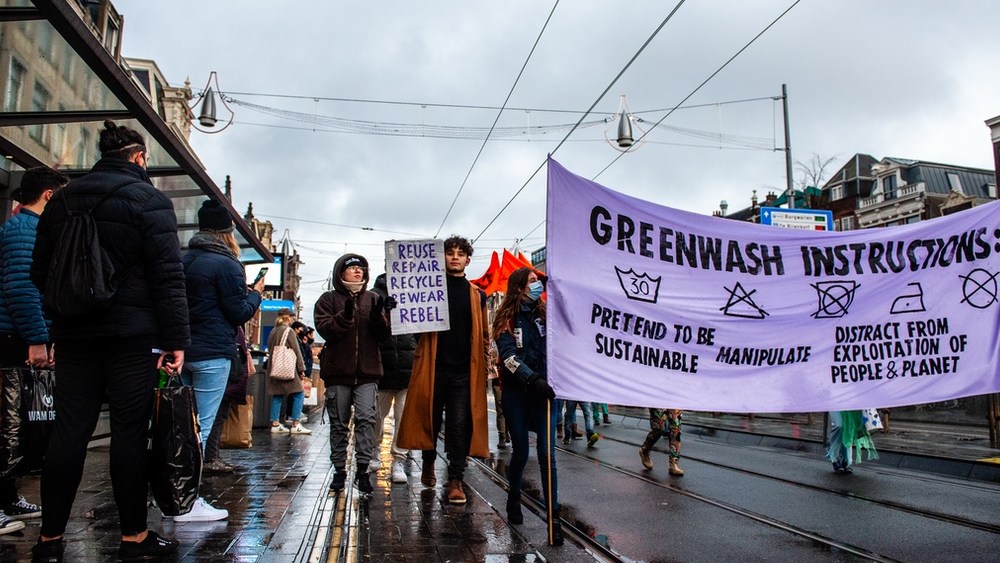
When the European Commission abruptly withdrew a proposed law targeting nebulous or unfounded corporate sustainability claims in 2025, saying it ran counter to the executive arm’s “simplification agenda,” environmental advocates feared it would open the floodgates to unchecked greenwashing. Their concerns, it seems, might have been premature.
On Sunday, the Empowering Consumers for the Green Transition Directive takes effect across the European Union, restricting vague assertions such as “eco-friendly” and “sustainable,” cracking down on climate claims based on carbon-offsetting schemes and reining in public and private sustainability logos that amount to self-certification.
EmpCo, as the directive is also known, falls short of the Green Claims Directive’s full scope. It lacks the mandatory third-party verification and pre-approval process intended to prevent greenwashing before marketing statements reach consumers, for instance. Nor does it prescribe a standardized life-cycle assessment or other specific scientific methodology for companies to validate their environmental claims and make apples-to-apples comparisons.
By updating the Unfair Commercial Practices Directive to blacklist specific misleading marketing tactics, however, EmpCo could lighten the load for watchdog groups by rendering once-routine declarations off-limits. These include statements about recycled-material use that Nusa Urbancic, CEO of the Changing Markets Foundation, says fashion brands “love to use.”
“Our research showed that brands use these claims in misleading ways, for example claiming that the coat was made from recycled polyester, when in fact it was only the lining,” Urbancic said.
The reach of the new rules, which were greenlit in 2024, is also broader than it may initially appear. While EmpCo applies to business-to-consumer commercial practices, information shared in a B2B setting can still make its way to consumers, say through the upcoming Digital Product Passport, said Anouschka Jansen, director of sustainability solutions at QIMA, a global provider of supply chain compliance, quality control and risk management services.
With a recent EU testing campaign finding inaccurate fiber-composition labels on 37 percent of clothing items sold in European markets, the need to close any information gaps couldn’t be clearer, she added.
EmpCo also applies an objective standard under which any message an “average consumer” would interpret as a green claim is treated as one. The standard extends to brand names and associated visuals.
“If it gives the impression that you’re a green brand or your product is green, any hint of that might be construed as a generic green claim, which is no longer allowed,” she said. “Therefore, you must make a specific claim that can be substantiated with data, clarifying exactly what part of your product the claim is for.”
One case in point arose in 2021 when the French advertising watchdog, the Jury de Déontologie Publicitaire, ruled that an Adidas ad claiming its Stan Smith sneaker was “100% iconic, 50% recycled” gave consumers the impression that half the shoe was made from recycled material when only its upper contained recycled content.
In 2022, Decathlon and H&M retired their respective “Ecodesign” and “Conscious” designations after the Netherlands Authority for Consumers and Markets warned that such ill-defined categories could mislead consumers into believing the products were better for the environment than they actually were.
More recently, the United Kingdom’s Advertising Standards Authority banned paid-for Google ads from Adidas, Calvin Klein and Uniqlo that promoted “recycled” and “organic” shoes and clothing after the brands failed to substantiate the claims or demonstrate that consumers would not be misled.
“You can’t make generic claims like ‘it’s better than’ or ‘it’s more sustainable’ anymore,” Jansen said. “You have to say exactly what it is.”
Silence isn’t golden
It’s for these reasons that the directive could also accelerate greenhushing, the opposing practice in which brands dial back sustainability communications to avoid scrutiny, said Ruth MacGilp, senior climate campaigner at the nonprofit Action Speaks Louder.
“The landscape of sustainability claims from brands has already become significantly quieter,” she said. “We’re seeing fewer consumer-facing messages, and there’s been a pullback in the level of detail in impact reports and the level of ambition in climate commitments.”
This isn’t necessarily a bad outcome if it means fewer inaccurate and misleading claims—or targets with no plan to achieve them—MacGilp said. Ultimately, she added, “we only want to see real, measurable action being talked about publicly, not meaningless promises.”
What MacGilp finds more troubling is the prospect of brands becoming reluctant to publicize credible sustainability efforts—such as investments in supply-chain decarbonization or hard data on energy use and emissions—because they’re wary of regulatory scrutiny.
“Public disclosure is crucial for civil society to identify areas for intervention, uplift positive case studies and hold brands accountable,” she said. “At this pivotal moment for the climate and human rights, we need more transparency, not less.”
Clear rules can help achieve that by leveling the playing field between sustainability leaders and laggards, MacGilp said.
“What matters now is whether brands choose to use them to enhance the integrity of their sustainability strategies with clear evidence, or further avoid accountability by staying quiet,” she said.
The Ecodesign for Sustainable Products Regulation, or ESPR, could be the next major test of how far the EU is prepared to push product-level sustainability rules, said Urbancic. Unlike EmpCo, which governs what companies can say to consumers, the ESPR could shape the eco-modulated fees they pay for products placed on the market.
“We are also watching this law closely and advocating for robust rules for microplastic pollution,” she said. “But this will only become clear next year, as the Commission is working on implementing measures.”
Still, reticence over green claims isn’t the solution, Jansen said, because it doesn’t stop the public, media or consumers from talking about a product. With the sheer volume of corporate data available today, companies are more visible than ever.
“Not saying something about a claim is not necessarily removing the risk; it’s just diverting it a bit because there is so much information out there on your company,” she said. “Someone is going to say a product is green, and that’s going to be picked up, so you have to be really careful. There are groups out there looking at lobbying activities. They are going to look at inconsistencies between what companies say about their targets and intentions on sustainable products versus what they lobby for.”
The speed at which artificial intelligence can scan online information to flag inconsistencies or problematic claims presents another point of exposure. At the same time, Jansen said, companies can use AI to audit their own communications and identify material that should be revised or removed, so it “works both ways.”
Jansen’s advice? Comb through everything. After identifying and removing potentially problematic language, companies should look to established certification systems or labels that regulators are likely to recognize, such as Germany’s Blue Angel or the EU Ecolabel.
“It’s important that companies aren’t too scared of claims,” she said. “Just make sure you prepare well. Look for claims you know will be accepted because the whole substantiation aspect is part of how the system works.”