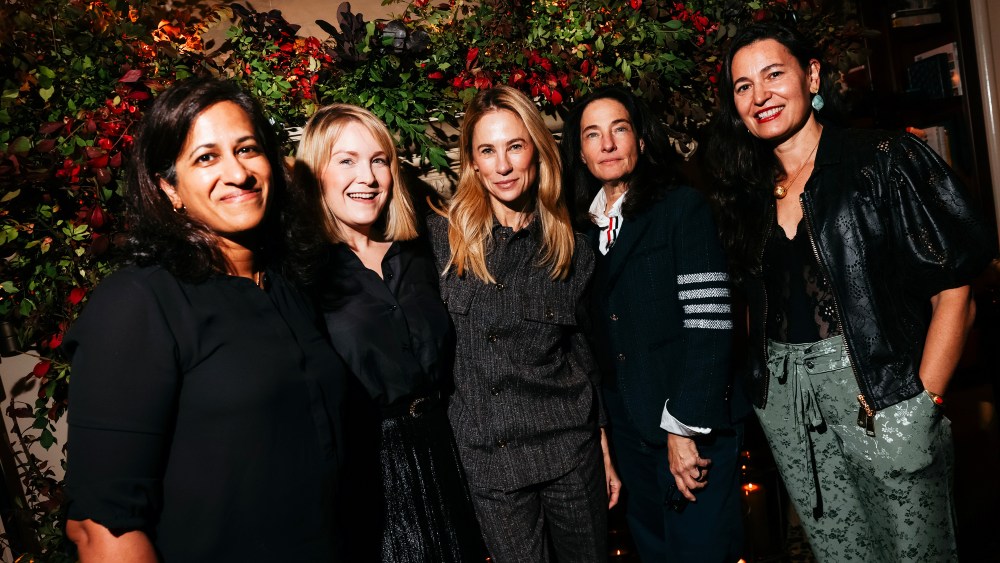
Chanel hosted a cozy cocktail hour at The Twenty Two New York on Thursday for the launch of their new Originators program with The Women’s Prize Trust to support emerging female writers. The program is part of Chanel’s growing constellation of arts and culture initiatives championing original voices. It will be an annual prize providing mentorship and grants to five unpublished female novelists in the U.S. working on their first manuscripts.
The evening commenced with cocktails and hors d’oeuvres as literary and fashion insiders arrived at the private members club. Guests were surrounded by copious stacks of books lining the candlelit and floral-adorned tables with titles including favorites from this year’s prize judges Tayari Jones’ bestseller “Kin” and A.M. Homes’ international bestseller and winner of the 2013 Women’s Prize for Fiction, “May We Be Forgiven.”
Judges for the inaugural cohort are V.V. Ganeshananthan, A.M. Homes, Tayari Jones, Nicole Krauss and Virginia Evans, who will also serve as mentors to the selected writers.
You May Also Like
Homes, Ganeshananthan and Kraus were in attendance, beginning the night seated together at a booth with cocktails to complement their literary musings. Reflecting on their early experiences, the trio discussed what it felt like when they were burgeoning writers coming into themselves and their crafts.
“I was very young, and I didn’t know I was writing a novel, which honestly was a great way to start, because then it was a mystery,” Ganeshananthan said. “And the adventurousness and freedom of that was really fun.”
“It was an escape. Writing [and] reading was an escape for me. It was a way of traveling to places and to a life that I had no other way to get to. So it was very liberating. And I wanted to hold on to that,” Krauss added.
“When I started to write a novel, it was because basically I felt that I had lost that sense of freedom. So just like, ‘how can I blow this open even wider?’” Krauss continued. “I don’t think I was thinking about being a writer amongst other writers yet or what the book would sound like or what people would think about it. I was just really pursuing this very strong desire, the sense of escape, of trying to reach another life. That wasn’t the life that I had.”
For Homes, her pursuit of other worlds began through phone books and letters to strangers.
“I actually dropped out of 10th grade to write a book of poems, or maybe I dropped out of 10th grade and wrote a book of poems. And I also developed a strange habit during that time of writing letters to strangers,” she said. “I really was trying to write my way out of my parents’ house and kind of make contact with this larger world.”
Though their journeys have each been unique, one conviction that they mutually are committed to is a desire to do justice to the craft and the responsibility held by women who dedicate their lives to their pen.
“The gravity of this vocation is really, really big. It’s not light. It really is a serious undertaking to be a writer,” said Krauss.
A key component of the Originators is mentorship between the judges and cohort. As they look toward next year, the trio are eager to continue the duty of mentorship that has helped shepherd them to where they are in their careers now.
“It is that thing where some other writer or person sees you and thinks, ‘follow me, kid.’ Like, you know, I’ll take you to the movies or whatever. So it’s special,” Homes said. “They’re also our invisible mentors. There are people whose work has that impact on you, inspires you, and shows you you can do something that you didn’t think possible, even if you never meet them. So it’s both for me, it’s both.”
“To show you that you’re part of a tradition — to make a mysterious world more navigable. I think that the metaphor of a map is kind of perfect, because otherwise, it can all seem really strange and confusing,” Ganeshananthan said. “So it’s important to have someone help you find your way, and say that ‘this is possible for you.’”