
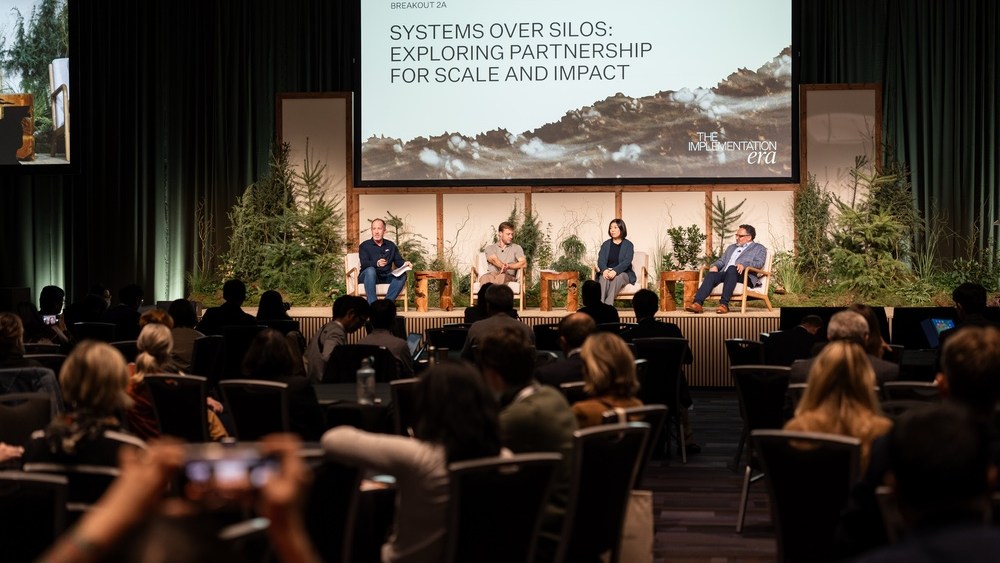
When Daren Abney, senior director of materials engagement at Textile Exchange, learned he would be moderating a panel about partnerships at the sustainability nonprofit’s annual meeting in Vancouver earlier this month, he barely suppressed a groan.
“We all know that partnerships are important,” he said at a session called, naturally, “Exploring Partnership for Scale and Impact.” “But I thought if we have to talk about partnerships in the same way, I might be ill.”
If there’s one thing the fashion industry can agree on, it’s that isolated corporate projects will not deliver its climate, nature and circularity goals. Reaching scale, experts say, requires shifting from “brand-to-land” silos to collective “brandscape-to-landscape” partnerships that give producers the financial support, shared infrastructure and long-term commitments they need to change how they operate—not more platitudes about collaboration.
But this is easier said than done. Systemic change requires systemic action, yet misaligned economic incentives, competing data demands and incompatible timelines routinely bog down implementation. The industry’s own production figures reveal the gap between ambition and action: While global fiber output hit a record 139 million metric tons in 2025, according to Textile Exchange’s latest materials market report, only 20 percent came from preferred production systems.
Emissions are moving in the wrong direction, too, rising 7.5 percent in 2023 and another 6.3 percent in 2024, according to the Apparel Impact Institute, which attributed the increases to growing fiber use, particularly of virgin synthetics like polyester.
“We know that as an industry, we are called to do more,” Abney said. “The goal is not partnership for the sake of partnership; the goal is impact.”
The stakes have become impossible to ignore. As Gail Whiteman, Hoffmann Impact Professor for Accelerating Action on Nature and Climate at the University of Exeter and founder of Arctic Basecamp, pointed out in the opening plenary, seven of the nine planetary boundaries that define a “safe operating space” for humanity have now exceeded safe thresholds, threatening to destabilize the Earth’s life-support systems. With climate-related disasters increasing in both frequency and severity, plus a “Super” El Niño cycle expected to drive already scorching temperatures to new heights, businesses will face a growing risk of disruption.
“Extreme weather is the No. 1 global risk in the long term, according to the World Economic Forum’s annual report,” Whiteman said. “But if you take a look at businesses and supply chains, extreme heat is the No. 1 climate risk for business. Very few of them have effective adaptation plans for their businesses and supply chains.”
Fittingly then, that the conference’s theme was “The Implementation Era.”
A few examples have stood out for showing what collaboration can achieve in practice. It was at a Textile Exchange confab a decade ago, in fact, that the Organic Cotton Accelerator took shape after multiple buyers realized they were facing the same issues securing enough genuinely organic cotton. One overarching problem, said Bart Vollaard, OCA’s executive director, was that even though companies were paying a premium for the fiber, almost none was reaching producers.
“Knowing that all the risk of transitioning to organic sits with those farmers, it was no surprise supply wasn’t growing,” he said. “There needed to be a business case for producers to transition to a regenerative organic system, yet those two parts of the supply chain weren’t connected. There was no structural investment in the support required for farmers to transition successfully—the technical assistance and the knowledge.”
OCA built a “collective space,” essentially shared infrastructure, to align brands, retailers, producer groups and suppliers around a single transparent program that invested in technical assistance and gave farmers their due.
“In return, brands didn’t just get organic cotton with greater confidence and transparency; they also got outcome-level data on how this was improving the business case for organic farming—proving whether we were helping farmers be better off while asking them to transition,” Vollaard said.
Ten years later, the organization has supported more than 100,000 smallholder farmers, with close to 15 million euros ($16 million) in direct premium payouts between 2021 and 2024 alone.
Toray Industries also faced a disconnection problem, said Gyobun Oh, the performance fiber manufacturer’s senior manager of textile business planning and promotion. As its products wended through the different production tiers, from spinning to weaving to dyeing, the supporting certification and traceability data didn’t necessarily travel with them. Drawing on the Japanese concept of sanchi—manufacturing clusters where different companies pool their strengths—Toray partnered downstream with Uniqlo and upstream with regional manufacturers to establish the Textile Data Ecosystem Project, a shared, pre-competitive digital infrastructure that linked data across tiers.
“In the manufacturing supply chain, we have partners and we have competitors,” Oh said. “But we saw the need to build a common foundation, even together with competitors. It doesn’t make competition disappear, but it allows us to save resources and put those resources where they matter most for actual competition. That creates a win-win relationship for every player in the industry.”
Making collaboration count
That same logic is also driving interest in sourcing pools—by no means a novel concept but one that has been discussed more in the abstract than put into practice. By aggregating demand into one streamlined offtake framework, sourcing pools can help farmers de-risk their investments, allow innovators to break out of the “chicken or the egg” deadlock and enable brands and retailers to secure volumes of preferred and next-gen materials closer to cost parity with conventional alternatives.
It’s why Australian biotech company Samsara Eco created the Nylon Materials Collective with the European Outdoor Group, later expanding it with the Outdoor Industry Association to include more companies. Circ and Re&Up’s textile-to-textile recycled “fiber clubs,” developed under a shared Fashion for Good framework, follow a similar model that turns individual commitments into a combined market signal.
“Together it allowed us to remove a lot of those sort of logistical and commercial barriers,” said Terri MacDonald Riedle, Samsara Eco’s head of partnerships in North America. “You can pool minimum order quantities. We can produce the polymer, and then we bring in the spinner and the fabric maker and whatnot.”
The recognition that progress can only be achieved collectively undergirds Textile Exchange’s recently released aggregate targets: shared, industry-level goals for 2030 and 2035 that measure the combined progress of brands and retailers in its Action Cohort, a commitment-based pathway for companies that directly source or produce raw materials and fibers.
Beginning in 2027, members must annually report material sourcing volumes through the Textile Exchange Materials Benchmark. They must also set company-level targets for the percentage of materials sourced through standards, certifications or programs that verify preferred production practices, with those targets covering key materials—including cotton, wool, polyester and man-made cellulosic fibers—that collectively account for at least 80 percent of each member’s portfolio.
The idea is to establish shared ambition and accountability while allowing companies to set targets suited to their sourcing contexts, Luca Mosca, Textile Exchange’s director of impact data and reporting, said at a panel titled “Targets That Work Together.” Ultimately, he said, the organization wants to “accelerate the adoption of verified and certified practices at Tier 4,” meaning the raw material stage.
Kelly Gupta, director of sustainable product and packaging at PVH Corp., said that because raw materials and packaging make up 29 percent of the emissions covered by the Calvin Klein owner’s Science Based Targets initiative-approved Scope 3 reduction target, “we are not going to hit our 2030 target unless we’re able to source more environmentally preferred materials.”
Gupta said she understands how difficult it is for companies to “find that fine balance” between being ambitious and being credible, particularly with legislation bearing down from the European Union that requires them to have evidence for what they claim. Engaging with their Tier 4 suppliers and refining their approaches together can help companies get there, she said.
“PVH alone can’t change the preferred fiber system, and no single company can,” Gupta added. “But if we all have signed on to these aggregate targets, we’re agreeing that we’re going to move in this direction. That sends a signal to the Tier 4s that it’s time; we’re ready. It’s time to start gearing up.”
Indeed, single-brand sourcing projects have reached their limit and can no longer deliver the necessary scale on their own, said Lindsay Humphreys, a sustainability and supply chain strategist formerly with BKB, the world’s largest Responsible Wool Standard broker. Collaboration among brands around shared interests—what she calls “brandscape to landscape”—establishes consistent expectations for farmers, rather than subjecting them to separate sets of metrics, certifications and audits.
H&M Group and BKB are taking such a landscape-level approach in South Africa’s Eastern Cape, where, instead of focusing on individual farms, the project spans the broader region’s Drakensberg Grasslands and Albany Thicket biomes. By pairing long-term impact targets—for soil health, biodiversity recovery and animal welfare—with flexibility in how they are achieved, Humphreys said, the partnership treats the agricultural landscape as a shared responsibility, not another compliance exercise.
“They were always very open to hearing us out when we contacted them and said, ‘We are seeing something on the landscape, and we think we need a different approach,’” she said of H&M Group. “As long as our outcomes were still the same, the approach could be pivoted on.”
Still, reconciling varied interests usually requires more than a willingness to change course.
At a plenary session on the conference’s final day, Brenna Atkinov, a senior consultant at Reos Partners, a firm that specializes in systems transformation, said that when dealing with deep, complex problems, it’s important to “bring together all perspectives, worldviews and existing conflicts” and allow people to talk through their differences and “build a shared understanding of the current reality.”
“We’re so often seen as the representative of our organizations, but we need to reconnect with each other as humans over why we do this work, so that we can build alignment—not consensus—on where we need to go and how to get there,” she said. “When people are willing to really flip the questions that they’re asking, expand what they’re willing to interrogate, and challenge the logic and the mental models that drive a system, that’s where the greatest breakthrough innovation comes from.”
For Vollaard, however, the harder question isn’t whether companies agree on where fashion needs to end up, but what each is prepared to contribute to get there.
“It’s easy to share a common vision,” he said. “It’s harder to get people to share the risk of this transition and to put investment on the table and to take accountability for their part of the solution.”


