
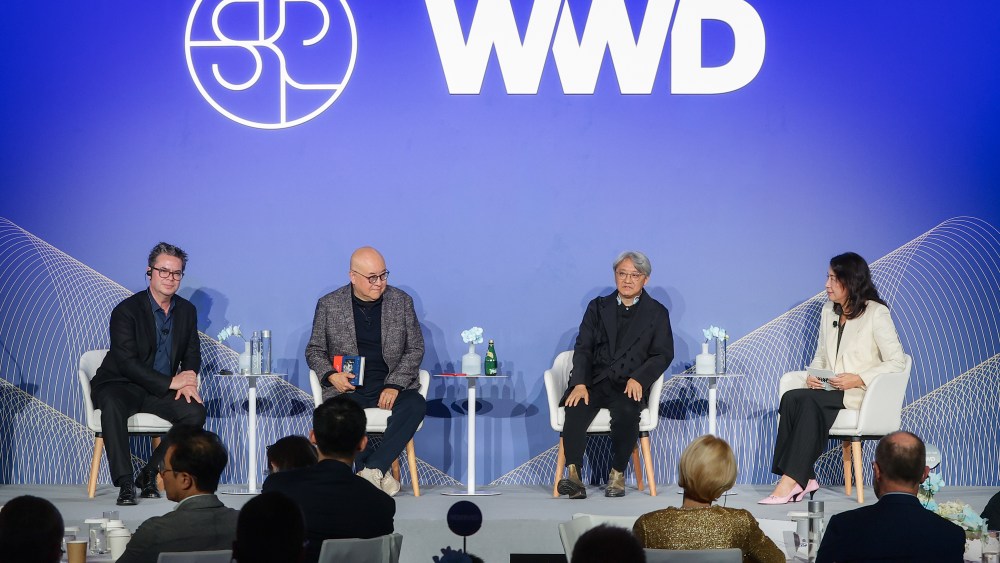
Creating a consistently personal luxury retail experience is the secret behind SKP‘s success, which also helped the luxury department store remain at the forefront of retail innovation. Most recently, the luxury department store has turned to the high-brow and high-impact art of opera for inspiration, and the result can be felt throughout the department store, which was devised by the London-based architecture firm Sybarite.
The symbiotic relationship between art, opera and fashion anchored a conversation between Torquil McIntosh, cofounder of Sybarite; Tian Hao Jiang, founder and artistic director of the iSing! Festival, and Wu Hongliang, president of Beijing Fine Art Academy and chief curator of Wuhan Biennale 2026.
Moderated by Kering‘s president of Greater China Cai Jinqing, the talk began with a discussion of SKP’s distinctive design language.
For McIntosh, that convergence of art, architecture and fashion has been part of SKP’s identity from the outset. His team began working with the retailer in 2012 to develop a visual language for its logo, then extended the visual language across retail surfaces, interiors and architecture.
The ambition was to create a coherent identity that could hold both heritage and a sense of the future.
“It initially was really a vision of Mr.Ji, to take a mall and really transform it into departments where all the brands sit very comfortably,” McIntosh said of the SKP founder Ji Xiao’an.
The vision, anchored by a sleek geometric shape, has continued as SKP expanded into other cities, each bringing a different design challenge. In Chengdu, the project involved an ambitious underground space; in Wuhan, China, the task was to work with an existing building. The common thread, McIntosh said, is that design can shape more than a store, it can create an environment with its own character.
For Tian, his encounter with SKP began with his autobiography, recounting his life as an opera singer at New York’s Metropolitan Opera, then around the world, and what eventually brought him to SKP Rendez-Vous, its in-house bookstore, which then led to an intimate meeting with Ji.
“Mr. Ji quickly developed an interest in opera through this book. Our conversations would touch on literature and opera, and of course, I would also share how Masa, my wife, and I feel about SKP,” Tian said.
“Everyone knows SKP for its luxury goods and high fashion, but what we noticed — especially Masa — was the attention to detail, the wall finishing, the color choice, the shape of the window, the spirit of SKP permeates every detail,” Tian added.
“Mr.Ji’s sensibility for literature is quite extraordinary, if you’re interested, you must talk to Mr. Ji about literature,” Tian added.
That personal friendship eventually brought Jiang’s iSing! opera festival to Wuhan. The festival has recruited more than 400 young artist from 38-plus countries since it was founded 15 years ago.
“I think opera can seem very distant from our everyday lives — in China, we have a term for that, ‘yangchun baixue,’ which refers to highbrow art that only appeals to a niche audience. But in reality, opera is all about human stories — the relationships between people, between humans and nature, and between individuals and the wider society. In that sense, fashion and opera shares the same vitality, one that can carry us forward into the future,” Tian said.
Wu Hongliang, president of Beijing Fine Art Academy and chief curator of Wuhan Biennale 2026, expressed the need to bring art closer to the local community via its programming.
“Our work is to connect, that’s why we chose ‘walk and talk’ as the slogan for Wuhan Biennale 2026, it’s about random meetings within the museum context or not, I would like to reference a Xu Zhimo poem to express that feeling, ‘You have your direction, and I have mine. Whether you remember or not, it is perhaps best to forget the light we shed upon each other when our paths crossed,’” Wu said.


