
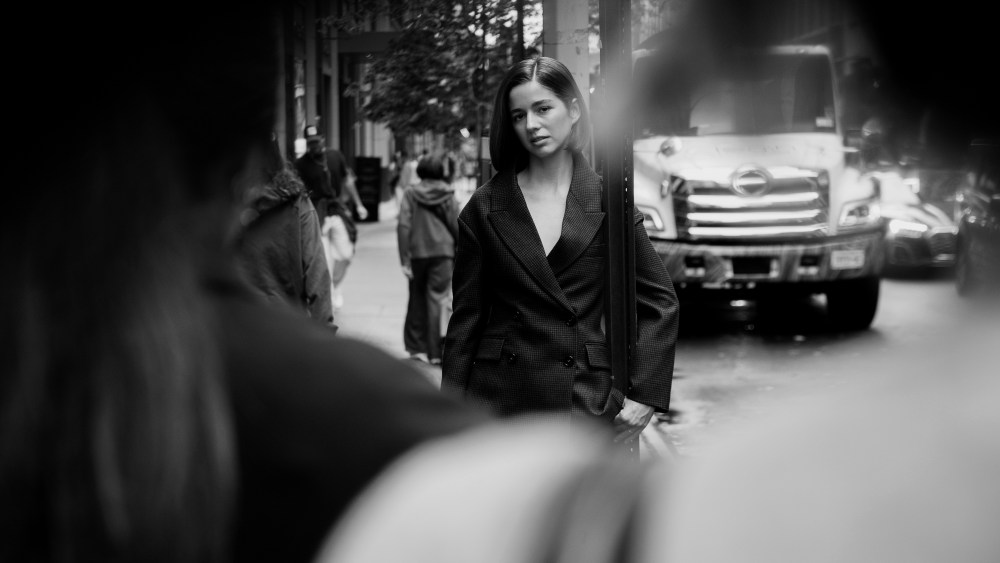
“I don’t know the scale in [terms of] Hollywood movies,” says Mariana di Girolamo, “but for me, this is a huge movie.”
It’s not just her: the movie, “Wild Horse Nine,” which is the Chilean actress’ English-language debut film, has been one of this year’s awards season front-runners since its premiere at the Venice Film Festival in September. Di Girolamo stars alongside Hollywood heavyweights John Malkovich, Sam Rockwell, Steve Buscemi and Parker Posey, and is directed by Oscar winner Martin McDonagh.
So, safe to say it’s a huge movie no matter your industry experience.
“Wild Horse Nine” follows two CIA agents, played by Malkovich and Rockwell, who are stationed in Santiago ahead of the Chilean coup d’état in 1973. They travel to Easter Island on what is billed as a vacation, where they encounter two young Chilean women, played by di Girolamo and the Argentine actress Ailín Salas.

Di Girolamo, who is 36, was working in Mexico when her team reached out to say that McDonagh was looking for a Chilean actress for his new movie.
“That doesn’t happen very often, so I was very excited and I prepared three scenes,” she says.
“I was shooting a Mexican series, and some of the cast helped me to prepare my scenes in English. I read the script and I felt like, ‘Wow, what is this? How is this possible? I’m laughing, I’m crying. I want to be part of this.’”
To prepare for her first role in English, di Girolamo worked so tirelessly at the lines that “I’ll know my scenes for the rest of my life,” she says. “That’s the only way that I know to perform. You have to know your lines and then maybe you can play. I knew that it was going to be very important to be on set with John, who I have a lot of scenes with, to look into his eyes and see what was going to happen there.”
Initial nerves about working with some of her industry idols were helped along when McDonagh suggested the cast do some rehearsal in a public theater.
“[He said] part of the decision to do that was to break the ice, especially for Ailín and I to work with these legends,” she says.

Born and raised in Santiago, di Girolamo initially wanted to pursue being a therapist, then a nurse — “something related to biology or public service.” She even spent a year and a half studying to be a midwife, and while in the program took a theater course for fun.
“I felt alive,” she says. “I fell in love with the process of putting a play on the stage, and especially with a live performance, what happens with an audience and what happens inside you, those nerves, that excitement.”
Perhaps she should’ve seen it coming — her aunt, Claudia di Girolamo, is one of Chile’s most prominent actresses, and the arts are elsewhere in her family. Her grandfather was a painter and also founded a theater in Chile.
“I grew up with all of those colors, inspirations, textures, creativity in my own house and in my grandfather’s parents’ house,” she says. “I tried to have another life, but no.”
She was of course familiar with the history the film explores, but McDonagh’s script offered “a whole different perspective on what happened in Chile in 1973.”
“It’s so rich. It’s so complex. It’s so funny, sad,” she says of the film. “It’s about friendship and loyalty and regret and maybe forgiveness, redemption, but the political context is so strong, especially for us. I’ve never read something about that period of our history that is so unique.”


