
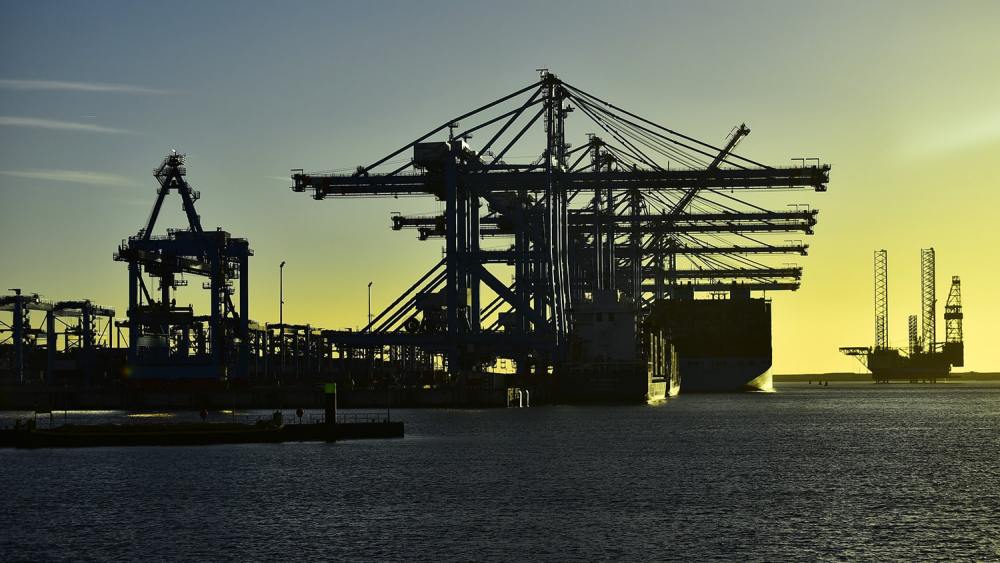
Container shipping’s return to the Suez Canal could crowd the ports along the Asia-Europe trade lane, as three services add the same Red Sea port in the same week and shorter Suez voyages start arriving in northern Europe alongside ships that still sail around the Cape of Good Hope.
According to Flexport, 131 percent of normal ocean freight capacity is set to arrive at northern European ports in the week of Nov. 16-22, with 40 percent of that capacity arriving via the Suez Canal.
Flexport treats anything above 120 percent as a congestion risk, said Jannik Amstutz, the company’s senior manager of ocean freight, in a Tuesday webinar. The digital freight forwarder forecasts capacity to exceed 120 percent in three out of the next 11 weeks through January.
Some major ports in northern Europe are outpacing the average, including the two busiest on the continent. The Port of Rotterdam is seeing 145 percent of its normal capacity during the week, Flexport says, while the Port of Antwerp-Bruges should expect 151 percent. Other ports exceeding 150 percent normal capacity include the U.K.’s London Gateway and Port of Felixstowe, Bremerhaven in Germany and Le Havre in France.
Amstutz recommended shippers to communication with intermodal partners and warehouses as the volumes flowing into their destinations may increase on short notice due to vessels on the same strings arriving in north Europe at the same time.
Amstutz said 31 container ships are arriving via the Suez Canal alongside 61 still using the Cape of Good Hope, with Suez cutting transit by roughly seven to ten days.
“Stay very close to the Suez arrivals,” Amstutz said. “It is definitely going to put more pressure on the congestion in north Europe.”
According to Flexport, 350,000 20-foot equivalent units (TEUs) of weekly capacity are expected to be deployed on the Asia-Northern Europe trade lane in October and November, a record for the route. From weeks 44 to 48, or Oct. 26 to Nov. 29, 9 percent of capacity on the trade lane was blanked, compared to 6.2 percent on Asia-Mediterranean voyages. Amstutz also pointed to low Rhine water levers adding surcharges and limiting barge capacity, and to vessels on the same strings arriving together in north Europe.
The protracted congestion in both Europe and the Middle East has absorbed part of the excess capacity flowing through the Red Sea, which helped carriers prevent a “downward rate spiral,” according to industry marketing intelligence firm, Linerlytica.
Three services adding Egypt’s Ain Sokhna Port in the same week show how narrowly the new Red Sea capacity is being concentrated.
Evergreen is restoring a Far East-to-Red Sea service with the 7,024-TEU Ever Superb scheduled to leave Qingdao on Saturday, Emirates Shipping Line is starting a China-to-Red Sea loop from Shanghai on Friday, and the Premier Alliance is adding Sokhna to its MD1 service on the first sailing of the 11,714-TEU YM Trust from Ningbo, listed for either Friday or Saturday. All three loops call at Jeddah Port in Saudi Arabia and Jordan’s Port of Aqaba.
Maersk and Hapag-Lloyd’s Gemini Cooperation made the switch when its India to Europe ME1 service returned to Suez with the first westbound sailing of Atlanta Express from Oman’s Port of Salalah on Nov. 4. Gemini is also launching a new Asia-to-West Mediterranean service, AE18/SE5, from Shanghai on Nov. 22.
Evergreen made its first Suez Canal transit in three years when the 16,556-TEU Ever Eon passed through on Sunday, and the Premier Alliance made its first westbound Suez transit on Monday on ONE Continuity.
Last Thursday, Drewry indicated that 60 percent of Asia-Europe ocean freight capacity was using the Suez route, with 53 vessels having transited the canal in either direction during the week ended Nov. 1—up 130 percent when compared to the same week in 2025.
Meanwhile, figures are still far from the levels seen prior to the start of the Houthi attacks that first led to the diversions around Africa. Xeneta suggests that measured weekly capacity committed to the Red Sea in October at 467,297 TEUs, about half the August 2023 level.
ZIM remains the only Red Sea holdout of the major ocean carriers, although its partner arrangement with Mediterranean Shipping Company (MSC) on routes to the U.S. East Coast gives the Israeli firm another way to send cargo through the Suez Canal.


