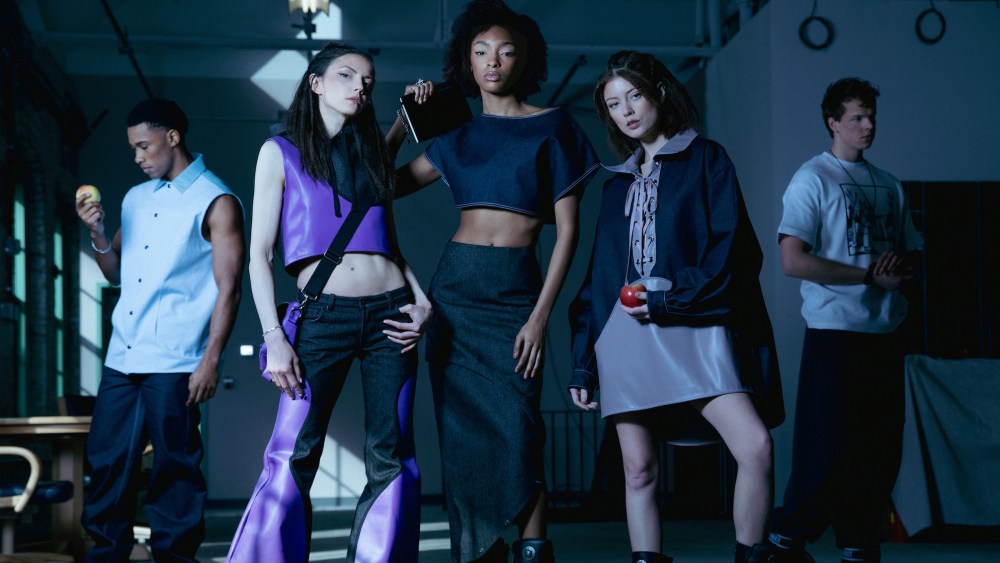
Leather and raw denim have long been a go-to combination for cool and rebellious style. Now, an emerging luxury brand is looking to challenge that formula—and make a positive impact along the way.
4NML’s inaugural collection, Primalis, combines raw denim from Candiani Denim with Vegatex’s AppleSkin, a plant-based alternative to animal leathers and fully synthetic artificial leathers. Rather than treating AppleSkin only as a substitute for conventional leather, Anya Oleynik, 4NML founder and creative director, said the collection places it in direct dialogue with denim.
Aesthetically, she said both materials have substantial structure, but very different characters. “Raw denim provides a textured foundation for exaggerated, architectural silhouettes, while AppleSkin introduces unexpected colors, curved lines and contrasting surfaces. Together, they allow us to push familiar garments into entirely new territory,” she said.
As Primalis took shape, Oleynik said the pairing acquired a deeper meaning. “The apple has long symbolized the knowledge of good and evil; the moment innocence gives way to awareness. Denim, rooted in workwear, represents human labor and what we create with our hands. Bringing them together became a way of weaving knowledge into work,” she said.
That idea lies at the heart of 4NML, also known as For Animals. “We live in a world of extraordinary beauty, but also tremendous suffering. None of us can eliminate all the harm in the world, but I believe there’s something profoundly human about wanting to leave it a little better than we found it. The apple reminds us of what we know, and the denim of what we can do with that knowledge. The meaning becomes part of the garments themselves, a reminder of why we create and what our work can ultimately be for,” Oleynik said.
The collection spans shorts, jackets, jeans and dresses. 4NML’s designs challenge convention, from jeans inspired by jellyfish and squids to exaggerated silhouettes and unexpected material combinations. Garments are made to order in Romania with options to customize colors, sizing and proportions. Prices range from $450 for the4Sight Shorts to $1,500 for the Core Jacket.
4NML launched in May. Commercially, the brand at the starting line but Oleynik believes it is on the precipice of a shift in which fashion places greater value on animals, the people who make clothes and the natural world. Or, as she puts it, “a future where wealth becomes a means of improving lives rather than simply producing more abundance and waste.” The brand is doing its part by supporting animal sanctuaries and welfare organizations, donating over $11,000 since 2025.
Oleynik added that Primalis is the first chapter of a much larger world she aims to create with 4NML. “We’re entering an era when the boundaries of what clothing can be made from, how it can behave, and what it can express are beginning to change. I want 4NML to be at the forefront of that exploration, creating an unmistakable visual language through materials, forms, and combinations that challenge our expectations of fashion,” she said.
Here, Oleynik discusses her design process, the untapped potential of unconventional materials and her outlook on sustainable fashion.

SJ: Why did you choose denim from Candiani, and what made raw denim particularly suitable for this application?
Anya Oleynik: Our atelier partner, Vidin Was Taken, was already working with Candiani Denim, and I was immediately impressed by its quality. Candiani is one of the most prestigious denim mills, with a history dating back to 1938. Its fabrics have been used by fashion houses including Gucci, Prada and Off-White, so there’s an extraordinary heritage of craftsmanship and innovation behind the name.
What makes Candiani particularly appealing is that its environmental commitments are backed by measurable efforts. The company reports recycling 100 percent of its cotton production waste, while regenerative cotton accounted for 30 percent of its total cotton supply in 2024. Investments in weaving technology have also achieved 63 percent water savings and 74 percent energy savings in the weaving department compared with the previous equipment. I appreciate that a mill with such an established reputation continues to invest in improving how denim is made.
For our collection, the raw denim’s substantial weight and rigidity were especially important. We wanted to create exaggerated proportions and sculptural forms that hold their shape while allowing the fabric to develop its own character through wear. I also like the idea of taking a material with such a rich history and using it to create something entirely unexpected. Candiani gives us that foundation, and we take it somewhere quite different.
SJ: What are the sustainable and performance benefits of AppleSkin?
AO: One of AppleSkin’s greatest advantages is that it transforms agricultural waste into something valuable. Vegatex uses apple pomace left over from beverage production, incorporating renewable plant-based ingredients into a material with up to 66 percent USDA-certified biobased content. This gives existing byproducts a new purpose while reducing reliance on virgin fossil-based resources.
There’s a common misconception that animal leather is inherently more environmentally friendly because it’s natural. In reality, animal skin is biological tissue that would decompose without extensive processing to preserve it. Most leather is chrome-tanned, using chromium salts that can lead to the formation of toxic hexavalent chromium, a known human carcinogen when inhaled. Leather workers can face occupational cancer risks from hazardous exposures, including leather dust, while chromium residues in finished leather can also cause allergic skin reactions in consumers.
The environmental figures are equally revealing. A 2026 peer-reviewed study estimated the carbon footprint of bovine leather at approximately 187 kg of CO₂ equivalent per kilogram, compared with just 15 kg for the nonanimal leather alternatives examined, a difference of more than twelvefold.
AppleSkin does contain polyurethane, but that alone doesn’t determine its environmental or health impact. Vegatex reports compliance with EU REACH chemical safety requirements, with testing showing near-zero levels of DMF and VOC emissions. By avoiding animal hides and chrome tanning, we can eliminate those hazards from our material supply chain while continuing to improve on conventional synthetic alternatives.
From a performance perspective, AppleSkin offers the thickness, flexibility and rich appearance of leather, with an exceptional range of colors. Its structure allows us to incorporate it into complex silhouettes and large garment panels, making it an integral part of our designs rather than simply a replacement for conventional leather details.

SJ: Did you encounter any technical challenges when combining raw denim with AppleSkin?
AO: Absolutely. Both materials require exceptional skill to work with, particularly when constructing unconventional silhouettes. Our atelier partner, Vidin Was Taken, has developed a rare expertise in heavyweight raw denim. There are relatively few sewing specialists worldwide who work confidently with this demanding fabric, so we were fortunate to have that experience from the beginning.
AppleSkin presented a different technical challenge. Its leather-like surface initially caused difficulties with the sewing machines, so the Vidin Was Taken team invited an experienced leather sewing specialist to collaborate on novel techniques. It was a valuable exchange of expertise, combining their knowledge of raw denim with specialized leatherworking techniques to develop an approach suited to our designs.
Each garment requires approximately six to ten hours of skilled labor. We believe craftsmanship deserves to be properly compensated, and we’re committed to working with an atelier that values its workers and their expertise. Combined with the high cost of our materials, customs duties and VAT, the labor-intensive construction contributes significantly to our production costs.
I believe true luxury should reflect the ingenuity, craftsmanship and human effort behind a garment. It’s particularly meaningful in Primalis, where work is a central theme. The people who bring these designs to life are as essential to the collection’s story as the ideas that inspired it.

SJ: How does AppleSkin perform in a raw denim garment designed to be worn and aged over time?
AO: One of the most fascinating qualities of this combination is that the two materials have different relationships with time. Raw denim gradually records the life of its wearer through fading, creases and changes in texture, while AppleSkin introduces a contrasting surface with its own character. As the denim evolves, so does the visual relationship between the two materials, creating something increasingly individual.
I think of these garments as evolving works of art. What leaves our atelier is only the beginning of their story. Every movement, experience and passage of time adds something to the composition that no designer could entirely anticipate. Two people can begin with the same garment and, years later, own two completely different pieces.
That’s part of what makes raw denim so compelling to me. We don’t artificially distress it to imitate a history it hasn’t lived. We leave that process to the wearer. I believe a beautiful garment should have a life beyond the moment it’s purchased, acquiring character, memories, and meaning over time. The marks of a life lived in it become part of the artwork itself.
SJ: What does this collection demonstrate about the potential for denim innovation?
AO: I think we’ve only begun to discover what denim can become. For decades, innovation has focused heavily on developing new fibers, washes, dyes and manufacturing techniques. Those advances are important, but there’s another world of possibilities waiting to be explored through the way we combine materials and rethink how garments are constructed.
With Primalis, we approached denim as a starting point rather than a finished idea. Candiani’s raw denim has exceptional strength, weight and character, but combining it with AppleSkin, organic cotton twill and cotton linings allowed us to take it in directions that would be difficult to achieve with denim alone. AppleSkin creates striking contrasts in color and texture, and its substantial body allows us to introduce sweeping curves and unexpected shapes. Cotton twill and linings contribute different qualities of texture, flexibility and comfort, helping us balance unusual proportions with the practical demands of clothing meant to be worn.
The result is denim that begins to escape its familiar identity. Our Bloom Jean takes inspiration from the extraordinary expanding forms of jellyfish, while the Squid Jean explores the strange movement and anatomy of marine life. These designs show how materials we already know can be brought together to express ideas that conventional denim construction rarely attempts.
What I find most exciting is the implication for the future. We don’t necessarily need to invent an entirely new material to create something revolutionary. Sometimes the breakthrough comes from discovering relationships between materials that nobody thought to explore. Denim has spent generations proving its versatility, yet we continue to see it through a relatively narrow set of conventions. I believe we’re still at the beginning of discovering its full creative potential, and that the next generation of denim could look almost unrecognizable compared with what we wear today.

SJ: When it comes to sustainability, do brands need to a have a broader lens?
AO: I think sustainability in fashion is often approached too narrowly, with most of the attention going toward the environmental credentials of the main fabric. A brand might use responsibly sourced cotton while overlooking the impact of its linings, coatings, adhesives, labels, and trims. Even a small leather patch on a pair of jeans raises questions about animal use and the environmental consequences of its production. Every component matters, but a garment’s impact also extends far beyond what it’s made of.
At 4NML, we’re trying to look at the entire picture. We consider our materials, including the smallest details, how and where our garments are produced, the people involved, the resources consumed, and the consequences of our decisions. But we also ask a larger question: how can the fashion industry actively contribute something positive to the world?
Our sponsorship model is an important part of that philosophy. By directly supporting animal rescues and sanctuaries, we’re creating a connection between the fashion we produce and the lives of animals who might otherwise never benefit from the industry’s success. I want that connection to become stronger as 4NML grows.
I believe we need to expand our understanding of sustainability beyond simply reducing the negative impact of production. We should also consider the positive impact a business can create through its success. Imagine if the extraordinary wealth and influence generated by the luxury industry could become a powerful force for helping innocent lives. The impact of a garment shouldn’t be measured only by what goes into making it, but also by what its existence makes possible.
SJ: What advice would you give to another denim designer that wants to eliminate animal-derived products?
AO: I would encourage designers to approach it as an opportunity for discovery rather than a limitation. We’re living through an extraordinary period of material innovation, with scientists and engineers developing possibilities that would have seemed like science fiction not long ago.
At 4NML, we’ve been exploring everything from plant-based leather alternatives made from cactus, pineapple and apples to entirely new generations of materials. Uncaged Innovations, for example, has developed a remarkable leather alternative using proteins derived from grains, which we’re interested in incorporating into future collections. Spinnova is developing textile fibers from wood pulp without harmful dissolving chemicals. Researchers at MIT have created fibers that change shape in response to temperature, while Columbia University has developed textiles that can automatically adjust their breathability in response to humidity. Imagine garments that adapt to their environment, changing their shape or properties as conditions change. An entirely new world of possibilities emerging.
My advice would be to experiment with these materials, understand how they behave and collaborate with skilled craftspeople willing to explore new techniques. It’s also important to consider every component, from the main fabric to linings, adhesives, labels and trims, and to evaluate the environmental impact of each alternative.
I think we’re entering an era when eliminating animal-derived materials can become a catalyst for extraordinary innovation. The goal shouldn’t be to reproduce everything we’ve made in the past. We have an opportunity to create materials, garments and experiences that have never existed before. Fashion has an extraordinary capacity to make unfamiliar things desirable, and I believe some of its most exciting discoveries are still ahead of us.