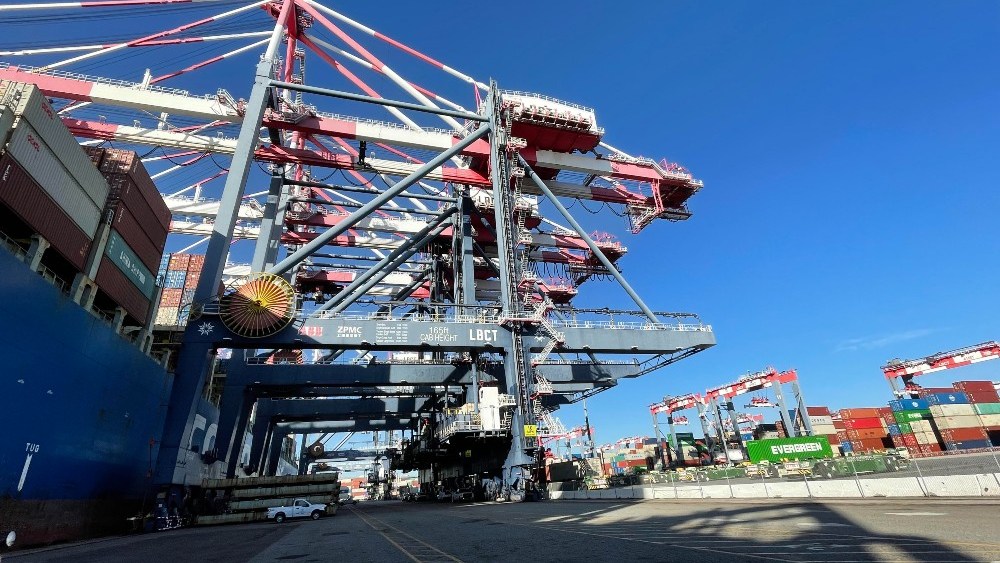
Shoppers waiting until Black Friday to commence their holiday shopping might not be behind the ball—and they won’t likely encounter markedly higher prices than they saw last year. But that doesn’t mean inflation won’t be a problem this gift-giving season and beyond.
According to a new analysis conducted jointly by the Port of Long Beach (POLB) and the USC Marshall School of Business’ Randall R. Kendrick Global Supply Chain Management Institute dubbed “Ships to Shelves,” financial pressures are likely to hit consumers acutely in early 2027.
That’s because changes to product pricing face some lag time—three to six months, approximately—following supply chain disruptions. While tariffs, consumer prices and supply chain performance are interconnected, “they do not move in lockstep,” the study authors wrote. That means that the impacts of heightened transportation costs, logistics snafus and tariffs that stacked up in late 2026 will take time to show up tangibly.
Realistically, the adverse effects of these pressures will be reflected in the prices seen at retail next year, putting more pressure to already overstretched shoppers’ pocketbooks.
According to the report, holiday shoppers are already paying more for the things they buy (and they’re likely to attest to it), but the increases they’ve been seeing have hit everyday household products and necessities more than gifts for loved ones.
The study authors analyzed a so-called holiday basket consisting of 224 items. For 115 that were characterized as Christmas and Hannukah gifts, matched price indices increased by an average of just 1.2 percent between 2025 and 2026—though Thanksgiving and Black Friday items saw average growth of 2.8 percent. Apparel and footwear both grew by 3.6 percent.
According to the report’s analysis of 17 headline products for the holidays, including faux Christmas trees, air fryers, sofas, treadmills, athletic shoes, winter coats and backpacks, among others, there’s very little correlation between combined tariff, sourcing and freight exposure and price index changes, meaning that while exposure to these challenges makes a product category vulnerable to disruption, it doesn’t necessarily predict heightened prices at retail.
However, the authors believe that the astronomical growth in costs associated with moving product are likely to drive up cost impacts to consumers in 2027.
USC and the POLB’s research showed that U.S. diesel prices have risen a whopping 156 percent since 2020, while ocean freight costs have gone up about 62 percent. Tariffs have provided another source of uncertainty and volatility, reaching an average rate of 10.3 percent in January before falling throughout the year.
As such, the report highlights fuel and transportation as “major sources of sustained cost pressure, even as tariff policy has shifted.” Huge additive fuel costs have fallen on the players managing each leg of a container’s sojourn from source to end market, from ocean freight to rail, drayage and final delivery.
“The fuel cost and the transportation cost rose significantly more than the cost of goods sold,” said USC supply chain expert Dr. Nick Vyas during a POLB-hosted webinar on Tuesday. “The report and analytics show us that the Strait of Hormuz… contributed significant impact on what we pay on shelves at the time of checkout. What we buy—what we consume—had a significant increase in cost related to the transportation and the cost of goods sold.”
According to Vyas, about 20 percent of the energy input into large, industrial systems is associated with gas and hydrocarbon used “from ports to transportation to the drayage to the last mile delivery to the consumer on the shelves.”
“That significant cost actually is what’s hitting the pockets of our consumers,” he added.
The POLB recorded its busiest month in September, having moved a whopping 997,177 TEUs. The port’s total cargo volume grew by 3.9 percent year over year from January through September 2026, hitting 7.7 TEUs.
The demand for on-dock rail has grown, rising 4.2 percent year over year. However, average rail dwell at the San Pedro Bay port complex, which includes the Port of Los Angeles, rose from 3.29 days on average in June 2025 to 7.19 days in September 2026. The report authors believe inland rail capacity might be the culprit slowing down operations. “Inland rail lag shows up as late restocking, missing sizes, or less selection of colors, rather than empty retail shelves,” the report said.
The port has invested heavily in on-dock efficiency initiatives, allowing average truck turn times to shrink from an average of 70.4 minutes to 58.9 minutes this year. Meanwhile, 26 percent of containers were moved by on-dock rail, the highest amount seen in a decade.
Ports, along with warehouse providers and other 3PLs, have absorbed some of the costs consumers would have been saddled with by driving efficiencies that reduce energy requirements and taking hits to their margins, “but they simply cannot absorb all the cost increase due to the cost of energy,” Vyas said.
“All of those [investments] add efficiencies to reduce the cost exposure to the consumer. But you can only go so far, so quick, to absorb the additional cost,” he added.
Vyas said that looking forward to 2027, he worries about trade disruptions driven by tariff policy driving more volatility into an already pressure-filled situation.
“I think, at some point, the resolution on the energy side will hopefully come in, but we need to have the stability on the policy side to make sure the supply chain stops worrying about what’s next. That uncertainty is what we need to really avoid going into the 2027,” he said.