The property that houses Orient Express Venezia is, in itself, a masterpiece to behold. Defined by its majestic winding staircase and Gothic windows, it’s housed in one of the city’s most historic palaces, Palazzo Donà Giovannelli, which was built as a noble residence in 1436.
The palace’s original design was realized by the same makers responsible for the design of Palazzo Ducale, otherwise known as the Doge’s Palace, the ancient seat of the Venetian Republic. Last April, Paris-based, Lebanon-born designer and architect Aline Asmar d’Amman unveiled her contemporary vision for the property, brimming with couture details and defined by a soft, baroque color palette inspired by the property’s frescoes and interiors.
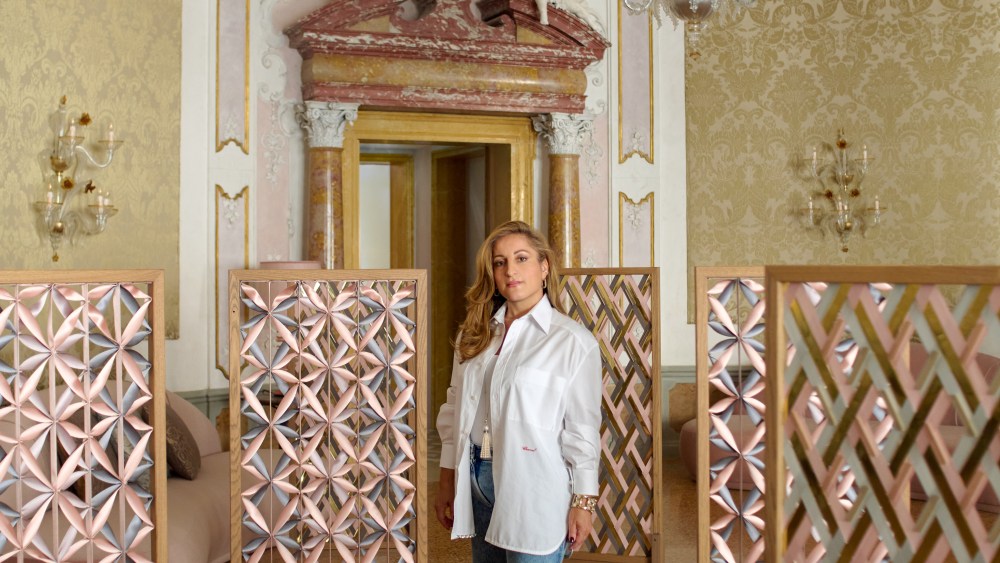
Many of those details were the result of deep ties to both design and fashion. Asmar d’Amman forged a collaboration with Le19M’s Maisons d’art — Studio MTX for architectural embroidery, handwoven ribbons, brass embellishments and the Ferronnerie textile and Harlequino architectural-embroidery screen totems for the Salone Vittoria ballroom, while Lemarié and Atelier Lognon crafted pleated, gilded veils for the fine-dining venue Heinz Beck Venezia.
You May Also Like
In an interview, Asmar d’Amman said the Vittoria Ballroom was built for Princess Farnese’s wedding to the son of the Duke of Urbino and that, in envisioning the screens, she was transported to the 16th century, imagining how the wedding unfolded. The ballroom’s cherubs, swan and other details evoke love and celebration, although she acknowledged that much of the wedding’s atmosphere must be imagined because there are no recordings of it.
“The choice of every color, the choice of every button or every piece of metal that is inserted to create this intricate weaving…really adds on to the whimsy and to the evocative power of the space, especially here in the ballroom,” she said.

Fashion played a role in other parts of the hotel, namely through the photography of Sheila Metzner, who worked with the late Karl Lagerfeld on a Fendi campaign in the 1990s and whom Asmar d’Amman contacted specifically for this project.
Elsewhere, there is a salute to one of Lagerfeld’s favorite fashion inspirations, and one of Venice’s most revered residents — Luisa, Marchesa Casati Stampa di Soncino. Casati Stampa di Soncino inhabited Peggy Guggenheim’s former home Palazzo Venier dei Leoni and infused Venice with 1920s glamour, wild parties with big band music and monkeys and filled it with famous guests like her lover, poet Gabriele D’Annunzio and visual artist Man Ray.
Casati Stampa di Soncino’s theatrical legacy greatly influenced the La Casati restaurant, where Asmar d’Amman translated the socialite’s love of adornment into bejeweled ceilings and sculptural plasterwork by Emmanuelle Luciani and Southway Studio inspired by a John Galliano gown associated with the late marchesa. The space also features chandeliers that evoke jewelry draped across the ceiling, reinforcing the interior designer’s broader vision of couture as an architectural language.

Asmar d’Amman was also able to place her own antique-market finds throughout the hotel. Antique frames, purchased before she had selected the artworks to go in it, completed one of the rooms, while a head of David sits in the garden. Driven by excitement, she acquired it from an antique store in Paris four years earlier, hoping to find a home for it one day.

Orient Express’ latest location is brimming with defining characteristics and historic relics, like the octagonal staircase added to the site by 19th-century architect Giovanni Battista Meduna. Meduna is famous for other cultural landmarks in the city, like the Ca’ d’Oro and the La Fenice theater. The hotel also houses the Library of Cultures’ adorned gilded wood accented with lapis lazuli as well as a music room, frequented by generations of Venetian high society.
Couture, she continued, is visible in the frescoes, particularly in the draped figures and allegories that informed the marble and stonework around the property. “I see couture, you know, in the frescoes. I see it in the Hayez. I see it in the patterns.” She connected those drapes to the pleated forms of the ottomans and Fortuny lanterns, describing them as part of the hotel’s “couture effect.”

Asmar D’Amman also designed the hotel staff’s uniforms, which were inspired by Venetian dress and iconic characters, including “the cape” and “that iconic hat.” The uniforms were made in Italy and incorporate a custom print inspired by Fortuny’s damask effect, used on “the revers of the capes” and the waiters’ gilets. For her, the details were about “allure” and “the sophistication of a very distinctive detail.”
Finally, Asmar d’Amman worked closely with Venetian boatbuilder Luigi Giacometti for a 31-foot mahogany boat that imbues the spirit of Palazzo Donà Giovannelli and lagoon life and on which guests begin their stay at the property.
Crafted from a single tree trunk, the vessel features celestial blue leather upholstery inspired by the palazzo’s Neo-Gothic staircase, bespoke drink cabinets and a stained-glass porthole reinterpreting the palazzo’s historic coat of arms.
“Everything in Venice is amplified,” d’Amman said. “To glide on the Laguna in a classic wooden boat is one of those wonders, another brushstroke of beauty.”
Conceived for Orient Express Venezia, the boat celebrates Venetian craftsmanship while offering guests a floating expression of the palazzo’s heritage.