MILAN — Moncler is making quite the statement in Milan with a new sprawling and modern headquarters in the city.
Chairman and chief executive officer Remo Ruffini unveiled the venue with a dinner event on Thursday evening for about 200 guests attended by the city Mayor Beppe Sala and some of his friends in the industry, from Diego and Andrea Della Valle and Gildo and Angelo Zegna to newly installed Kering CEO Luca de Meo, Stefano and Andrea Rosso, Technogym’s Nerio Alessandri, Marco Tronchetti Provera and Francesco Ragazzi.
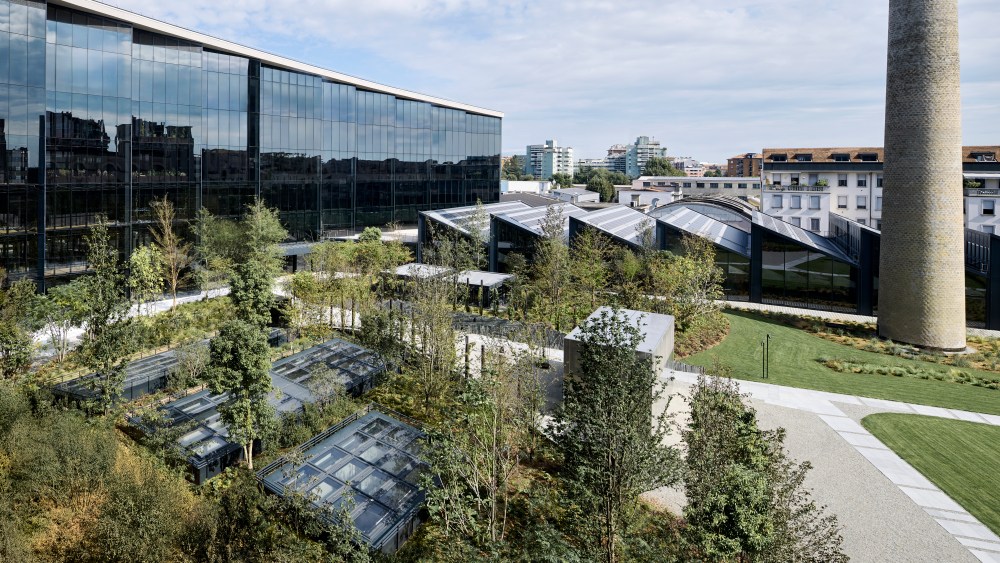
Naming it “Casa Moncler” is an understatement, as the headquarters are majestic, spanning over a total area of 829,000 square feet, a six-floor building, a double-height 48,400-square-foot showroom with a shed roof, and surrounding landscaped green area designed for gathering and interaction.
You May Also Like
“We built this thinking of the future of Milan and as a beautiful gift for our employees,” Ruffini told WWD. He said it was a project he “had in mind since before COVID-19, interrupted during the pandemic as I was reevaluating prospects,” and taken out of the drawer after the end of the health emergency.
Located in the Symbiosis district, one of Milan’s most dynamic urban regeneration projects in a former industrial area converted into a new mixed-use urban center, Moncler’s neighbors range from Fastweb and LVMH Italia to Boehringer Ingelheim and Mars Group.
“Casa Moncler is not just a place — it’s the manifesto of who we are and what we strive to continue being. For the first time, we are bringing together over 700 colleagues from our Milan offices under one roof, in a space designed to foster collaboration, dialogue and creativity,” Ruffini said. “Here, we want ideas to move fast, and creativity and uniqueness to find their voice. Here, everyone is part of something greater. Casa Moncler is where our energy takes shape and becomes the future.”
Ruffini could not hide his pride in the the “Warmer Together” ad campaign fronted by Al Pacino and Robert De Niro and the event was an opportunity also to celebrate its launch. During the dinner, held in the sprawling showroom and, inspired by autumn, decked out with long tables filled with small pine trees that will be replanted, backstage videos of the two legendary actors were projected on a screen.
American musician Tobe Nwigwe performed a version of “Lean on Me,” the soundtrack of the “Warmer Together” campaign, with musicians of the Milan Scala theater.
The architectural project was overseen by international firm ACPV Architects Antonio Citterio Patricia Viel, preserving the storied chimney of the former furnace. Citterio “is a friend,” Ruffini said of the choice of the studio.
Large glass facades on the south and east sides of the building open the interiors to an inner garden, while the north and west facades recall industrial rigor through framed concrete openings.

In the garden, serpentine stone elements draw inspiration from Moncler’s alpine history, while the trees are aligned to echo the rhythm of the glass facade.
Inside, a double-height lobby leads to shared spaces including a café, a company restaurant, a fully equipped gym and a modular auditorium. From the first floor, dedicated to prototyping and patternmaking, up to the fifth, home to the design teams, the building houses all creative, corporate and commercial functions — including a laboratory for fabric and material testing.
“We designed a building with a manufacturing character, rigorous and measured, that represents a significant intervention in Milan’s urban development,” said Citterio, chairman and cofounder of ACPV Architects. “The project comes from an ongoing dialogue between us, the architects and the client: It is a statement of intent about the role architecture can play in shaping a contemporary corporate identity.”
The chimney, a symbol of the site’s industrial heritage, now functions as an intake for external air captured at 60 meters, which is then circulated through the bioclimatic greenhouse on the south facade, which Ruffini highlighted, and that helps to regulate internal temperatures. “This is really a sustainable project, and will allow us to save energy,” Ruffini enthused.
Ruffini underscored how the well-being of his employees was top of mind, ticking off the amenities, from the gym to the restaurant serving seasonal and balanced menus; the mobility services, such as the company shuttle and electric bikes; a 400-space parking area, including 100 electric vehicle charging stations, and concierge services such as postal delivery, laundry and repairs. Common areas, kitchenette corners and “The Nest,” a dedicated nursing room offering a quiet and comfortable space for new parents, further enhance the sense of community — always a priority for Ruffini.
The bioclimatic greenhouse hosts three distinct ecosystems: the grassland, the Mediterranean scrub, and the cold desert, with shrubs, climbing plants and cacti, contributing to thermal comfort and natural temperature regulation of the interiors through the greenhouse effect and a passive ventilation system. It serves as a buffer between interior and exterior, regulating light and temperature across seasons, providing a milder climate in winter, and promoting natural ventilation in summer, in synergy with the chimney.

“Set within an urban context undergoing profound transformation, the building brings quality and vision back to a historically neglected area,” said Patricia Viel, architect and cofounder of ACPV Architects. “The project integrates identity and innovation, people’s well-being and environmental comfort, into a coherent system that represents a new paradigm for building: architecture designed to evolve with those who inhabit it.”
The entire complex has been designed to meet the highest environmental standards and is in the process of obtaining WELL and LEED certifications. Indoor air quality, thermal comfort, natural lighting and, wherever possible, the use of materials with a lower environmental impact were key in the project. High-efficiency energy systems, photovoltaic panels and a geothermal system further contribute to minimizing emissions.
Among the recycled materials are the carpet and the bases of the office chairs partly made from nylon production scraps. The sound-absorbing panels and some cabinets and desks contain recycled fibers, while some outdoor flooring contains recycled shoe soles. Moncler collaborated with leading external partners such as Kvadrat Really, ESO Recycling, Impact Acoustic and Radici Group.