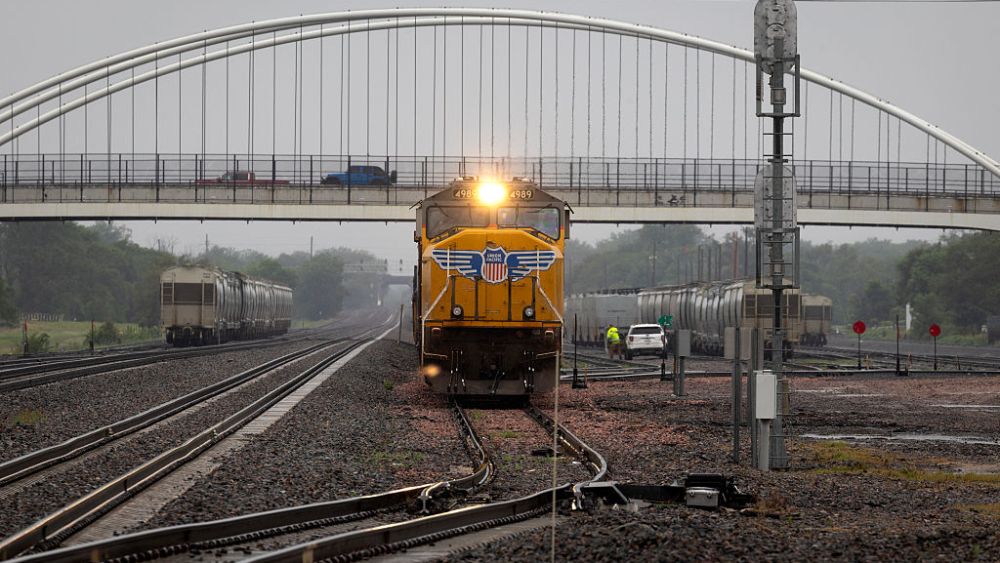
The top federal railroad regulator has resumed the merger review for Union Pacific and Norfolk Southern, removing the hold it placed on the process in late May.
The Surface Transportation Board (STB) is adopting a procedural schedule to further consider the $85 billion proposed deal, which would create the nation’s first modern coast-to-coast freight network and unite two of the six remaining Class I railroads.
In a statement Tuesday, the STB asserted that the decision does not mean it approves the deal.
“This determination is not a finding on the merits of the revised application,” the STB said.
The board determined the supplemental information submitted by the railroads was sufficient to resume the review process. That filing offered several new assurances to customers including service protections and fixed pricing agreements for more shipments.
The board’s projected timeline estimates the process will last through at least May 28, 2027. The date for the close of record remains to be determined, with a final decision on the merger due within 90 days after the close of record.
Additionally, the STB’s judgment lays out a timeline for public comments on the proposed merger, giving stakeholders and regulators time to review its potential impact.
The board denied the companies’ request for an expedited proceeding related to their proposed divestiture of control of the Terminal Railroad Association of St. Louis, saying control of the railroad “is best evaluated within the context of the larger transaction and granting the request would be premature.”
Union Pacific and Norfolk Southern have also been directed to re-submit additional data omitted during the refiling process by Aug. 28 so the board can review the full datasets. According to the report, the companies filtered out data they thought wasn’t material to the review.
“In several instances, these filters removed substantial portions of the underlying analysis from the final presentation layer,” the STB report states.
Parties wishing to participate in the merger review as parties of record must file their indication to do so by Sept. 4.
Competing Class I railroad BNSF Railway, which has been outspoken against the merger, reiterated that it was confident the deal does not meet the STB’s standard of enhancing competition and serving the public interest.
“The growing opposition from key stakeholders continues to speak for itself,” BNSF said.
BNSF, CSX and Canadian Pacific Kansas City (CPKC) filed motions with the STB earlier this month, urging the agency to dismiss the merger proposal. The companies claimed UP and Norfolk Southern fail to meet the “prima facie” threshold that the acquisition is in the public interest.
Another Class I rival, Canadian National (CN), agreed to drop its opposition to the merger agreement in exchange for deals that gave the railroad haulage rights in areas across the Midwest and southern U.S. CN also gained access to customer facilities where the UP-Norfolk Southern merger would reduce Class I railroad options from either two-to-one or three-to-two.
With the terms, Union Pacific also gets expanded operating rights over a CN-owned railroad corridor near Chicago.
While the railroads take sides on the issue, some lawmakers have sought to sway the STB into rejecting the megamerger.
On Aug. 11, seven state Republican attorneys general urged the regulator to shut down the deal, taking aim at the companies’ proposed pricing arrangements. The lawmakers said Committed Gateway Pricing mechanism would set rates at the 70th percentile of the railroads’ own comparable traffic rates, rather than at a median or below-average benchmark.
The attorneys general argue that the approach means many eligible shippers could receive a higher price than they pay today.
Union Pacific rakes in profits from Iran war-driven surcharges
The STB’s resumption of the merger review followed another Union Pacific filing with the board, which revealed it collected more than $90 million more in fuel surcharges than it paid in the second quarter.
Reuters first reported the filing, noting that only Norfolk Southern and CSX also had surpluses in the quarter, or a respective $3.6 million and $8.4 million.
The profit boosts underline criticism from some shippers that surcharges meant to recoup rising oil costs due to the war in Iran are sometimes excessive.
“Ultimately, fuel surcharges are a component of the overall cost we negotiate with customers and something they take into consideration when choosing Union Pacific and the service we provide,” Union Pacific said in a statement.
Last month, Union Pacific said fuel surcharges added earnings of 14 cents per share in the quarter.