
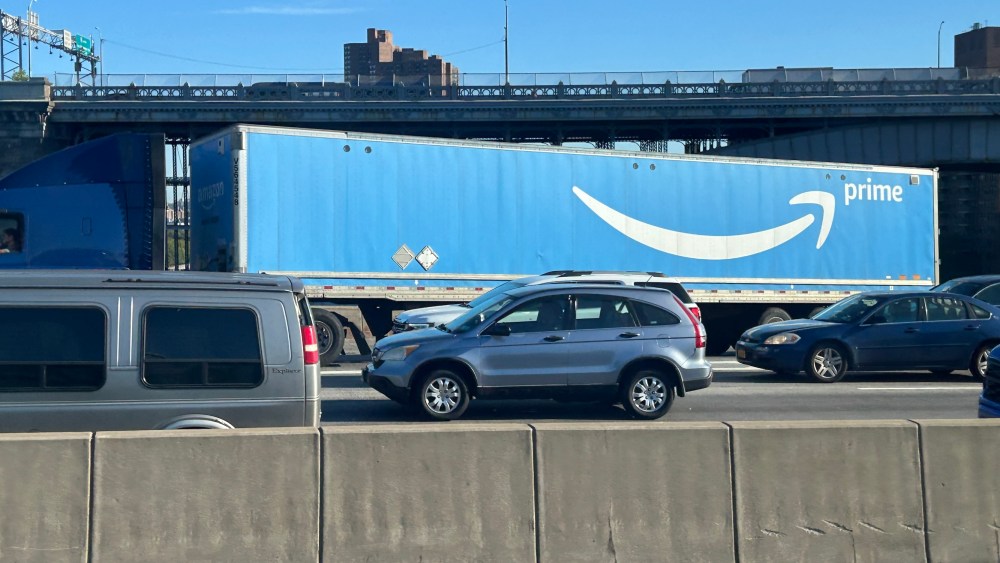
Amazon is opening its less-than-truckload (LTL) services to businesses outside its seller network.
Since Amazon entered the LTL industry early last year, the services have been limited to the company’s marketplace sellers. As part of the launch, Amazon only moved sellers’ inbound goods from the port to an Amazon fulfillment center.
Now, through the Amazon Supply Chain Services (ASCS) offering, any business can sign up to use Amazon-branded trucks to move goods to any type of destination—including third-party warehouses, distribution centers and retail sites—or in between their own facilities.
According to the tech titan, businesses of all sizes can now use Amazon’s LTL services to move freight ranging from one to six pallets, or between 150 and 15,000 pounds.
Using LTL transportation, trucks transport freight from multiple customers on a single trailer, instead of full truckloads from one customer. Amazon is looking to capture more businesses that have the flexibility to ship by pallet, choosing LTL to share trailer space for partial loads instead of reserving and paying for a full truckload.
The e-commerce giant offers flexible booking and pickup options, including next-day live pickup for orders placed by 5 p.m., same-day pickup through Amazon’s drop trailer solution and standing daily pickups for high-volume shippers.
“The feedback from Amazon selling partners using our LTL service was clear: the technology, visibility and reliability were exactly what they needed—and they wanted to use it more broadly,” said Jim Ruiz, director of Amazon Freight in a statement. “Now Amazon LTL can move your freight wherever it needs to go, servicing destinations nationwide for businesses of all sizes. With LTL, shippers get cost-effective freight shipping while still benefiting from the real-time tracking and dependability they expect from Amazon.”
The move follows Amazon’s wider ASCS launch last month, which packaged the online marketplace’s portfolio of freight, distribution, fulfillment and parcel shipping capabilities into one solution to be accessible for companies beyond its third-party sellers.
In many respects, the move was considered a warning shot to logistics incumbents including UPS, FedEx and DHL, as Amazon positioned itself as a direct third-party logistics (3PL) competitor.
Amazon said it is expanding the LTL capabilities via ASCS based on strong positive feedback and growing customer demand.
“We started using Amazon for full truckload shipping four years ago because we needed a provider that could keep up with our growth,” said Zech Hintz, vice president of global supply chain at Pattern, a global e-commerce accelerator. “LTL has been the same story. In the past year, we’ve seen faster transit times and lower costs compared to traditional LTL services. It’s rare to get both, and that’s what makes this service stand out.”
Trucking companies specializing in LTL saw stock sell off on the news, including recently spun off FedEx Freight (6 percent), Old Dominion (6 percent), XPO (5 percent), Saia (3.5 percent) and ArcBest (3.5 percent).
According to TD Cowen analyst Jason Seidl, the offering is geared toward shippers using slower, more cost-effective routes with a three-to-four-day delivery window. These companies often rely on intermodal for middle-mile transport and have a smaller coverage footprint, he said.
Amazon also offers full truckload services. According to the company, its physical network now includes more than 80,000 trailers and 24,000 intermodal containers.
Amazon currently accepts inbound freight at roughly 115 facilities, but many of these are fulfillment centers without a full truck-to-truck transfer design. As of the first quarter of 2025, Amazon had about 74 cross-dock facilities, Seidl said in a research note. These are the inbound facilities placed near major U.S. ports where goods are picked up by trucks.
The company also offers a unified drop-trailer pool that supports both LTL and full truckload shipments, which is designed to simplify yard operations for qualified customers using multiple ASCS freight services.
“When Amazon trailers are in your yard, you don’t have to waste time sorting through which ones are for FTL and which ones are for LTL before you load them,” Amazon said in a press release. “The result is improved dock door utilization and faster facility turnover.”
The company says all drivers are trained specifically in LTL operations to handle pickup and delivery, with expertise in freight handling, multi-stop routing and dock procedures. The logistics giant also touts real-time GPS tracking from pickup through delivery, alongside cargo cameras and door sensors across the entire fleet.
Additional technologies embedded within the service include automated appointment scheduling at receiving facilities and electronic proof of delivery in an effort to eliminate manual tracking.
The LTL service delivers real-time tracking through EDI integrations and a web portal, including pallet-specific milestone events including terminal arrival and departure updates.