
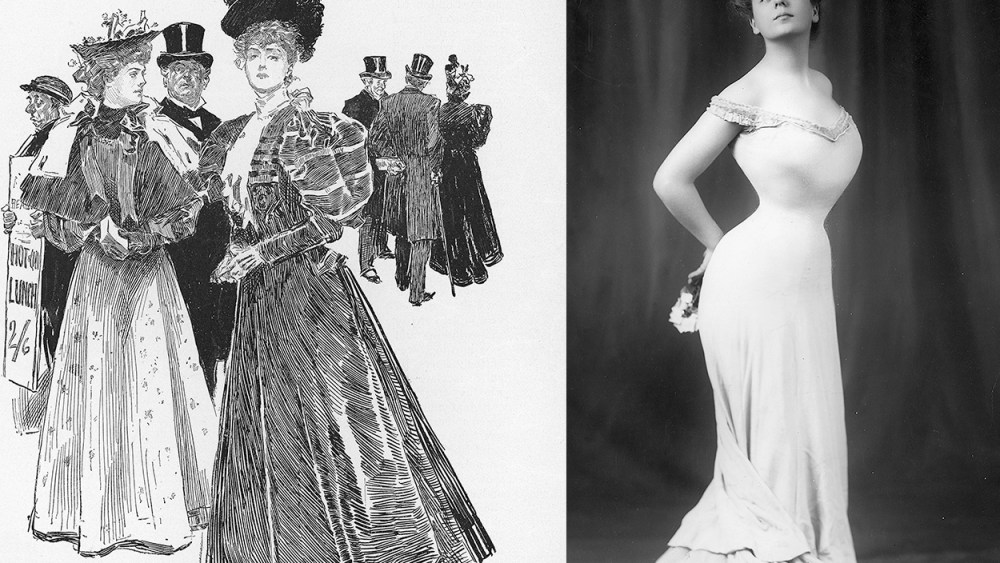
American fashion entered the Gilded Age from 1876 to 1900, an era defined by display, ambition and social performance. Communication changed with the telegram and the telephone, while electric lighting broadened the spectacle of fashion and its vocabulary. Wealth became more visibly expressed through department stores, luxury hotels, exhibition spaces and the city streets, with names like Astor, Whitney and Vanderbilt helping to define the world of taste, while Palm Beach, Fla., New York’s Ladies’ Mile and the Metropolitan Museum of Art gave fashion new settings in which to be seen.

Wide crinolines gave way to the bustle, though trailing yards of fabric soon become passé, as generational change leads fashion to embrace the Gibson Girl and Arrow Collar Man archetypes. Popularized by the drawings of Charles Dana Gibson, her shirtwaist costume borrowed from his tailoring, creating a new American look that traveled abroad and overlapped by century’s end with the body-conscious S-curve silhouette.
You May Also Like
By the 1890s, a combination of Arts and Crafts and Art Nouveau begin to influence dress, decor and entertainment, even as immigration fueled industry growth and sweatshops, jobbers and contracting systems made the trade harsher, especially after the Depression of 1893. In retail, Henri Bendel and Bergdorf Goodman joined Bloomingdale’s and B. Altman in New York, while Sears, Roebuck & Co. extended fashion beyond the city through mail-order catalogues.

Here, a list of events converging around fashion from 1876 to 1900.
- 1876: Alexander Graham Bell patents the telephone.
- 1879: Thomas Edison invents the practical incandescent light bulb.
- 1888: National Cloak and Suit Association is founded.
- 1900: International Garment Workers Association (ILGWU) is founded.
High Jewelry
One of the oldest high jewelers in New York, Black, Starr and Frost, dates to 1810, but most would know Tiffany & Co. as the name that helped establish high jewelry in America. While Charles Lewis Tiffany sold jewelry for the firm he founded in 1837, it is Louis Comfort Tiffany, its artistic force, who began designing jewelry under his own name in the late 19th century. His influence helped define America’s place in luxury, while jewelers including Harry Winston would build on that foundation.