
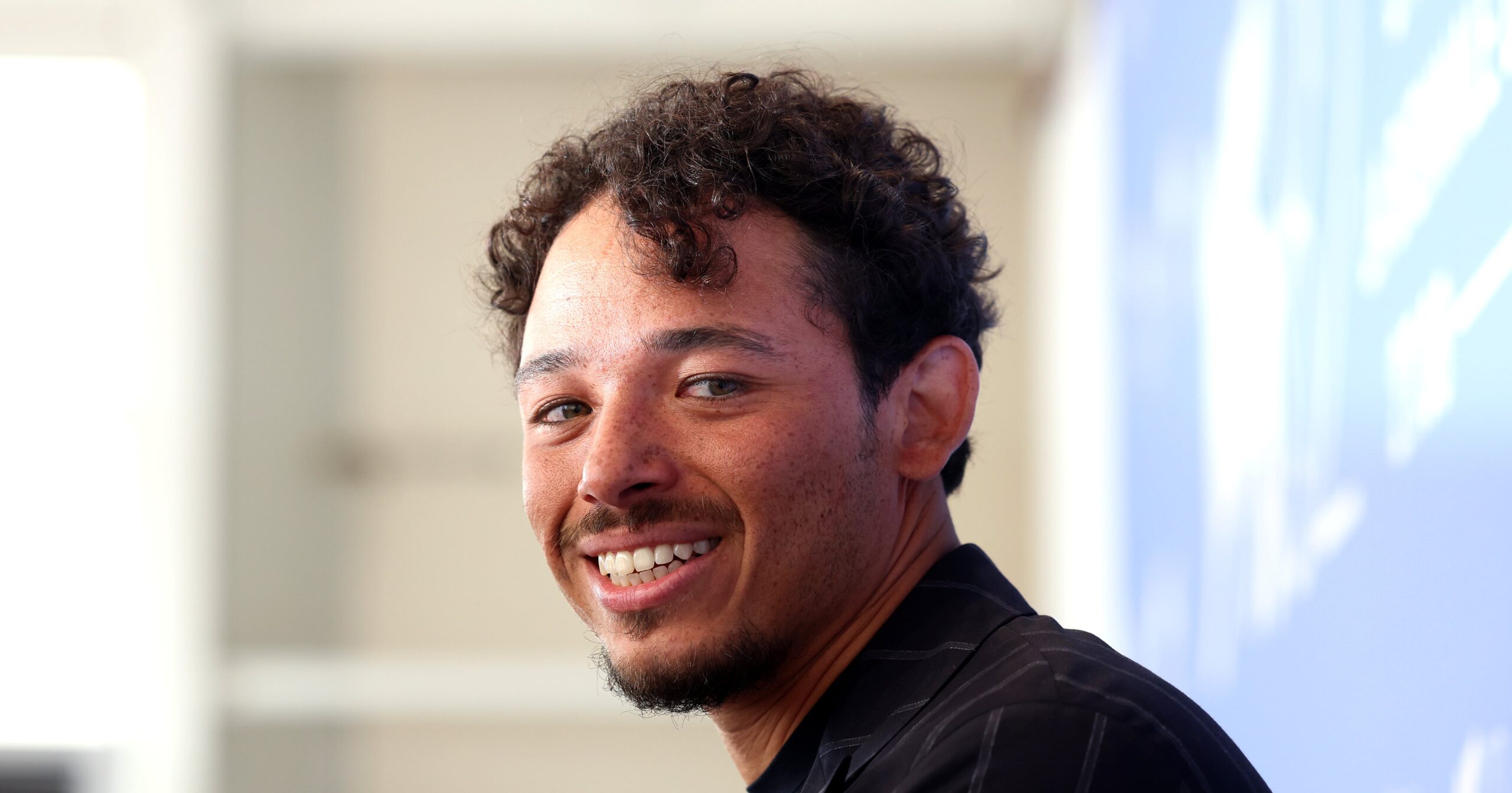

There are very few challenges Anthony Ramos isn’t willing to take on. Since his 2015 breakout role in the hit Broadway musical “Hamilton,” the Puerto Rican actor has carved out an impressive path for himself – quickly becoming one of the most visible Latinos in Hollywood, with standout roles in “A Star Is Born” and as Usnavi de la Vega in the big-screen adaptation of “In the Heights,” a performance that earned him a Golden Globe nomination for best actor in a musical/comedy. His latest project – Kathryn Bigelow’s thriller, “A House of Dynamite” – recently hit theaters and is now streaming on Netflix.
Beyond acting, the born-and-bred Brooklyn Boricua has also made a name for himself in music as a singer-songwriter – even going viral on TikTok with his song “I Was the One,” produced by Sergio George. He’s currently writing a musical, too. But perhaps one of the most notable shifts in Ramos’s life lately has been his commitment to fitness and overall wellness – so much so that he trained for and completed his first New York City Marathon this year.
In fact, he took the challenge so seriously that Ramos wound up partnering with Brooks Running for the marathon and trained with professional runner and Olympian Des Linden.
“It’s something I’ve been wanting to do for a long time, and I kind of just woke up one day and was like, ‘Yo, I think I want to do the marathon. I think this is the year,” Ramos tells Popsugar. “I kind of just hit up my agents and was like, ‘Hey guys, I don’t know if there’s an opportunity for a partnership here, but I’m just letting you guys know I’m doing the marathon.’ And Brooks was like, ‘We’d love to partner with him.'”
The brand was able to hook Ramos up with a coach and full running gear. While he didn’t get to train with Des Linden in person because they live in different cities, every week, Linden would send Ramos a text with a training blueprint for that week. Ramos’s only goal, he says, was to get to the finish line.
“That’s all I wanted to do, really,” he continues. “I mean, I wanted to pass the finish line. It was really tough. It was really hard. It was difficult on the body. When they tell you, ‘It’s mind over matter,’ it really is all mental. It really is. You just got to keep pushing. You’ve got to tell your body it can do it because your body wants to stop.”
Ramos also ran the marathon the day after his birthday. “I turned 34,” he says. “This last year has just been full of difficult decisions. Life decisions and a lot of moments where I’m like, ‘Alright, I really need to have a lot of faith here. I don’t know if this is the right decision, but it feels like it is, so I have to do it.'”
Ramos has also taken this opportunity to encourage folks in the Latine community to consider running. Since his breakout role, the actor has been beloved by the Latine community for how deeply he embraces his Puerto Rican roots and identity – often highlighting them as strengths. He’s spoken candidly in the past about being advised by industry people to erase his background or to work to present himself as more “ethnically ambiguous” and “less Latino.” So for Latines, Ramos taking on the challenge of running a marathon is another representation of what we can do. He admits that he also understands the economic and systemic obstacles that can sometimes come in the way of Latines prioritizing their health.
“I didn’t grow up in a house that was like we’re eating quinoa and let’s watch our weight. We ate whatever we could afford, ” Ramos says. “Mom was creative with whatever she could afford, and yes, she tried to have us have salad with whatever we were eating, but whatever she could afford that week was what we were eating. You know what I’m saying? I think specifically in the Latino community, while our food is good, some of our food is not always the healthiest – like chicharron de pollo.”
He shares that he had to maintain a healthy, nutritious diet while training for the marathon, making him much more aware of his food choices and the importance of balance. “We could still have our foods and eat the food that we love and the food that we grew up with and the food that is part of our culture, but also there’s a level of working to keep your body in good shape, so we can occasionally enjoy things like coquito,” he says.
Running hasn’t just supported Ramos’s physical health; he’s also noticed a significant difference in his mental health and overall well-being.
“Some of the runs were emotional for me, too. When you’re out there, and you’re by yourself just moving, your body is under pressure, and it just naturally releases things,” he says. “Anything that is holding it back from continuing to do the thing that you’re asking it to do, it’s going to release it.
And you’re like, maybe I’ve got to release this person, or I’ve got to stop doing that job, or I need to call that person who I haven’t spoken to in a long time. I got to make amends in that relationship. Anything that’s been weighing on you, you’re going to feel it when you run.”
He currently has his eye on running the marathon in Puerto Rico next March, a place that holds great significance for him.
“I think for me, my first two places to run are the places that made me. I was born in New York and by way of Puerto Rico. My grandmother came to New York and started a life here in the ’50s,” Ramos shares. “She’s from Naguabo, and my dad’s family is from Bayamon. Puerto Rico just means a lot to me. It’s my other home, other than New York. Miami is where I live now, but Puerto Rico is still a home for me, and I think it just means a lot for me to run there – to run through those streets and feel that energy.”
Ramos celebrated his marathon run with friends and family at his new restaurant, Milly’s Neighborhood Bar, located in Bed-Stuy. The restaurant is named after his mother, Mildred Ramos, and is inspired by her community-focused hospitality.
“My mom was always hosting everybody when we were growing up. She had this two-bedroom apartment in the projects in Brooklyn, and it was like we barely had enough room for us, but she was always like, ‘Oh, the cousins from Puerto Rico are coming for two weeks. They’re going to stay here,” he shares. “I was always like, ‘where?’ But she’d make it work all the time. If it was somebody’s birthday, my mom was raising her hand – like, let’s do it. Her and my Aunt Lucy.”
Ramos shares that while his mother doesn’t work at the bar-restaurant, she’s almost always there, hanging out with family, friends, and neighborhood locals. Milly even has her own little corner spot where you can usually find her.
“She brings her friends. It’s our spot to just kick it,” he adds.
Aside from being mindful about his eating and staying on top of his fitness, Ramos says he also leans on therapy and spirituality to keep him grounded.
“I thank God for everything. Without God, I’m nothing. I also have an amazing therapist,” he shares. “Donna has been in my life for four years now. Honestly, she’s been so incredible in just teaching me skills and also teaching me how to communicate better, how to receive information better from people, and how to adapt to different people’s personalities.”
In terms of what he wants people to take away – not just from his career but from his overall story – Ramos says he wants people to see him as someone who takes risks and is intentional about the roles he plays and the art he creates.
“I want people to see that there’s something always deeper behind the roles I do, whether it’s a rom-com or thriller like in the ‘House of Dynamite’ or like in ‘Transformers’ or ‘In the Heights,’ he says. “I want people to see that I’m intentional about the roles I pick because I really am. It’s just about being intentional about your life in general.”
Johanna Ferreira is the content director for PS Juntos. With more than 10 years of experience, Johanna focuses on how intersectional identities are a central part of Latine culture. Previously, she spent close to three years as the deputy editor at HipLatina, and she has freelanced for numerous outlets including Refinery29, Oprah magazine, Allure, InStyle, and Well+Good. She has also moderated and spoken on numerous panels on Latine identity.