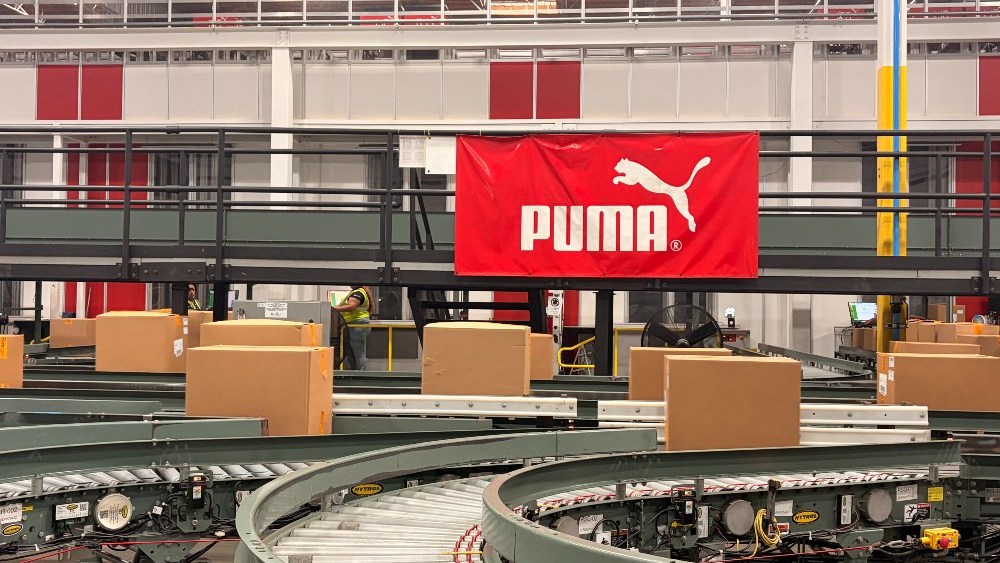
A pair of Puma sneakers that ends up gift-wrapped under a tree this holiday season may pass through the proverbial hands of a robot moving merchandise at the brand’s distribution center in Los Angeles.
There are 171 zooming automatons helping 70-90 human workers pick and pack products at the brand’s 672,000-square-foot Torrance, Calif. facility each day. A creation of AutoStore, the robotic system operates within a gargantuan cage-like framework where lidded crates are stored 16 rows high, optimizing the use of a 50,000 square-foot space dedicated to storing and fulfilling Puma’s orders of sneakers, apparel and accessories.
About 170,000 such crates are dedicated to Puma’s merch at the warehouse, and each one can store 66 pounds worth of product—say, six fleece zip-ups or shoeboxes each, give or take. To put the system’s impact into perspective, the building itself can hold about 5-6 million units of product, and 2-3 million can be stored in the 50-foot-tall AutoStore.
Human workers operate at stations surrounding the massive structure. Crates, pulled from throughout the towering stack, descend down an elevator shaft of sorts and appear before workers, who then pack them full of product and send them back up into the stack where they’re stored in optimal locations based on upcoming or in-process orders.
Torrance is part of a three-site U.S. distribution network that supports Puma, alongside facilities in Phoenix, Ariz. and Whitestown, Ind. Operational for the past 15 years, the California location has served as a template for the others—most recently Phoenix, which opened two years ago and is nearly double the size.
Ditlev Blicher, regional president for North America at Maersk, which operates the facility, characterized the AutoStore’s autonomous activities as “like a beehive”—but without the deafening buzz. Operating in relative silence (for a warehouse), the system allows for at least 30 percent greater efficiency than a manual pick-and-pack process, he told Sourcing Journal.
“It takes away all the redundancy of having to go from location to location; it just comes to you,” he said, describing the benefits to workers. “Then, you have the dense storage. If this was a typical warehouse, this place would need to be twice the size because you’d have to stretch everything out so that people could get to it.”
According to Blicher, a standard warehouse management system (WMS) controls the AutoStore’s daily activities. “As soon as someone signs on, the robots start attaching themselves to the assignments that people are logging into.”

“The technology and innovation is designed to work with our people, with our associates,” added Dave Hune, regional head of North America contract logistics for Maersk. “They work hand in hand—this does all the tasks that we deem repetitive, and the associates are doing more decision-making, problem-solving, working with our customers and driving quality in the operations.”
Known chiefly for ocean freight container shipping, Maersk is seeking to scale its warehouse logistics business by partnering with cutting-edge technology providers like AutoStore. “We operate 70-plus facilities in the U.S. that do this type of activity, and that’s backed by a global footprint of over 500 facilities,” Hune said.
“This is what we call high-velocity omnichannel—the channels being wholesale, which would be Puma like shipping to Foot Locker; retail, like Puma shipping to one of their stores; and e-commerce shipping to you at home, if you purchase it,” he said. The vast majority of the facility’s deployments are destined for physical retail, with about 15 percent of fulfillment dedicated to online sales.
“This is not just a technology showcase,” he said, eyeing the robots gliding by. Automation of the AutoStore variety helps Maersk drive down waste—whether it’s caused by energy usage, labor costs or footprint, he believes. Each robot needs to be charged for about eight minutes per hour of work, and the chargers use about the same amount of power as a conventional vacuum cleaner charger that could be plugged into an outlet in a home.
Blicher added that the next step for Maersk is to offer such solutions to more clients, and not just retail giants with global reach. “It doesn’t matter what size business you have, you can get a block of these totes and store your product, and we’ll pick the product and ship it out,” he said.
Puma in October expanded its relationship with Maersk and will allow the company to store and ship orders for other brands from its three facilities.

That’s likely welcome news for AutoStore, which was founded just over 30 years ago in Norway but has dutifully plotted an expansion that now spans 2,000 sites across the globe, servicing brands like Macy’s, H&M and Lululemon along with Puma. North America now represents its fastest-growing market, according to the company’s vice president of product, Ellen Brune.
Asked whether there’s been a marked acceleration in logistics investment in recent years despite the fiscal challenges brands are navigating related to tariffs and the economy, Brune said, “bigtime.”
The reason has everything to do with shifting consumer expectations and the need for brands to meet them where they are—or risk being shirked for a competitor.
“After Covid, retailers established this contract with their customer that if you order it, you can have it in less than 48 hours. It then became 24 hours, and then somehow Amazon drove it to become overnight,” she said. “The only way to get there is to have some kind of automation backing it.”
There are other practical reasons for verticalized storage solutions, which “increase the density of your storage significantly,” she said.
“Companies are trying to reduce the shipping for that last mile, and so they’re trying to bring their warehouse storage closer to the cities. Having a big warehouse in the middle of LA is kind of unique; if you’re trying to do that in Paris, you’re probably looking at a much smaller space,” Brune added.

With the holidays fast approaching, there’s no room to skimp on fulfillment speed. Asked whether the technology responds to peak-season needs, Brune said that it responds to operational changes through the WMS.
“Maersk and Puma are likely going to change their staffing operations for peak; different buildings have different strategies on how they want to do that. Either they’re adding an extra shift, they’re changing shift operations, or they’re changing the ratio of products put into the AutoStore versus being picked out of it,” she said. “The system is designed to automatically adapt to whatever they want to do in terms of their strategy.”