
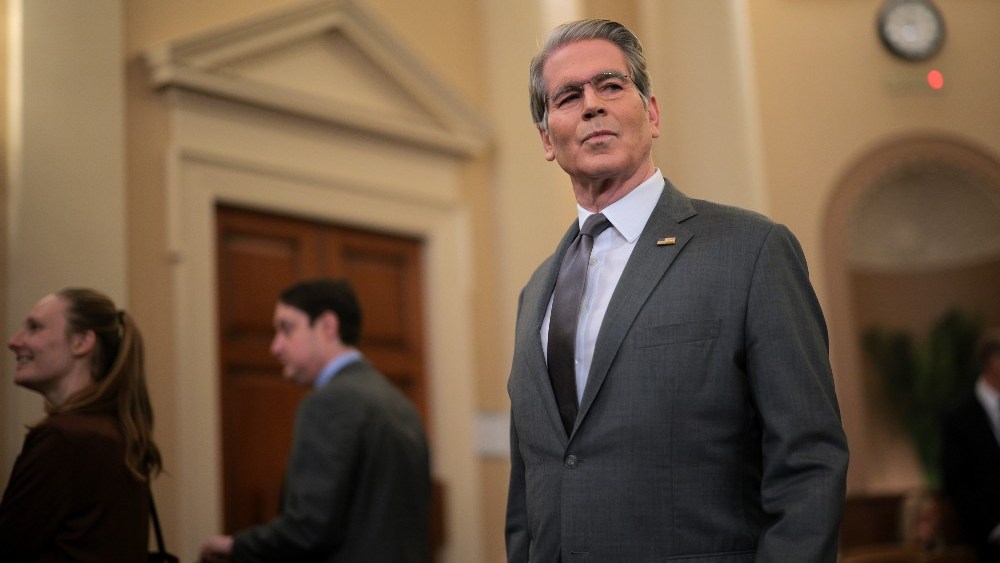
Tariff rates on American trading partners will jump back to the same levels seen before the Supreme Court ruled against the Trump administration’s “reciprocal” duties, according to Treasury Secretary Scott Bessent.
Appearing on CNBC on Thursday, Bessent claimed that the “unfortunate” decision from the nation’s highest court to invalidate President Donald Trump’s International Emergency Economic Powers Act (IEEPA) duties in February will be effectively reversed next month.
“Currently, USTR Ambassador Jamieson Greer is doing studies for Section 301 and if those studies are successful, and I have no reason to believe they won’t be… then the tariff rates are going to go back to exactly where they were,” he said.
“I think it’s been a big success at Treasury. Assuming that the 301 studies go through, we think that there’s going to be a de minimis decline in tariff revenue in our projections for fiscal year 2026,” he added. Bessent also pointed to the global 10 percent duties levied under Section 122 as a part of the tariff “reboot,” though those are slated to expire on July 24.
The Office of the U.S. Trade Representative (USTR) proposed ad valorem tariffs of 10 percent or 12.5 percent on almost all imports from 60 countries following Section 301 investigations into their failure to effectively ban goods produced with forced labor.
The USTR also launched Section 301 investigations into 16 economies including China, the European Union, Mexico, and Japan, claiming that they have structural excess capacity in their manufacturing sectors. Often bolstered by government subsidies, the USTR claimed, the overproduction undercuts U.S. producers. The proposed associated tariffs resulting from that investigation are expected to be announced soon.
Recently released insights from the Atlantic Council attempted to project how much the government can hope to rake in using these tariff mechanisms, and whether new duties imposed under Section 301 can stack up to its IEEPA revenue.
“Drawing on what we know, we have modeled the potential new 301 architecture to show how much revenue the government can hope for. Our first estimate is that a Section 301-based regime could generate up to $169 billion, assuming 2025 import levels,” the nonpartisan public policy organization wrote in early June.
Reports on the amount of revenue the federal government brought in under the IEEPA regime vary, but $166 billion to $175 billion is the range most often cited. Due to the Supreme Court’s decision, the U.S. Treasury is now refunding that money to importers.
But Bessent, a key advisor to the president in trade strategy, is keen to see the coffers refilled—and he’s in agreement that tariffs are still the way to do it, despite a spate of legal challenges to previous efforts, including the Section 122 duties.
At the Economic Club of New York’s America 250 Gala Dinner on Tuesday, the Treasury Secretary provided a snapshot of how he views U.S. economic statecraft in the 21st century. A large portion of his speech pertained to trade relationships, and he said that the country should pursue “trade that is fair, reciprocal, and consistent with our national interest.”
“Countries cannot seek access to our market while denying fair access to theirs. They cannot invite American capital while imposing discriminatory taxes and investment obligations aimed at American companies,” Bessent said.
The U.S. “possesses many tools at its disposal to remedy practices that distort trade and undermine reciprocity,” he said, alluding surely to tariffs, a key tenet of the administration’s economic policy as much as its trade strategy. “We will always seek to use those tools judiciously—but we will never hesitate to use them decisively.”