
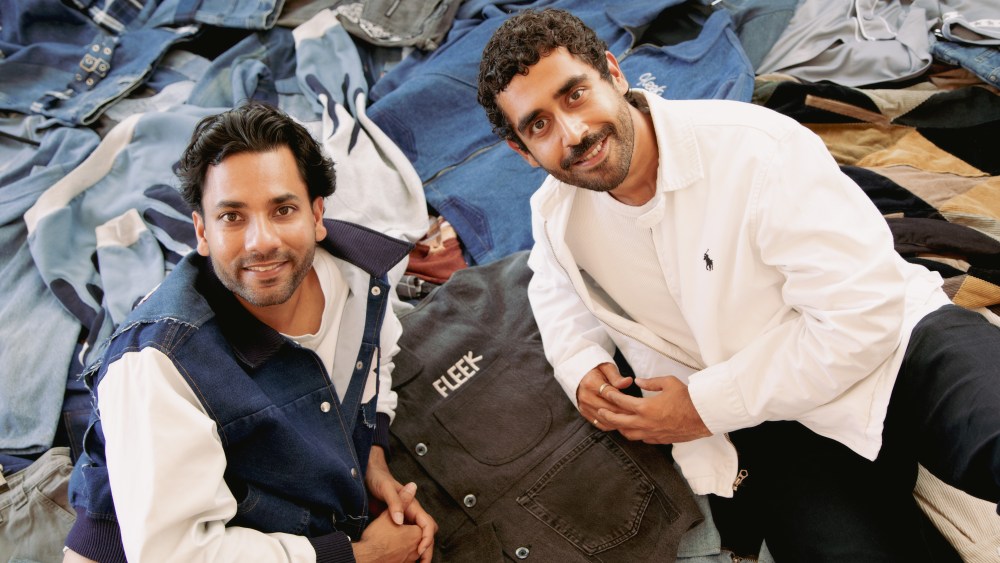
Fleek, a London-based company that wants to bring AI to secondhand fashion, has secured $25 million in its latest funding round.
Founded in 2021 as a wholesale marketplace for preloved fashion, Fleek has lately reframed itself as an AI native that wants to use AI to digitize how the global secondhand fashion market works.
Burda Principal Investments, which had also backed secondhand resale giant Vinted, led the investment with participation from eBay, FJ Labs, and H14, alongside existing investors Andreessen Horowitz, HV Capital, and Y Combinator.
This brings total funding to $45 million, giving the company more resources to improve Fleek Sort, a custom vision-language model trained on millions of secondhand marketplace transactions from Fleek’s global network over the past four years.
“There’s more data locked inside the global secondhand supply chain than almost any other market, yet historically very little of it has been captured,” said Sanket Agarwal, co-founder and chief technology officer of Fleek in a statement.
“We’ve built the world’s first AI trained specifically to understand secondhand inventory—what it is, what it’s worth, who wants it and where demand exists. Every transaction improves that understanding, creating an intelligence layer we believe will become critical infrastructure for the future of the industry.”
There is huge demand for secondhand fashion, a global market that is expected to reach $393 billion by 2030, growing more than two times faster than the overall apparel market, according to the latest industry report from ThredUp, an online consignment and thrift store.
While the world has enough secondhand apparel to clothe the next seven generations of consumers, Fleek believes the infrastructure behind the market is not enough to support the demand.
Garments are still assessed by hand, graded using inconsistent standards and traded through disconnected networks with little pricing transparency, the company said. To meet the demand, the industry ultimately needs the digitization that can only brought by AI.
If traditional practice requires garments to be assessed by hand, Fleek Sort just needs a picture. Fleek Sort helps identify, categorise, grade and merchandise secondhand garments using photographs or videos. It’s already being used by graders in sorting hubs in Pakistan, India and Dubai, and in pilots launching in the U.K., Europe and the U.S.
Once processed, inventory is automatically listed on Fleek’s marketplace, where AI-powered pricing, search, recommendation and matching systems connect stock with relevant buyers around the world.
Fleek Sort grows with the market. Every item graded, listed, and sold trains Fleek Sort, giving the AI lessons based on real-world outcomes. Over time, the company said the AI will be faster and more accurate.
Today, with 12 million items in circulation, Fleek’s platform connects more than 2,000 verified wholesale suppliers and graders with over 50,000 retailers, resellers and boutiques across more than 100 countries.
“Most people have no idea what happens to a piece of clothing after they part with it. It travels thousands of miles, gets sorted by hand in a warehouse in Karachi, and finds its way back to a vintage shop in London or New York, if it’s lucky,” said Abhi Arora, co-founder and CEO of Fleek.
“We started Fleek because that system is broken, the market it serves is exploding, and nobody is building the technology and infrastructure to fix it,” he added.