Preliminary signs from retail experts, online data, and shopping centers pointed to decent gains in traffic and shopping on Black Friday, but without the stampedes of years past.
With the weather turning dry, temperatures in the 40s and 50s and cooling through much of the country, and retailers not letting up on price promoting, Americans got out to shop, both in-store and online on Black Friday.
Depending on the geography, some sources said the retail traffic seemed modest early in the day but picked up by early afternoon, while others cited lines forming before the stores opened.
The level of traffic and sales seen as of early afternoon Friday were enough so that executives felt business was on track to meet industry forecasts for mid-single sales holiday 2026 gains.
At the Westfield Garden State Plaza in Paramus, N.J., “We opened at 7 o’clock this morning and we’ll stay open through 9:30 this evening, and right now, our parking lot is close to full, and turning over really nicely,” William Lewis, director of marketing for the mall, told WWD at 12:30 p.m. “I could walk you to probably 10, 12 stores right now where there are lines outside, and we have active line management in place…What’s interesting is the earlier part of the day was really driven by that younger customer, particularly Gen Alpha.”
Lewis cited Hollister, Abercrombie & Fitch, Skims, Aritzia, Aeropostale, and Editked as being particularly popular on Black Friday.
Regarding department stores, Lewis said, “Macy’s is really leading the charge in terms of discounting. Strong business right across all their categories. They’re doing anything from 40 percent all the way up to 70 percent. Nordstrom’s discounting is more in a region of 40 to 50 percent.” There is also a Neiman Marcus in the mall.
“We are expecting a good season,” said Lewis. “We had good back-to-school and fall seasons. It’s been consistent. NRF research and forecasts are touting four to four-and-a half percent growth” for the holiday season. “That’s certainly what we’re seeing here at Garden State Plaza.”
Apparently, doorbusters are back in style. “If anything, retailers are more aggressive with doorbusters,” said Lewis. He acknowledged all the pre-Black Friday promotions would siphon some retail sales from Black Friday. “But net, net, they’ll get a few extra dollars in their registers,” he added.
Stephen Lebovitz, chief executive officer of CBL Properties, said, “We’ve had a lot of retailers offering doorbusters. And we offered some mystery gift cards, so we had lines as early as 3:30 a.m. at certain malls.”
He said Black Friday’s traffic was strong, particularly at Barnes & Noble, American Eagle Outfitters, Aerie, Offline, Lego, Ulta, Sephora, Bath & Body Works, Pandora, and Lululemon.
“I feel more retailers have been offering early promotions and reasons to get people in the stores on Black Friday,” said Lebovitz. “It’s hard to differentiate and bring in more shoppers earlier in the stores because (sale in stores versus online) are the most profitable transactions.” CBL operates 55 shopping centers, including malls, lifestyle, outlet, and open-air centers.
“The weather has been a little bit strange across the country,” observed Stephen Yalof, president and CEO of Tanger, which operates 38 outlet centers and four open-air lifestyle centers. “It snowed in Grand Rapids, Mich., and Nashville. But from the reports I’ve been getting from both of our centers there, the traffic might have come a little later, but traffic is coming, and shoppers are definitely showing up… Customers today are shopping for value.”
Regarding the Black Friday traffic this year versus last year, Yalof said, “We maxed out our parking lots today, some a bit earlier, some a little bit later. Most of our parking lots are full. I think the customer is starting out a little bit later this year. I think it’s geography-centric.”
He believes the NRF forecast for over $1 trillion being spent this holiday season will be proven correct.
Among the most popular stores at Tanger properties, Yalof cited Ugg, Nike, The North Face, Michael Kors, Hollister, Aerie, Vera Bradley, Abercrombie & Fitch, Adidas, Coach, Ralph Lauren and Under Armour.
“A lot of younger consumers are looking to buy clothes and shoes and starting to dress up more,” said Yalof. He also cited a pickup in coats and other cold weather items, which have been soft due to unseasonably warm temperatures, up until this week.

Salesforce, based on shopping data from more than 1.5 billion global consumers, characterized Black Friday 2026 as the biggest day of the year for online shopping, expected to generate $83 billion in global sales, up 5 percent year-over-year. Salesforce predicted $18.7 billion in online sales in the U.S. on Black Friday, up 4 percent year-over-year. In the U.S., active apparel and active footwear, home, and general apparel, in that order, were tracking as top performers. Globally, appliances, followed by active footwear and active apparel, were the top-selling categories.
Adobe’s U.S. number wasn’t nearly as high, predicting $12.9 billion online on Black Friday, up 9.2 percent year-over-year. Between 10 a.m. and 2 p.m., shoppers would spend $13.7 million online every minute, Adobe projected. Consumers are also taking advantage of buy now, pay later offers, more so than last year, with such plans expected to drive $807 million in online spend, up 8 percent year-over-year, Adobe indicated.
Asked why there’s such a big difference between what Adobe and Salesforce have forecast, an Adobe spokesperson said in an email, “We can’t comment on what other entities are predicting (or) their analysis, but would just note that Adobe’s data comes from a comprehensive analysis of direct transactions online, covering over 1 trillion visits to U.S. retail sites, 100 million SKUs and 18 product categories.”
Forecasts of mid-single digits gains for the holiday season are holding up despite low and middle income consumers being pinched for cash due to rising food, gas, health and housing costs. Retail sales gains are to a great extent being driven by the more affluent cohorts, inflation, AI, and the persistent promotional activity. Nevertheless, there’s uncertainty in the air about how the holiday business ultimately plays out, and whether internet outages, hackers and online scams cause any significant disruption.
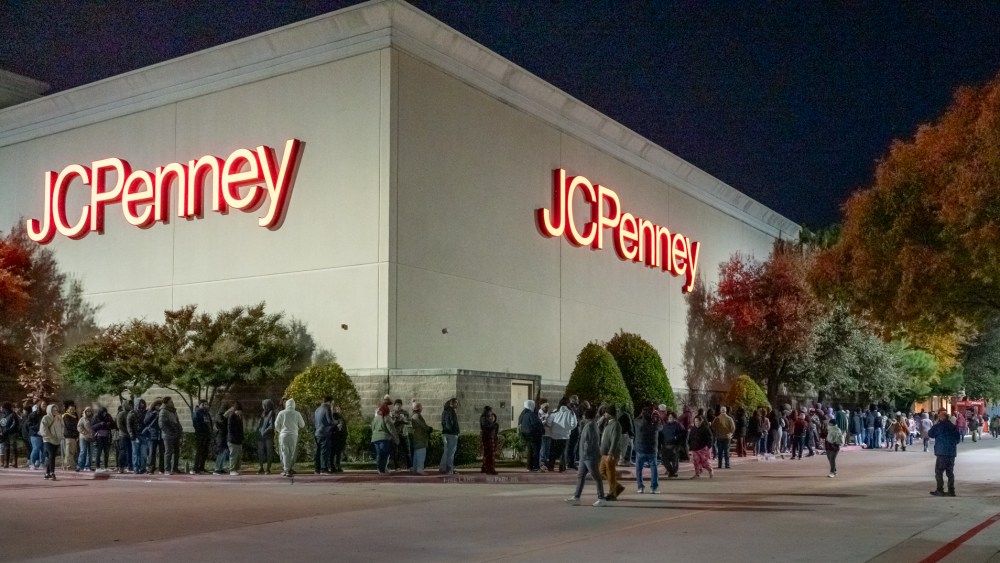
Michelle Wlazlo, CEO of JCPenney, said in a video tape that there were long lines outside Penney’s stores before they opened Friday. “Consumers opt to come for the deal, but they really come because it’s such a family experience. There’s a cash queue outside of the JCPenney store right now, and it’s so fun watching all of our loyal customers get in there and try to win some money,” said Wlazlo, who was at Penney’s in the Barton Creek Square in Austin, Tex., where she was handing out free Harry Potter Hogwarts Express Train snow globes to shoppers entering the store. “Black Friday continues all weekend long. So whether you are getting out there today, Saturday, or Sunday, the deals will continue,” said Wlazlo.
Evan Gold, executive vice president of global partnerships and alliances at Planalytics, said that after Thursday’s storm in the Northeast, on Friday conditions cleared for most customers around the country, supporting retailing. Planalytics forecasts the weather and helps retailers adjust based on future weather conditions.
“For those impacted by the storm, need-based clean up categories will be the initial focus,” rather than gifts, Gold suggested. “This will benefit home centers and mass merchants, especially as many customers are already going to these retail centers for holiday trees and outdoor decorations.
“Most regions and markets across the U.S. will be near or slightly warmer than normal; for example, New York City will be in the mid to upper 50s, but there will still be some gusty winds, so for many shoppers, Black Friday will feel colder that it actually is. Additionally, there are snow threats in the interior Northeast and in the Ohio Valley.”
Added Gold: “For consumers who are out shopping, expect strong demand for warm foods and drinks, rainwear, especially for those who realized yesterday that they don’t have raincoats and boots, and apparel categories such as sweaters, fleece, outerwear, gloves and hats.”