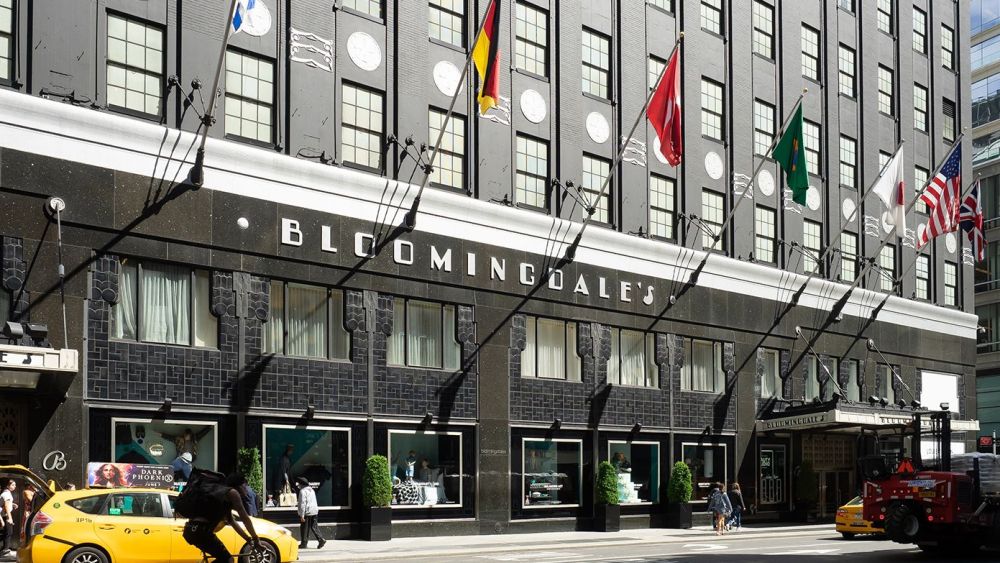
With Bloomingdale’s distancing itself from the competition and strengthening its luxury and contemporary profile, the challenge is clear — how to sustain the momentum and build upon last year’s gains.
That formidable task falls on the shoulders of chief executive officer Olivier Bron, a 48-year-old Frenchman. Before taking the reins of Bloomingdale’s two years ago, he served as CEO of the Central and Robinson Department Stores in Thailand. Before that, he was chief operating officer and director of strategy at Galeries Lafayette Group in France, and earlier he worked at Bain & Company, the global consulting firm, focusing on retail transformations.
“We had a great performance in 2025, which set a new high watermark for Bloomingdale’s. We’re working on building 2026 into a better year than 2025,” Bron told WWD. “It was the highest sales in Bloomingdale’s history. We’re doing amazingly well in ready-to-wear — across the board from contemporary to luxury. We’re doing amazingly well in beauty and in fine jewelry, and we’re doing great in home, which is a key differentiator for us. These trends will keep going in 2026.”
You May Also Like

Bloomingdale’s comparable sales rose 9 percent in the third quarter last year — the upscale department store’s biggest gain in 13 quarters — 5.6 percent in the second quarter, and 3.8 percent in the first quarter. Total annual volume hovers around $4 billion, industry sources estimate.
Bloomingdale’s recent performance provides some affirmation that with proper execution, the department store model is still viable, despite what have been decades of consolidation and skepticism dogging the sector. Bloomingdale’s operates 31 department stores, 25 Bloomingdale’s outlets and four Bloomie’s units, which are smaller, contemporary-oriented versions of the full-line stores.
There’s little chance for opening additional department stores, but Bron has built a strategy for organic growth, with the rallying cry, “Dream Big.” The strategy centers on investing in store renovations at the 59th Street flagship and key branches; building up the luxury image by attracting designer and premium contemporary brands not previously carried, and giving top brands deeper, fulsome presentations and additional points of distribution through much of the store fleet.
“We launched, let’s say, 3,300 new points of distribution over the past 12 months,” said Bron, citing Acne, Chloe, Burberry, Casablanca, Bottega Veneta, Jacquemus, Khaite, Roger Vivier, Skims and Zimmermann as examples.
“We’re still developing our luxury footprint, which was very much focused on a couple of doors. Now, we’re creating the right ecosystem for luxury brands to succeed. We have more opportunities in luxury ready-to-wear and luxury fine jewelry. We also have opportunities outside of New York for really expanding points of distribution.”
He cited 10 “destination” Bloomingdale’s doors best suited to bolstering luxury: 59th Street; South Coast Plaza, Century City, Valley Fair and Fashion Valley, which are all in California; Roosevelt Field in Garden City, N.Y.; Tysons, Va.; Aventura, Fla.; Short Hills, N.J., and Chestnut Hill, Mass.
“But we don’t want again to be luxury only. It’s very important we’re not Neiman Marcus,” Bron said. “The core, the sweet spot for Bloomingdale’s, is premium and contemporary to high luxury. We don’t ask the brands just to join us. We’re creating this ecosystem for them to succeed, meaning great store environments, big spaces for brands to express their identity and great service.
“Let’s move from a transactional relationship with the customer to a more experiential relationship.”

During an interview at Bloomingdale’s Long Island City, N.Y., offices, which command sweeping views of the East River and Manhattan skyline, Bron pointed out that it’s the day before Bloomingdale’s was due to stage its first vendor conference, happening at the 59th Street flagship. (He also maintains his office at the 59th Street flagship.) About 200 people representing 180 vendors would learn about the “Dream Big” strategy, plans for the future and why Bloomingdale’s is an outlier.
“It’s rare in our industry [when] all the planets are aligning like today. The underlying economics are actually pretty OK, despite some uncertainty, and of course, the competition is struggling, but most importantly, it’s the fruits of this ‘Dream Big’ strategy we implemented. It’s about modernizing the assortment, bringing new brands in, and new points of distribution for the brands. We are really expanding with brands that are working well. Our growth is happening with almost no new stores, maybe one outlet here and there, but it’s mostly organic. We’re also playing the role of incubator of new brands to make sure Bloomingdale’s is the place of discovery.”
At the vendor event, Bron would introduce a “partner intelligence platform” geared to strengthen partnerships with vendors by giving them greater information on customer shopping behavior. It’s being beta tested with five brands with the aim of a rollout to all brands within a few months. Vendors will be able to get greater customer information on how a customer shops their brand, other brands and other categories.
“It’s impossible to get this unless you’re launching a big survey, but we have this information,” Bron said. “Brands can benchmark the behavior of their customers against comparable brands. For example, if you’re L’Agence and you’re selling a lot of pants, where are customers buying tops? Department stores are the only ones able to deliver this kind of data.”
“Dream Big” also entails enhancing service and customer engagement by bringing more salespeople to the selling floors. Over the past year or so, about 90 “top” sellers were hired, many recruited from competitors and armed with client books filled with “VICs,” those high-spending, very important clients.
“It’s my worst nightmare when a customer comes to a store and can’t find anyone to help. That’s a disaster,” Bron said. “We increased our number of our VIC sellers — our top sellers — by 30 percent. They sell at least $1.5 million a year [each]. It’s very important that locally we’re relevant. The story we’re building at Bloomingdale’s right now is making us more and more attractive for these top sellers. We have the right brands. We have the right environment. We have the right momentum now. And we have a great culture at Bloomingdale’s.”
So what makes for a good salesperson?
“You have to genuinely care for people,” Bron said. “If you don’t, you don’t belong in retail. At department stores, there’s a complex selling ceremony because we have so many different types of customers and categories. The people in the store have the hardest jobs in the company. Without them, we can’t live. We can’t make a difference. You’re standing all day long, waiting and welcoming customers. And sometimes [business] is soft. Sometimes you have challenging customers. Sometimes you have a bad day or a bad evening with your kids or significant other. And what I keep saying is when you come to the store, you have to shine. You have to be welcoming. You have to be enthusiastic. That’s tough when otherwise, you’ve had a bad day.
“We have not only the best sales ever, but we have the best NPS score ever, thanks to the service that we’re providing in our stores — more people, better people and better training,” meaning more storytelling and awareness of the brands. “Are we perfect? By far no. We will keep working on it. But honestly, when you look at the surveys and what we’ve done, customers can perceive the evolution.”
In certain ways, Bron is reshaping the culture. He’s taking much of what he learned overseas and liked best about department stores in Europe and Asia and applying it to Bloomingdale’s. Overseas, retailers invest in stores differently, often providing richer experiences and presentations, with greater impact than stores in the U.S. He believes that in Europe and in Asia, a visit to a department store can be an enjoyable family outing. That’s not what department stores are generally known for in the U.S.
“Bloomingdale’s is definitely the best job I ever had,” Bron said. “It’s the convergence of everything I learned before and what I’ve learned since coming here. It’s an amazing opportunity to bring everything together with the team here and build the next chapter, the next golden age of Bloomingdale’s. 2024 for me was about learning the U.S. market, learning about Bloomingdale’s, learning how to work with the teams, and for the teams to learn to work with me. It was really about setting the vision. We launched our ‘Dream Big’ strategy two years ago, with this key notion of being the local leader,” meaning dominating the competition in each market where Bloomingdale’s operates, not just in New York City, where for much of Bloomingdale’s history, investments were heavily weighted toward the flagship.
“Our model for the department store model is a profitable and very strong model,” Bron said. “We have a strong balance sheet. We can invest in small brands. We can invest in service. We can invest in renovations.” The plan is to upgrade 12 stores, with renovations underway in Century City and Glendale, Calif., in addition to 59th Street.
“We have 4.2 million active customers every year. They visit at least 2.7 times a year, and many of these customers come every week. So saying the department store model is dead is crazy. There are some boring department stores that might be dead, so we have to keep reinventing ourselves and challenging our reasons for being.”
The Saks Global bankruptcy this year perpetuates doubts about department stores, yet for Bloomingdale’s, “it accelerates our journey,” Bron said. “We were already on track, and our performance was already very strong without the Saks Global situation. Now it’s important for brands to consider some diversification, and we’re probably the best option in that given context. So it’s not changing our strategy. It’s accelerating the success of this strategy. With ‘Dream Big,’ we are on a five-year journey. We started two years ago.”
Saks Global is closing certain department stores — nine have been revealed so far — which could pose some opportunity for Bloomingdale’s. “We remain open to opportunities of potential expansion,” Bron said. “We don’t have any plans right now.” It has to be the right market and right box. “If some opportunities come on the market, we will look for sure.” Bloomingdale’s does not operate any department stores in Texas or the Pacific Northwest, though the retailer has “a pretty strong online performance” in those areas, Bron said.
At Bloomie’s, the smaller format, contemporary-oriented versions of the bigger department stores, “We’re looking for some more opportunities. There is nothing we can share now,” Bron said. “It’s a profitable model for us, and very complimentary to our full-line stores.”
Additional outlets are also expected to open. About 30 percent of the merchandise in the outlets is from Bloomingdale’s department stores; 70 percent is bought expressly. Last year, two outlets were opened.
Asked if food and beverage is another growth opportunity, Bron replied, “I think you are right about that. It’s a very important complimentary service for our customers.” He suggested possibly opening additional restaurants in the department stores, though several operate in such locations as White Plains, Short Hills, South Coast Plaza, Roosevelt Field and 59th Street. “It’s definitely something we’re exploring.”
At 59th Street, there are three restaurants: Forty Carrots for frozen yogurt and salads; Flip for burgers, and Studio 59 for sophisticated cocktails and quick bites like tuna tartare or avocado toast. There is also Magnolia Bakery. A fourth restaurant is being “explored,” Bron said.
Regarding selling food to take home, “It’s a bit more complex in the current environment,” particularly given inflation and low margins. “But we could do that from an opportunistic perspective. In some of our campaigns, where we’re pushing food products, it worked pretty well with [fall 2024 campaign] ‘From Italy With Love.’ But I don’t think it will be a significant portion of our business in the future.” Decades ago, Bloomingdale’s 59th Street operated a section for epicureans on its main floor.
E-commerce represents about 38 percent of Bloomingdale’s total volume. “It’s still growing massively. We’re elevating the editorial content, and bringing new brands in, but the best way to invest in our digital business is to invest in our stores. When we talk about the marketing investment for digital, we talk about lower funnel, which is really about activating Google, Facebook, etc. Upper funnel is more about the branding. But what better way to invest in our brand than investing in our stores? Think about your best experience at Bloomingdale’s. You will never remember a brown box in front of your door shipped by someone you don’t know. That’s not the experience at Bloomingdale’s. It’s about being in a store to buy a suit or a sweater, and the seller was great, the store looked good and the ambience was good.”
His biggest challenge is enabling Bloomingdale’s to keep up with the fast-changing market. “We have to get ahead of the wave, and that’s why I’m pushing and pushing the teams to go bigger and faster. With the opportunities in the market and our positioning, we are doing the right things, but we have to keep going faster.
“My best day at Bloomingdale’s was when I realized what Bloomingdale’s was all about. It was the Saturday launch of ‘From Italy With Love.’ At noon, I told my wife I’m going to spend an hour in the store to check what’s going on. We had so many activations; I really wanted to take a look. Ultimately, I spent six hours in the store instead of one. When I went back home, there was this kind of negotiation with my wife — that’s a different topic. But I realized what Bloomingdale’s was about: all these customers, all these brand partners and our staff having fun together, having a drink together, going from one activation to another, one brand corner to another and spending time together. There is one KPI we don’t measure in our store, that I’m sure would be amazing — the amount of time people spent in the store that day. Sales were great, but most importantly, when I was watching the people, seeing some still there after three hours, I realized, that’s Bloomingdale’s. It was just my best day.”
Since then, Bloomingdale’s has stepped up its special events strategy. “Saturdays at Bloomingdale’s” occurs about eight times a year at all stores. “It’s where people just come to enjoy having a glass of Aperol spritz, an ice cream and chat with the brands doing some activations,” Bron said. “It’s an opportunity for people to relax, spend time together, for brands to cascade their storytelling. It’s about amplifying animation with our vendor partners. You see more carts, more food, DJs, installations and personalization.”
When the “Dream Big” strategy was launched, Bron and his executive team visited every Bloomingdale’s store to explain the strategy to everyone in the stores, before opening hours. “People were challenging us, questioning us. It was about getting some feedback. Were we missing something? The reactions were amazing. So the energy and the vibe it created in the company was amazing. We’ve done that for every single function here in the head office, at every single store. We went to the distribution centers. We went to call centers. We explained to 100 percent of the people in the company what the strategy was. It took us six months. I wanted our people to hear about the strategy directly from me and from the executive committee, not through layers of management and intermediaries.
“Our people are making the Bloomingdale’s experience different. They are engaging. That’s one thing. The brand mix is also different. This mix of contemporary with luxury, I think is very attractive. And look at our stores — they don’t look the same as others. It’s absolutely not the same experience.” There’s a vibe unlike other stores. The stores are high energy, upscale, pulsating with crisp, sophisticated of-the-moment merchandise displays with bright lighting, and they’re often busy, with a multigenerational draw.
“We want people to feel cozy, warm, to feel connected, to feel this relationship. It’s all about emotions, and that’s exactly why we’re investing and redesigning the look, feel and the aesthetic of Bloomingdale’s, because we want people to feel these emotions, and you won’t feel that anywhere else,” Bron said. “We’re redesigning totally the entire store in a warm way, in a festive way,” Bron said, referencing the 59th Street flagship. “Actually the experience at Bloomingdale’s is not as formal as others. It’s not intimidating. It’s easygoing. You can come in your weekend outfit. We don’t care. Come as you are and feel good.
“There’s always something happening. We’re doing these campaigns three or four times per year. So our next campaign this spring is going to be ‘California.’ We will have another campaign in September, and another campaign for holidays. You don’t see that anywhere else. Each of these campaigns will be bigger and more impactful from a creative standpoint and an execution standpoint.
“There’s a lot to do, and we have to go fast, but the opportunity is here. We have this opportunity to bring Bloomingdale’s to international market standards. It’s an opportunity to really realign the department store strategies with the brand strategies. It’s about more storytelling, and less about pricing and discount and things like that. It has to be vibrant, but without being overwhelming.”