Sombr made his fashion campaign debut inside Cy Twombly’s Italian palazzo. Julia Fox climbed into a bubble bath for a sexual-wellness gummy. American Eagle followed last fall’s widely argued-over “great jeans” campaign with an April sequel built around another Sydney Sweeney pun: “Syd for Short.”
Bluesign cast textile chemistry.
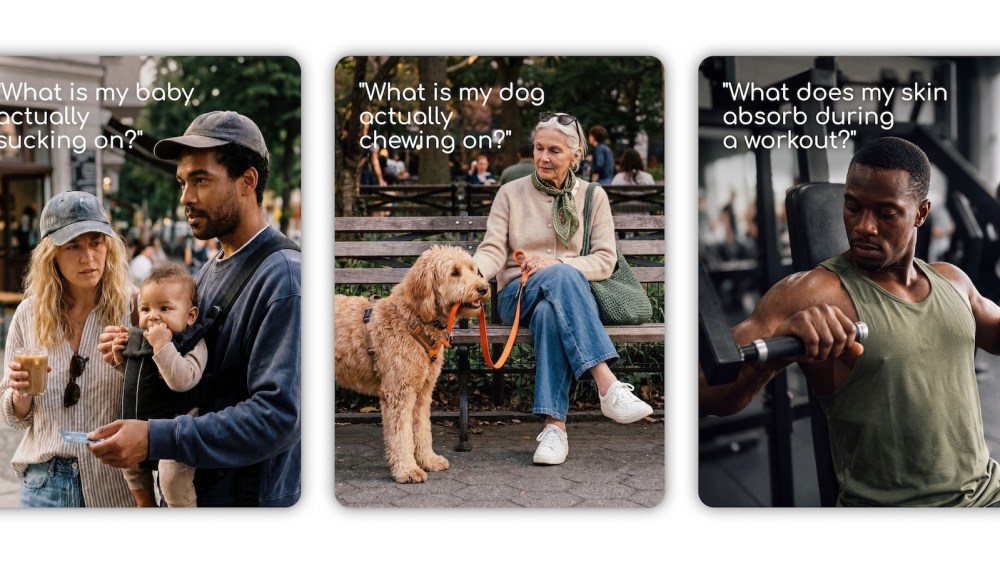
A baby chews on the strap of a carrier. New socks bleed color in the wash. A jacket goes out in the rain.
The Swiss-founded textile chemical management organization has spent 25 years working on the manufacturing questions behind those moments. Now it wants shoppers to know its name.

Bluesign plans to launch “The Unseen Process” on Sept. 20, its first global consumer advertising campaign. The ads move the organization out of factories and sourcing departments and into the fitting room, laundry basket and checkout line.
“We check how it was made,” the campaign tells shoppers. One rainwear execution gets more specific: “So the coating stays on the jacket, not on your skin.”
The campaign also introduces shoppers to BluePass, the certification mark replacing the Bluesign Product and Bluesign Approved designations. Bluesign began the transition in April. The criteria and assessment process remain the same, the company said, while the new label adds standardized claim language, a QR code and a unique certification ID.

The QR code directs shoppers to a Bluesign-controlled platform with information about how a product meets its criteria and how the underlying processes were assessed. The system has three marks: one for finished consumer goods, another for intermediate articles such as fabrics and trims and a third for chemical products. Existing labels remain valid while companies switch over during 2026.
“When a consumer recognizes and scans a Bluepass label, they are not just seeing a claim, they are accessing the verified information behind it,” Barbara Oswald, Bluesign’s chief commercial officer, said when the system debuted in April.
Despite its consumer-product mark, Bluesign says it certifies production processes rather than finished products themselves. Eligibility depends on the share of a product made with materials from processes that passed its review.
According to Bluesign’s verification page, at least 90 percent of an apparel product’s textile components and 30 percent of its accessories must come from assessed processes, with the accessory minimum rising to 40 percent in January 2027. Zippers, buttons, threads and trims count toward that category. Suppliers of the remaining materials must meet the brand’s restricted-substances requirements.

Bluesign assesses chemical inputs, material traceability, resource use, emissions, wastewater and worker safety, among other areas. The campaign preview does not specify the protocols or results supporting its statements about coatings remaining off skin or color staying in socks. But the ads’ everyday language tracks with research from Ceres and Northwind Climate. In September 2025 message testing, statements about longer-lasting products, recycling and lower energy use outperformed “third-party certified,” one of the weakest phrases tested in the organizations’ “From Intention to Action” report.
The research did not test BluePass or apparel labels. In a separate July survey conducted by Northwind Climate, nearly half of 2,297 U.S. adults said they had passed over a more sustainable product, often because of price or doubts about quality.
The Bluesign campaign arrives seven days before the European Union’s Empowering Consumers for the Green Transition directive begins applying on Sept. 27. Under the new rules, sustainability labels must be established by a public authority or based on a certification scheme that meets requirements including independent third-party verification and publicly available terms.

The certification scheme does not automatically substantiate every claim made alongside its label. European Commission services said in June guidance that claims made through sustainability labels remain subject to other rules barring misleading commercial practices.
Bluesign says the directive drove the change to BluePass and that the QR-linked evidence is designed to meet its requirements. The company has said the labeling system will be implemented across its network of more than 900 partner brands, manufacturers and chemical suppliers.
The campaign preview does not name the participating brands or say how many products will carry BluePass at launch. It also does not disclose its spending, channel mix, markets or whether companies face new fees to change labels and use the verification service.
A July Flywheel report said 80 percent of consumers take a nonlinear path to purchase, moving among social platforms, search, retail media and physical stores.
Moncler’s “Warmer Together” campaign, fronted by Al Pacino and Robert De Niro, ran globally across outdoor, press, web and social. In June, it beat roughly 130 entries to win the Grand Prix Luxury Lion at the 73rd Cannes Lions International Festival of Creativity.