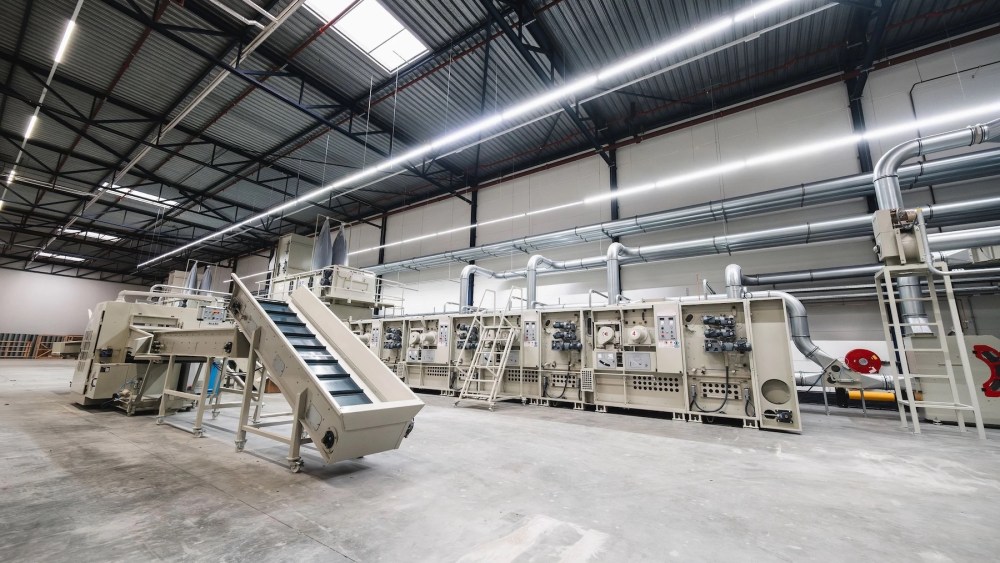
Dutch textile recycler Brightfiber Textiles has suspended fiber production at its Amsterdam facility, citing insufficient investment and slower-than-expected demand for circular textiles.
The company said production would stop immediately and remain suspended until further notice. It plans to keep sorting discarded textiles for reuse and recycling while exploring whether it can resume fiber manufacturing elsewhere in Europe.
Founder and chief executive officer Ellen Mensink said Brightfiber had spent the past year developing and upgrading an industrial line for mechanically recycling post-consumer textile waste into fibers used in yarns, fabrics and finished products.
The company maintains that its technology can produce commercially competitive recycled materials but said market conditions had prevented it from sustaining manufacturing operations in the Netherlands.
Brightfiber attributed the decision to several pressures, including insufficient enforcement of textile regulations, competition from ultra-fast fashion and geopolitical uncertainty affecting brands’ sustainability budgets. It also said the investment needed to support its transition to larger-scale production had not materialized in time.
The company did not disclose how much financing it sought, its production volumes or the financial performance of the Amsterdam operation.
Brightfiber opened its recycling facility in February 2025, working with textile recycling specialist Wieland Textiles. The operation uses near-infrared technology to sort discarded clothing by fiber composition and color, along with automated systems that prepare materials for mechanical recycling.
Brightfiber says its GRS-certified products contain at least 40 percent Dutch textile waste. The company has not disclosed updated production figures or the volume of material processed before the suspension.
Mensink was still courting investors in September, when she invited prospective backers to tour Brightfiber’s Amsterdam facility. At the time, she said the production line was operational and that the company needed additional financing to expand.
A September study of the Dutch textile recycling sector identified comparable challenges, finding that additional collection and processing capacity alone would not ensure a viable fiber-to-fiber recycling industry.
Prepared by Circular Innovations as part of the Ketendoorbraakproject Circulair Textiel initiative, the analysis modeled how demand, production costs, technology and producer funding could affect the sector through 2036.
The study projects 29,000 metric tons of potential recycled-fiber output in the Netherlands by 2030. But under its reference scenario, demand would support only 16,000 metric tons—leaving a substantial gap between production potential and market demand for recycled materials.
The study also estimated a commercial viability gap of approximately 22 million euros (roughly $24.6 million) in its 2030 reference scenario. It found that additional producer funding could help close the gap, although the analysis did not account for the capital investment required to build recycling facilities.
The findings provide broader context for Brightfiber’s suspension but do not establish what caused the company’s financial difficulties.
Brightfiber now intends to concentrate on textile sorting, material preparation and product development with existing partners. It also plans to expand its white-label business through a collection of knitted and woven products scheduled for release later this year.
The company is evaluating opportunities to continue fiber production elsewhere in Europe, although it has not identified a prospective location or manufacturing partner.
For textile recyclers, the challenge goes beyond securing enough discarded clothing to process. The Dutch study suggests that even facilities with sufficient material and production capacity may struggle to operate commercially without buyers willing to pay prices that cover their costs. Financing the facilities themselves presents a separate hurdle.