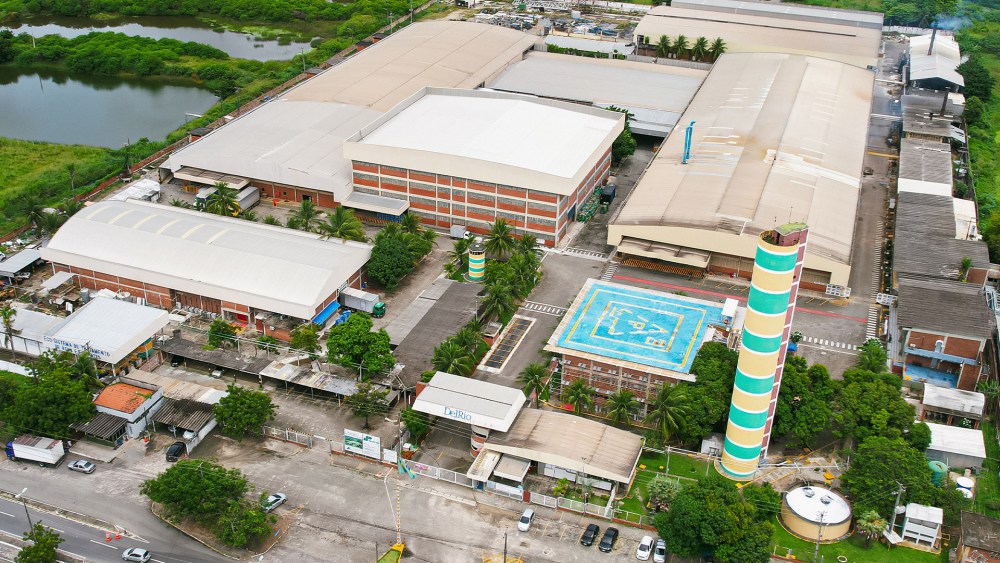
DelRio is entering a new chapter in its more than 60-year history. Based in Northeast Brazil, the massive vertically integrated manufacturer’s 5,000-strong workforce produces around 70 million garments per year. With a legacy in intimate apparel, DelRio has been growing its capabilities in activewear.
With an EBITDA margin of around 20 percent, DelRio now aims to become a premier Western Hemisphere original equipment manufacturer and original design manufacturer platform for brands and retailers in underwear and activewear, combining scale, vertical integration, industrial independence and access to the U.S. and European markets.
Here, the company’s founder and president of the board Carlos Pereira de Souza discusses DelRio’s competitive advantages, its plans to further scale its business and what sets Brazil apart as a sourcing destination.

Sourcing Journal: Could you give an overview of DelRio’s operations and capabilities?
Carlos Pereira de Souza: DelRio combines consumer market knowledge with large-scale manufacturing capability. Because we operate both a Brazilian brand and the factory platform behind it, we understand the consumer, the product and the factory floor.
Today we produce seamless and cut-and-sew underwear and activewear at scale, working with nylon, spandex, cotton, modal and selected polyester blends. Our mission is to build one of the most competitive apparel manufacturing platforms in the Americas, serving leading brands and retailers across the Americas and Europe with quality, reliability, speed and cost discipline.
Sourcing Journal: What differentiates DelRio’s manufacturing platform?
C.P.S.: The first advantage is scale, which creates discipline in planning, procurement, quality control and industrial engineering.
We’re also vertically integrated. We produce our own fabrics and elastics and operate important parts of the production chain, giving us more control over quality, lead times and costs.
The third advantage is specialization. Intimates and activewear are technical categories—fit, stretch, comfort, durability and consistency matter. You cannot treat these products like basic apparel. Our know-how is in high-volume production of products that touch the body and need to perform every day. We support brands through product development, material selection, sampling, product engineering and industrialization for large-scale production.
Sourcing Journal: What is the growth strategy for the company’s next chapter?
C.P.S.: We see two major growth vectors: expanding our OEM and ODM manufacturing business with brands and retailers serving the U.S. and European markets and gaining market share and growing in Brazil and South America. Both depend on the same agenda for industrial competitiveness: lowering production costs, raising quality standards and developing more differentiated products.
DelRio already has the scale, workforce and industrial base to pursue these strategies. To accelerate our efforts, we are seeking the right strategic investor that can bring additional operational, product-development and market expertise as we build a platform serving Europe, North America and South America.
For an investor, the opportunity is to scale and add value to an established platform with proven operating performance. Its high-volume manufacturing base is anchored by the robust domestic demand generated by DelRio’s own leading brand in Brazil, while also serving as a fast and resilient sourcing alternative for North American and European brands.
Sourcing Journal: Why is Brazil uniquely positioned as a Western Hemisphere sourcing platform for the U.S. and Europe?
C.P.S.: Brazil offers a rare combination of industrial depth, geographic diversification and Atlantic access. For the U.S., Northeast Brazil can be part of a nearshore sourcing strategy. For Europe, it provides a direct Atlantic sourcing alternative to long and highly concentrated Asia-dependent supply chains. Brazil also has a complete fiber-to-fashion supply chain and can source most key raw materials domestically, significantly reducing dependence on Asia.
That matters because resilience now requires capable production in more than one geography. Brands and retailers do not need to abandon Asia, but they do need complementary capacity outside the traditional Asian sourcing corridor. A strong Western Hemisphere platform gives them more options when tariffs, geopolitical events, port congestion, freight disruption or capacity constraints affect one part of the network.
Sourcing Journal: What does that mean specifically for U.S. and European sourcing teams?
C.P.S.: For sourcing teams, the value proposition is practical: quality, cost, speed and resilience.
Northeast Brazil has among the lowest labor cost structures in the Americas and one of the most competitive sewing costs per minute in the hemisphere. At the same time, port-to-port transit from Pecém is approximately nine days to the Port of New York/New Jersey and approximately 11 days to the Port of Rotterdam.
Brands and retailers can work with a large-scale, technically capable factory with short Atlantic access to both markets, supporting faster replenishment and lower inventory risk.

Sourcing Journal: How does the changing tariff environment affect DelRio’s competitiveness?
C.P.S.: Tariff competitiveness is an important part of every sourcing decision. In Europe, the outlook has improved significantly. The EU-Mercosur trade agreement began taking effect in May 2026, and tariff reductions are already underway. This is an important achievement for Brazil and strengthens the country’s competitiveness as a sourcing platform for Europe.
Another encouraging development is Canada. Mercosur and Canada are targeting a free trade agreement by the end of 2026, which could further strengthen Brazil’s competitiveness and broaden its opportunities in North America.
With the United States, negotiations are ongoing. Since the U.S. ran a substantial trade surplus with Brazil in 2025, we do not see the additional tariffs as a response to a structural trade deficit. Given the political context surrounding Brazil’s 2026 presidential election, we view them as part of a broader negotiation. The post-election environment should create more room for a constructive outcome and a move closer to the original 10 percent tariff baseline, especially given Brazil’s importance to the U.S.
Sourcing Journal: How do you view the Brazilian domestic opportunity?
C.P.S.: Brazil is not only an export base. It is one of the world’s largest apparel markets, with around 90 percent of consumption supplied by local factories in a tariff-protected environment.
Most producers still trail global benchmarks in efficiency, product development and quality systems. That gap gives DelRio room to gain share, while the domestic market provides scale and stability for international expansion.
Sourcing Journal: What kinds of partners is DelRio looking for now?
C.P.S.: First, we want to work with U.S. and European brands and retailers seeking reliable OEM/ODM capacity and greater sourcing resilience.
Second, we are seeking a partner that shares our vision of building the most competitive intimates and activewear manufacturing and sourcing platform in the Western Hemisphere, serving the Americas and Europe.
Click here to learn more about DelRio. To discuss OEM/ODM manufacturing, strategic partnerships or long-term growth opportunities, contact business.development@delrioexport.com.