When Kering CEO Luca de Meo announced at last month’s Capital Markets Day in Florence that the luxury conglomerate would reduce its reliance on leather by 30 percent by 2028, he signaled nothing less than a seismic shift away from a material long central to the business.
Buried among dozens of announcements tied to the group’s new ReconKering vision, the news was easy to miss, even if its significance was hard to ignore. Leather accounts for roughly half of Kering’s total raw material use and remains its largest product category, representing 49 percent of global revenue. In 2025 alone, the group sourced approximately 38,000 tons of cow and sheep hides across brands including Balenciaga, Gucci and Saint Laurent.
Still, Kering is aiming to pivot toward so-called “next-generation” alternatives, which de Meo said could account for as much as 40 percent of its materials by 2035. The move now carries an added twist: the European Commission has decided to exclude leather imports from its anti-deforestation law, even as obligations for large and medium-sized enterprises are set to take effect later this year.
It’s not a done deal—not entirely, anyway. The public feedback period for the proposal to amend and simplify the EU Deforestation Regulation, or EUDR, runs through June 1. But with leather trade groups pressuring for the exclusion and leather-heavy brands—including Kering’s—largely staying silent, the conclusion seems all but inevitable. LVMH, Tapestry and Prada Group also did not respond or declined to respond to requests for comment.
“They’ve basically been hammering this message that leather is not linked to deforestation, despite overwhelming evidence to the contrary from years of investigative and research work that shows that leather has a very direct link to large-scale illegal deforestation, including in Indigenous territories,” said Rubens Carvalho, deputy director at Earthsight, a London-based environmental watchdog group.
Carvalho’s skepticism is backed by Earthsight’s research, which has repeatedly linked cotton and leather supply chains tied to major brands to illegally deforested land in and around ecologically fragile regions such as the Brazilian Amazon. Broader industry data adds weight to his argument: a 2024 study found that leather linked to European supply chains was associated with up to 31,000 hectares—or nearly 77,000 acres—of forest loss annually. New data from the World Resources Institute shows the world lost 4.3 million hectares of tropical primary forest in 2025 alone—equivalent to almost 11 football fields per minute—with agricultural expansion being the leading cause.
“It’s clear that this is a political move and not a proposal based on evidence or the Commission’s own analysis, because the assessment of the Commission published clearly justifies maintaining leather in the regulation,” he said. “If there is one commodity that makes sense to regulate, it is leather, because the EU is one of the world’s largest markets for it.”
Europe imports 1.3 billion euros ($1.5 billion) worth of bovine leather and hides annually, including 263 million euros ($305 million) from Brazil and 26 million euros ($30 million) from Paraguay, another country with significant forest ecosystems, according to Eurostat, the EU statistics agency. That is pretty significant leverage, Carvalho said.
The EUDR could also deliver real climate impact. It’s estimated to save emissions equivalent to 18 million cars driving on the road each year, according to Earthsight analysis of the Commission’s impact assessment. Yet between 2024 and 2025, seven out of the top 10 Brazilian states for tree cover loss exported leather to the EU, it added.
In its draft delegated act for the EUDR, however, the European Commission recommended removing hides, skins and leather products from the regulation’s scope, arguing that their relatively low economic value as “derived products” compared to meat, along with asymmetries in trade flows, limits companies’ ability to obtain the information necessary for compliance. It also cautioned that maintaining downstream leather products within scope could create a “fragmented and incoherent approach” for the industry that risks shifting—rather than eliminating—deforestation by pushing production outside the bloc.
COTANCE, the European tanning industry group, more than welcomed the move, calling it “a historic moment for the tanning industry” and saying it supports its belief that bovine hides are not a driving factor of cattle farming and therefore cannot be considered a cause of deforestation.
“The Commission has rectified a fundamental flaw that has existed since the EUDR proposal was first put forward, confirming what logic has long suggested: converting a by-product of livestock into leather does not drive deforestation,” said Edoardo De Paola, secretary-general of COTANCE. He said European tanners operate under some of the “most stringent environmental and social standards in the world” and that the industry’s ongoing investment in traceability infrastructure reflects a “genuine commitment to accountability.”
A reputational risk
But Emma Håkansson, founding director of Collective Fashion Justice, a not-for-profit aimed at creating a “total ethics fashion system,” doesn’t buy it, calling the leather industry’s claims to sustainability, while campaigning to undermine the EUDR and other EU environmental protections, “disingenuous.”
“Leather is a profitable co-product of the meat industry; it is not a worthless by-product,” she said. “The leather industry does not operate as a waste-diverting charity, and it must take responsibility for the deforestation, environmental destruction, animal suffering and Indigenous land rights violations associated with deforestation in its value chains.”
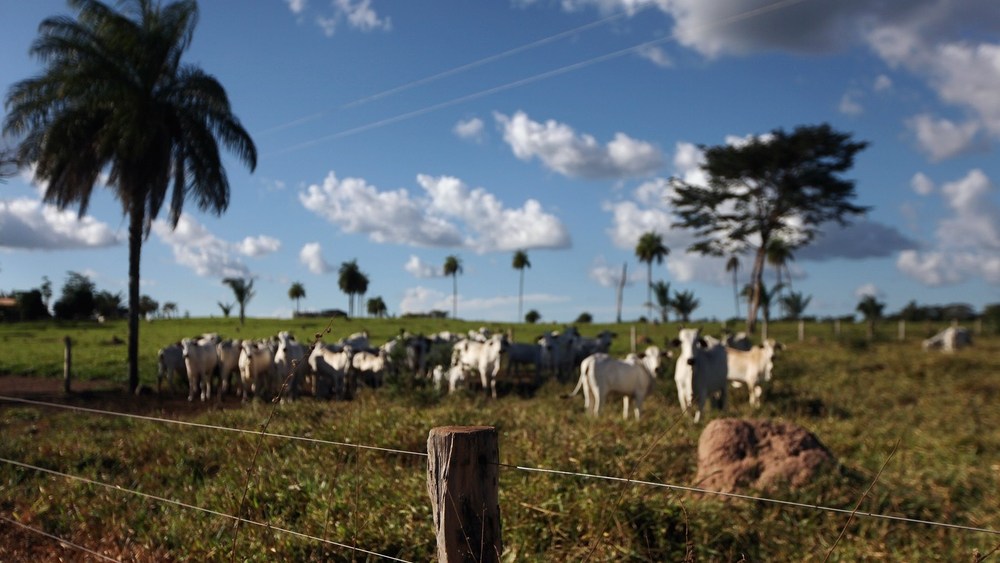
Collective Fashion Justice’s own calculations, based on existing research, find that in Brazil—where 80 percent of Amazonian deforestation is tied to cattle ranching in the leather supply chain—the production of enough cowhide leather for fewer than 10 bags can result in 10,000 square meters of once-biodiverse land being cleared or kept cleared for production.
Textile Exchange, the multi-stakeholder organization that launched the Deforestation-Free Call to Action for Leather in 2023, likewise said it was disappointed by the European Commission’s decision and that the Leather Working Group and World Wildlife Fund will continue to urge brands and retailers to commit to sourcing bovine leather from deforestation- and conversion-free supply chains by 2030—if not earlier.
“The rationale for the Deforestation-Free Call to Action for Leather remains as important as ever,” said Anna Heaton, Textile Exchange’s animal materials lead. “While beef production is the primary reason for cattle farming, the leather industry has an important opportunity to drive change. The Deforestation-Free Call to Action for Leather sets meaningful expectations for brands and retailers, with tools and guidance to support them on their journey.”
What Carvalho wants to see, however, is brands actively advocating for keeping leather in the EUDR while offering their customers more sustainable choices.
“If leather is not regulated, they’re removing their customers’ ability to have those options, because we know that leather has long suffered from lack of traceability and due diligence,” he said. “We don’t believe the sector can voluntarily regulate itself and clean up its supply chains. It’s had decades to do that, and it hasn’t. The only way to achieve that is through regulations, so this is really the opportunity to make that happen.”
A coalition of NGOs, including the Environmental Investigation Agency and Greenpeace, agrees with him. In an open letter to the European fashion industry, they warned that brands’ reputations are at risk if they remain silent. A law that includes leather, the organizations said, is the “only mechanism” that can provide “credible, independently verifiable assurance that leather tanned in Europe is free of deforestation and human rights abuses.”
Right now, the organizations added, the brands’ silence is being interpreted by decision-makers as consent.
“Without a guarantee that all leather tanned in Europe is deforestation-free and legal, you will need to pay for supply chain traceability in order to satisfy consumers that your leather products are not linked to the destruction of the Amazon or the Indigenous communities protecting it,” the letter said. “Without the EUDR’s leverage, that traceability will be far harder to build and verify independently. The legal, commercial, and reputational risks of avoiding dirty leather will fall on your shoulders. A single story linking your brand to illegal cattle ranching could undo years of sustainability positioning. ‘We relied on our supplier’s assurances’ will not be an acceptable defence.”
Håkansson went further, saying that if fashion is serious about sustainability, it must divest from animal-derived leather entirely and replace it with recycled and biomaterial sources. In this, Kering is leading the way, she said.
“Kering’s commitment to do this is commendable and one the industry must follow,” she said. “It benefits biodiversity, reduces potent methane emissions and protects animals.”