
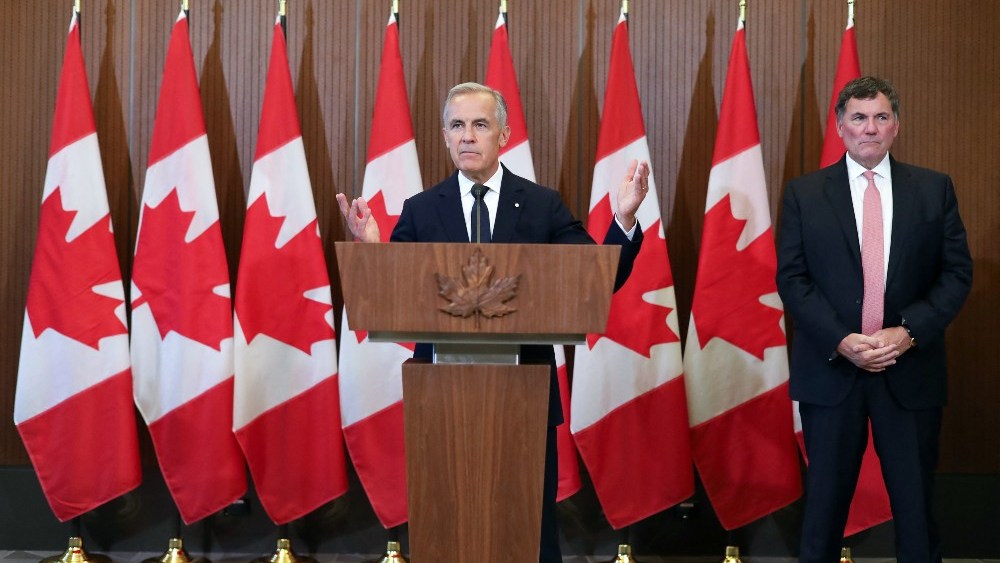
Talks between the United States and Canada about a deal that could have staved off the imposition of 50 percent duties fell apart Friday evening, deepening a months-long fracture between the North American neighbors.
Canadian Prime Minister Mark Carney summoned the country’s premier negotiators back to Ottowa after days of back-and-forth with U.S. Trade Representative Ambassador Jamieson Greer and other members of the administration, saying that the delta between the countries’ respective demands and concessions had grown too wide.
The U.S. tariffs, which impact 5 percent of all Canadian imports including textile and apparel products, took effect Saturday. Carney vowed that Canada would issue its own retaliatory duties against U.S. goods by Sept. 8.
“We progressed to a point Tuesday night where we had enough agreement among the parties to announce that we had… found the way to a deal,” Greer told CNBC Monday, assessing the fallout. “Then we set about to finalize it, and then in the last hours, I think there were things that the Canadians just—you know, they wanted more,” he said.
President Donald Trump on Monday responded to Canada’s threat with one of his own: that the U.S. would raise tariffs on Canadian cars, trucks and auto parts to 50 percent on Jan. 1, 2027. Last week’s scrapped deal, by contrast, reportedly included cuts to the topline tariff rate on Canadian autos from 25 percent to 15 percent, and on aluminum and steel from 50 percent to 25 percent.
The news prompted a swift response from Carney, who on Monday afternoon highlighted the disadvantages that such a trade policy could present for Americans and Canadians alike, given the collaborative nature of essential supply chains for products like cars and their parts. “What message does that send to workers in Michigan, Ohio, Kentucky and Alabama who rely on Canadian demand?” he asked.
“An attitude at the negotiating table that Canada is a subsidiary of the United States, that Canadian industry is going to be disadvantaged relative to American industry, that we’re going to set up terms so that over time Canadian industry is going to face constant headwinds—that’s not something we are going to accept,” Carney said.
Ontario Premier Doug Ford was more succinct in his assessment of the situation, calling Trump a “dictator” and a “bully.” He commended Carney for walking away from the trade talks rather than capitulating to American demands.
The war of words raged on, with Trump responding to Ford with personal and pointed jabs while asserting that “America has been carrying Canada for decades” economically. “The U.S.A. will always be far bigger, richer, and stronger than Canada. Without the United States, Canada couldn’t survive,” he wrote on Truth Social, threatening that the country’s leadership should “fall in line” or risk an escalation in consequences.
The tit-for-tat televised browbeating, tweeting and Truthing between leaders raised eyebrows and heart rates.
“Our industry may not be the primary target of these tariffs, but apparel and footwear companies will still feel the impact. Canada is an important source for certain tailored and wool apparel, ski jackets and other outerwear, waterproof footwear, hosiery, and specific travel goods categories,” Beth Hughes, vice president of trade and customs policy at the American Apparel and Footwear Association, told Sourcing Journal.
“By applying duties to USMCA-qualifying products, these measures create unnecessary costs and uncertainty while weakening the benefits of North American trade,” she added, noting that the group hopes both sides will return to the negotiating table despite the rough rhetoric.
“Surprised” but “not shocked” was the reaction from Nicole Bivens Collinson, International Trade and Government Relations Practice leader at Sandler, Travis & Rosenberg, P.A. She said she could “easily imagine a scenario” where the i’s were nearly dotted and the t’s nearly crossed on the deal only for Trump to make a last-minute demand shift with the expectation that the Canadians would cave readily.
Trump’s announcement regarding enhanced auto duties because of Canada’s subsequent tariff threat was “to be expected,” she said, as the Commander in Chief isn’t known for shying away from trade conflict. The timing, she believes, is notable, however, given that the tariffs will take effect two months after the midterm elections.
“Americans are hurting in their pocketbooks and they don’t need even higher tariffs on goods that they need from Canada,” Collinson said, “so I think the delay is intentional, to give some room for possible negotiations but to push any impact to American companies and consumers until after the elections and holidays.”
The escalation in trade actions and harsh words will almost certainly have an impact on future U.S.-Mexico-Canada Agreement (USMCA) negotiations, she believes—and that could spell further trouble for producers of textile and apparel working across borders to create products using inputs and labor spanning multiple markets.
“I think this breakdown is significant. I think it will cause the U.S. and Mexico to double down on their bilateral negotiations and leave Canada out of it. It is possible that if the U.S. and Mexico reach an agreement, the U.S. will pull out of the USMCA,” she opined.
Dave Townsend, partner in Dorsey & Whitney’s International Trade Group, agreed that the developments of recent days have injected more trouble into USMCA negotiations. Those mediations were already fraught due to the U.S. decision not to renew the trilateral trade pact in July, which triggered a cycle of yearly reviews.
“I think from Canada’s perspective, what the United States has chosen to do is inconsistent with [USMCA],” he said, referring to the new 50 percent duties, levied under Section 338 of the Tariff Act of 1930.
“I think [Canada] would say they’re fully committed to the USMCA, including a potential renegotiation of it, and the current trade negotiations are sort of a steppingstone” toward broader talks about its future. “Both sides need to get to a position where they can resolve the current trade war or trade dispute before they can get back to the longer-term horizon of working out a new USMCA deal,” he added.
In the near-term, though, importers on both sides of the border are no doubt nonplussed by the new tariffs, and Townsend believes their respective governments will hear about it. “It seems unlikely to me that a 50 percent tariff on the broad range of goods coming into the United States would be acceptable to either side, really, over a long period,” he said.
Asked whether he believes companies sourcing from Canada will remain in a holding pattern as government leaders continue to squabble, Townsend said many may not have another option but to make swift choices about sourcing in the face of uncertainty.
“Now, it’s an issue of, ‘Are we holding shipments?’” he said. “It’s back into the framework of April 2025 when the initial reciprocal tariffs came out: ‘How long can we wait? Are there options to defer shipments? What’s our inventory look like? If we’re in a situation where we have multiple supply lines, can we rely on those?’ Those kinds of questions—maybe a week ago they hoped they weren’t going to have to confront them, but now they are, because the tariffs are actually in effect.”
The American Association of Exporters and Importers said as much on Monday, calling the dissolution of the trade relationship “deeply disappointing” and warning that “the consequences will extend far beyond” the immediate impacts of the new duties.
Canada isn’t just a trading partner, it’s “an integral part of North American supply chains,” the group wrote in a statement, noting that manufacturers, distributors, retailers, and other businesses “rely on the predictable movement of goods, components, and materials across the border to remain competitive.”
“The impact will be especially significant for small and midsized U.S. businesses that depend on access to Canadian customers. For many of these companies, Canada represents an important and accessible export market. New tariffs can make their products less competitive overnight,” the group added.
“We strongly encourage both governments to return to the negotiating table and find a durable path forward,” AAEI wrote.
Drew DeLong, head of corporate statecraft at Kearney Foresight, an arm of global management consultancy Kearney, said he believes the nuances of the actions of both governments are telling.
Canada has its own elections coming up, he said, and positioning is no doubt crucial to Canada’s Liberal Party, of which Carney is a part. The prime minister is polling favorably as he continues to stand up to Trump when it comes to trade and tariffs, earning kudos even from Conservative Party premiers like Ford for upholding Canada’s sovereignty and refusing to bend the knee to U.S. demands.
Meanwhile, Trump announcing tariffs that will take effect in five months, rather than this week, points perhaps to a desire to use the threat as leverage toward a desired outcome. “I think that this administration economically has shown that they are willing to send a shot across the bow” before taking trade actions that would cause “immediate whiplash,” DeLong said.
Canada’s response to Trump’s persistent tariff saber rattling has also illustrated key differences in the way North American trading partners are approaching trade in the 21st century. “I think this a very interesting moment that I believe will be studied in the textbooks of trade policy history for a very long time,” DeLong asserted.
“What we’ve seen is a bifurcation in how both countries are negotiating, where Mexico seems to be doubling down on aligning with the U.S. economic security agenda, and meanwhile, to the north, you have Canada positioning with more domestic sovereignty and looking for broader trade diversification in other markets,” he said.
Carney has been championing the world’s so-called “middle powers” while pushing back against the hegemony of the U.S. Over the past year, Canada has engaged with China and Europe to secure more robust trade relationships while Mexico imposed duties on foreign-made products—widely viewed as a means of appeasing Washington by espousing a more protectionist agenda. “They’re two very different approaches,” DeLong added.
Viewing the situation through that lens, there are several scenarios that he believes could take shape regarding the future of North American trade. “Scenario One is that we stay in perma-negotiations like this until the end of this administration, and then we see what the next admin looks like,” he said.
“Scenario Two is that we get two separate deals between Mexico-U.S. and Canada-U.S., and they stack with existing USMCA, but there’s no return to a trilateral handshake, and that adds higher costs and higher complexity to the businesses that operate across all three countries,” he added. There’s a “third domain,” or a “Scenario Three,” of course—wherein the three countries can work out their differences and reframe USMCA with a fresh and productive outlook—but the window appears to be rapidly closing on that possibility.
For North American business leaders relying on the trade pact, which provides cross-border duty-free access across three markets, USMCA represents a critical source of stability and the upheaval is undoubtedly unwelcome.
“All of these conversations are taking place around what new hoops everyone must jump through to retain that duty-free access—and now, that’s not one set of negotiations” around USMCA, but bilateral trade talks, too, DeLong said. “It sets up for a much more consequential next chapter of the story.”