
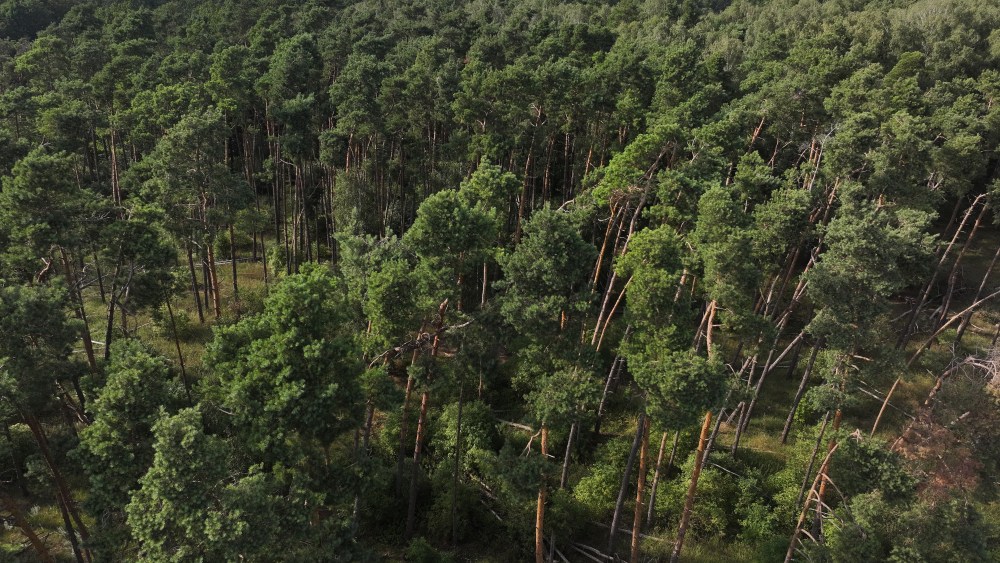
Canopy, a nonprofit that advocates for forest protection, estimates that 300 million trees are logged globally a year to make the virgin wood pulp needed to make viscose, one of the world’s most used fabrics.
It’s an environmental cost that often gets lost in the conversation about viscose, a man-made fiber that is made from trees. It’s silky smooth, fluid and historically cheaper than cotton. How can a plant-based fabric be bad for the environment?
The short answer is that the industrial process behind it is toxic to the environment. Canopy, which urges brands worldwide to spare ancient and endangered forests from their viscose supply chains, could talk extensively about why the process is harmful. On Tuesday, however, the Vancouver-based nonprofit wanted to talk business. It was not a call to entirely eliminate virgin wood pulp from the supply chain. On the contrary, it was a proposal for a small reduction: 5 percent.
What if brands replaced 5 percent of their virgin wood pulp with next-generation feedstock also known as textile-to-textile pulp? And what if this was done by 2028?
Canopy developed a financial optimization model that explores this as a business case. It presented the model at a forum in the Fashion Institute of Technology called “Convening The Next-Generation Materials Transition.” It was part of Climate Week in New York, which is considered the world’s largest annual climate event.
“Let’s get into the numbers because the moral case does not necessarily convince the CFO to give a green light to next gen,” said Nicole Rycroft, Canopy founder and executive director, during her presentation.
To illustrate its point, she said Canopy used a hypothetical global apparel brand in the model, particularly one that produces in high volume and has significant exposure in the European Union. The model also assumes another key market player in the equation, a China-based viscose producer.
The benefit is in savings, which can go up to $40 million over the next decade for a brand that typically buys a significant amount of viscose every year. This, however, is if it gets the timing and mix right: 5 percent of recycled textile-to-textile (T2T) pulp by 2028.
“The main finding is that adopting immediately—if not today, then tomorrow—5 percent next-gen textile-to-textile fiber into your MMCF [man-made cellulosic fiber] is an absolutely no regret, high impact return option for brands,” Rycroft said.
“This is without needing policy mechanisms in place. This is even without the inevitable wood pulp shocks,” she added.
Canopy dove deeper into this in a working white paper called “Seeing the Forest for the Trees.” In the report, Canopy emphasized why 5 percent in 2028 is important, even though it just seems a small number. For costs to decline over time and commercial adoption to reach its full potential, near-term uptake needs to hit “meaningful levels soon enough.”
More complicated than it seems
Either way, Canopy sees three market drivers that may sway the brand to a 5-percent adoption, and they all have something to do with the tendency of business to be risk-averse, whether it be wood-price volatility, persistent shocks to wood pulp prices, or EU policy costs that can be offset by T2T.
Canopy acknowledges that actual market conditions can be more complicated than what the model projects. The analysis relies on two important assumptions: that viscose producers will have sufficient access to recycled pulp, and that price takers do not influence market prices.
In reality, reaching a mix of 30 to 50 percent textile-to-textile pulp might require brands and viscose producers to implement more changes in other related operations such as textile waste collection and sorting, Canopy said.
The nonprofit also highlighted China’s role, which is targeting 30 percent recycled textile waste by 2030, in this future.
“Its large volumes of textile waste, significant viscose production, and deep textile and apparel manufacturing base make it one of the few markets with the potential to build more integrated T2T [textile-to-textile] supply chains at scale,” it said.
Ultimately, all of these assumptions and projections hinge on the savings that can benefit a global company’s bottom line. It’s a practical environmental approach that addresses the elephant in the room for executives: the cost.