“The idea is that the brand is much bigger and more relevant than the products we sell.”
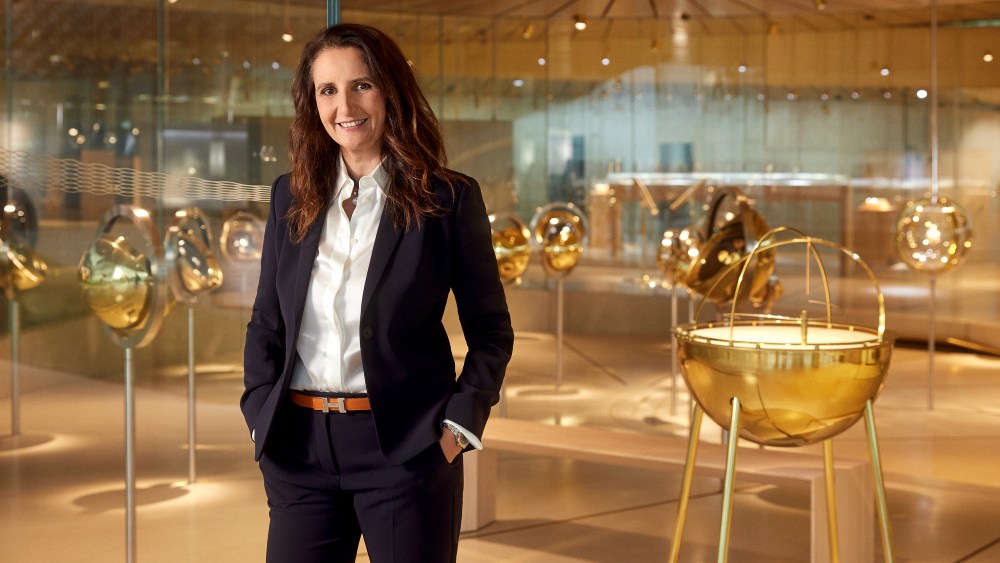
So said Audemars Piguet chief executive officer Ilaria Resta ahead of the company’s first participation in Watches and Wonders, the industry’s most prominent annual rendezvous.
As far as she’s concerned, it’s a moment that’s been a long time coming — and goes far beyond the business perspectives such a moment offers.
Well before she took the helm of the watchmaker from Le Brassus, Switzerland, Resta was among the tens of thousands of enthusiasts attending the fair and predecessors like SIHH — visits that left her convinced of the need to throw the doors wide open on the industry.
That’s why “radical openness” is what she has been putting in place since her arrival as CEO in 2024.
You May Also Like
Take its 150th anniversary year, where afficionados were afforded plenty of opportunities to get up close with the brand.
Among them were exhibitions in Dubai and Shanghai that drew over 50,000 visitors in total; the publication of “The Watch, Stories and Savoir-Faire,” a 584-page compendium that dives into the inner workings of fine watchmaking, from a timepiece’s anatomy to the many professions involved in its making, and the filming of the “Inside the Dream” documentary that will premiere Wednesday at the fair.
Openings of AP House cultural spaces have come at a fast clip, with the brand’s Miami outpost bowing in March. Its London address was also relocated and expanded.
All this aims to create experiences and stories that convert casual interest into lasting attachment — purchasing optional.
That said, there were plenty of covetable releases, from perpetual calendars in a 38mm size that garnered rave industry reviews to the recent Art Deco flair of the Neo Frame Jumping Hour.

Payoff is already palpable. The family-owned private company does not publish figures but Resta said revenue had grown 10 percent, a figure that would be higher at constant exchange rates given the very strong Swiss franc, with a broad-stroke figure of 53,000 watches produced for the year.
There’s appetite — and now room — for more. So far, 2026 has seen the inauguration of the new 255,000-square-foot, cutting-edge L’Arc manufacture in January and another facility in Meyrin, dedicated to bracelets and cases in precious materials, in mid-March.
But the real yardstick of success as far as the CEO is concerned is “how many people turned their heads towards watchmaking and towards us, with huge interest,” she said.
Tuesday’s reveal at Watches and Wonders of a trio of inaugural pieces from the Atelier des Établisseurs, a new project dedicated to remarkable timepieces rooted in collaboration and rare traditional crafts, will no doubt contribute to keeping eyes on the watchmaker.

Here, the executive tells WWD how Audemars Piguet is maneuvering the levers that convert cultural relevance into durable demand — and do its part to ensure the watchmaking ecosystem continues to thrive.
WWD: Why did 2026 feel like the right moment to join Watches and Wonders?
Ilaria Resta: It’s the beginning of a new journey for Audemars Piguet, after celebrating 150 years last year with a big, intense tour of exhibitions around the world. [The fair] is a great way to continue [what] we call “radical openness” to the world, an opportunity to show not only our innovation, but also our history and savoir‑faire.
Ever since I visited the first edition, I could feel the vibe of that event — open and exciting, not only for the sector, because you have professionals, brands and retailers, but also because it’s open to the public. That addition to the fair was important: you can see the excitement of the general public engaging with the watchmaking industry at large.
As one of the biggest brands, with a long history in watchmaking, Audemars Piguet needed to be part of that moment of sharing for the industry. It’s important to stay close to other brands, and also to the small independent brands that use Watches and Wonders as a pillar to showcase their expertise and innovation. It’s really a big [celebration], and it’s important to be there.
WWD: What will matter most over the next three to five years for the industry, your clients and the general public?
I.R.: The first is making watchmaking of broader interest. I really believe watches are objects of art, and as such, they need to be exhibited and shown. There is so much invention and artistry behind them, this mechanical genius, and I want to make sure we communicate broadly, educate, and create more people passionate about this industry.
The idea is to make watchmaking the equivalent of art again. It needs to be shown; the general public needs to have access. Education is key: the more we explain the movements and the mechanical soul of the watch, the more people get excited. Around that, there are many métiers that are at risk of disappearing. It’s important that, as an industry, we keep pushing the learning of manual savoir‑faire, which is part of a long history in Switzerland and beyond. I really want that to be a critical part of the strategy.
Then there is client centricity. We have a direct relationship with our clients, and this is an important pillar: to stay close to them, have a direct relationship, create human connections and transfer emotions. The AP House is a great example of how we welcome clients differently. We are creating more and more exhibitions and small museums in every AP House. The idea is to offer the opportunity to learn about watchmaking and see what was part of our history. We showcase pieces from our museum, which we make travel. We also launched a program of masterclasses so clients and nonclients can subscribe and participate in sessions held by watchmakers, to explain movements and do some simple hands‑on operations in assembling a movement. It’s a huge success; all the masterclasses are fully booked until after summer.
Then there is manufacturing excellence and innovation. We continue pushing forward with our interpretation of watchmaking — a blend of the past, anchored in our manufacturing philosophy, and the future, with new materials, new movements and new features. That’s important. Our R&D department is a critical investment for the future.
WWD: How does L’Arc play into this?
I.R.: L’Arc was conceived to be many things. First, it’s a common house for all the different ateliers that were dispersed around the valley for Audemars Piguet. We are really bringing together all the savoir‑faire under one roof. By doing so, we’re changing the production flows and rethinking the way we work. In the past it was very specialized; now it’s more open. The ateliers are still specialized, but there are many areas where different expertise meet. This exchange is driven by the desire to push creativity and optimize production, because when you put together people from different ateliers, you get better ideas.
Each atelier is, in a way, a supplier and a client of the others, because of the production flow. We’re trying to break this linear flow and create much better visibility of the entire production and simulation of a watch. That has generated many new ideas.
L’Arc is also where we train apprentices and develop people. We’re bringing in‑house new savoir‑faire and expertise that we used to outsource. It doesn’t mean we no longer work with suppliers; it means we want to be sure we know how to do every single part of the watch. That’s what makes us excellent in terms of quality.
L’Arc is also home to one of the Fab Labs we’ve created at each production site. The Fab Lab is a new interpretation of research and development: a multifunctional, multidisciplinary group working on the future of watchmaking.

WWD: In that context, what do you see as Audemars Piguet’s true competitive advantage today?
I.R.: Our cultural relevance, the fact that we are really in the zeitgeist of culture, art, history, innovation. This comes after many years of investing in multiple platforms like art and music. We’ve always been close to the culture of each country and region we serve, and the direct relationship with clients is the real competitive advantage that keeps us culturally relevant across generations.
When you know your clients and speak their language, you understand their needs. You can create emotional connections that are very difficult to achieve without that direct relationship. I personally like to meet clients; I’m often with clients, I’ve met many of them, and I like to talk to them. Proximity makes us relevant and authentic.
As a consequence, we are now relevant across all generations. We serve four generations at the same time, and they love us. We don’t have the challenge of being seen as too old or too young as a brand. We are just right for every age.
WWD: Is that what underpins the evolving approach to collaborations, ambassadors and friends of the house, which has seen a shift away from buzz and toward, say, accompanying an artist like John Mayer for his performances?
I.R.: Indeed. Shifting is necessary, because we evolve while staying authentic to ourselves. As our client base changes with generations, it’s important to get closer to women and to open the door to people who are interested in watchmaking even if they’re not clients.
The idea is that the brand is much bigger and more relevant than the products we sell. It’s a philosophy, it’s culture. People are interested in getting closer to us simply for the pleasure and excitement of seeing watches in their hands. We just launched a very, very complicated pocket watch — actually the third most complicated in our history. So many people are excited just to see it; it’s not about owning it.
We are shifting from a focus on ownership to engagement, connections and emotions. The platforms we leverage are all intended to create real, authentic connections with people.
WWD: Hence the documentary?
I.R.: Exactly. It responds to the need to give people a sneak peek of what’s happening at Audemars Piguet, like we did with the exhibitions. For the 150th anniversary, the exhibitions hosted and welcomed more than 50,000 people in just two cities, Dubai and Shanghai. These were public events, not reserved for clients.
We continue to have very intimate engagement platforms with clients, and these are critical. But the reason we launched the book “The Watch” last year, the reason we’re doing the documentary, and our overall posture in communication, is about building a much bigger connection and impact beyond clients.
I believe there is broad interest in this industry that we need to nourish. There are many people who want to know what’s behind a watch, how you create it — engineers, artists, kids, younger generations. They don’t necessarily want to buy a watch, but they are curious about these wonderful objects.
WWD: Does this mean you would consider signing on as an official timekeeper of a major sporting event?
I.R.: Nothing is out of consideration. We are assessing a few options and platforms. We’re very close to art with Art Basel, and we’re extremely passionate about music with the Montreux Jazz Festival. We keep looking and seeing where it makes sense for us and fits with our passions.
WWD: After the effervescence of the pandemic era and with numerous ongoing challenges, how are you redefining success beyond unit sales and revenue? You’ve said increasing production is not necessarily the answer. Where does sustainable growth come from for Audemars Piguet?
I.R.: For me, the priority is anchored on three pillars. I refrain from talking numbers, because we can honestly sell as many watches as we produce. If we doubled, tripled or quadrupled production, we could sell them. But that is not the intent — innovating is.
[This] takes a big part of our investment, our manufacturing space and our people. We devote people to working on movements and materials for the next five, 10, 15 years, and for some we don’t even know if we’ll ever launch them. This pure research is at the core of our philosophy of watchmaking. Being independent and family‑owned gives us the freedom to invest in our values and passions.
I [view] success as our ability to innovate and to keep learning. One example is the perpetual calendar we launched last year. That movement is extremely close to our history; the perpetual calendar is a complication that belongs to Audemars Piguet and symbolically helped save the brand during the quartz crisis in the 1970s. We didn’t want to innovate in a nostalgic way by simply continuing with the same type of movement. Instead, we revolutionized it with a completely new setting of the functions. It’s an invisible innovation, but a meaningful one that required a lot of invention.
The same goes for the RD#5, with pushers with [a feel similar] to smartphone buttons. That’s another important invention. Everything that helps the wearer use the watch more ergonomically and intuitively is a vector of innovation. That’s why to me, innovation is a major measure of success.
The second is protecting and mastering the savoir‑faire of watchmaking. In L’Arc and in our other production sites, we’re bringing in the entire ecosystem of watchmaking expertise to make sure we master every aspect and keep perfecting this savoir‑faire. That includes training and developing talents. This industry requires passionate people who devote their professional life to evolving and improving. High‑end watchmaking skills that are acquired over decades — that’s a big investment for us.
Last but not least, success is creating people passionate about watchmaking. That’s why I believe radical openness is a critical strategy for Audemars Piguet — and, more broadly, for the industry. The more you open the door, the more you are accessible and explain watchmaking, the more passionate people you develop. These people may work in watchmaking, buy a watch, or simply maintain a strong interest in the industry.
WWD: Which regions are strategic priorities for the brand right now?
I.R.: In terms of regions, we are well‑positioned everywhere, with some white‑space opportunities that we can slowly tackle organically. India, for example, where we’re not currently present.
Overall, we are present everywhere else with solid growth, [making] sure to be balanced and not [be] over‑dependent on any region. That has proven extremely successful.
When one region was in crisis, like China, we didn’t suffer. We continue to have strong demand in China. And when there were debates about U.S. tariffs, we didn’t make any move that penalized our clients.
That’s the winning choice. We continue serving our clients in every region, innovating, engaging with them through events, and investing across regions. That’s important, and we should continue, because we’re here for the next 150 years and more. A one‑, two‑ or three‑year crisis won’t change our geographic footprint.

WWD: What do you want people to take away from Audemars Piguet’s presence at Watches and Wonders?
I.R.: I want them to realize how cool watchmaking is. And it’s not only about Audemars Piguet. We will show all the savoir‑faire, expertise, people and passion around an industry that took hundreds of years to build and is still resilient, despite the fact that watches no longer have a functional role in daily life.
I want people to come with eyes full of wonder and discovery, and to leave saying, “Wow, I want to work in this industry. Wow, I want to buy a watch. Wow, I want to learn more about the movement.” I want passion. I want to create people who become ambassadors, evangelists for this beautiful industry. That’s success for me.