PARIS – Berluti has a new home in Milan.
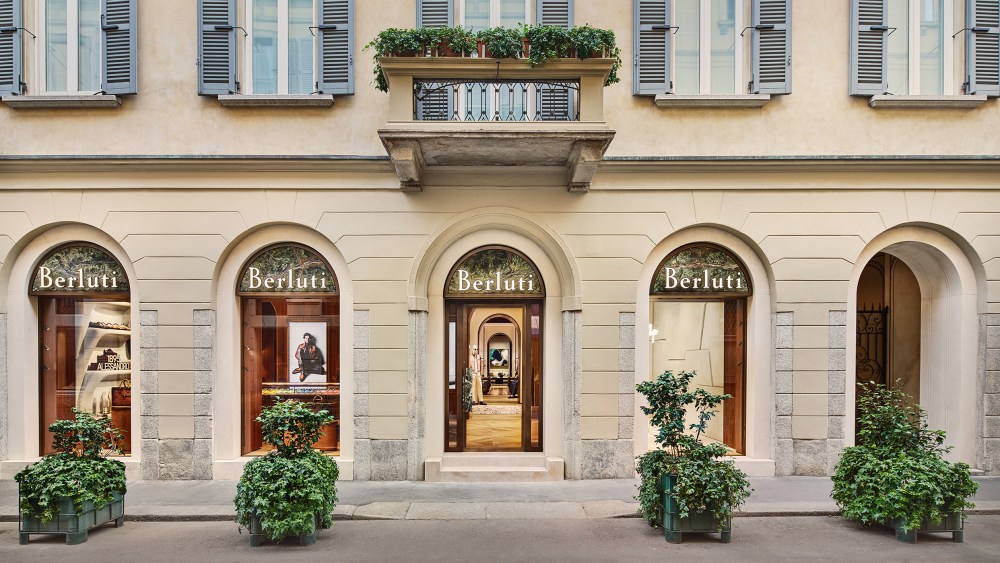
The French menswear label has opened a boutique on Via Gesù on the ground floor of the Four Seasons Hotel Milano, the first in Europe to feature its latest retail concept, originally introduced in Tokyo five years ago.
In an exclusive interview with WWD, Jean-Marc Mansvelt, chief executive officer of Berluti, said the brand hopes its new location will attract a larger proportion of local clients than its previous unit on Via Montenapoleone, which catered mainly to tourists.
It’s part of the brand’s broader strategy of recentering its business on its most lucrative segments and markets, having opted out of seasonal collections to stage an annual presentation during the Paris Fashion Week men’s shows in June.
You May Also Like
“One of our main goals with this new store is to reconnect with local Italian customers. We want them to see and understand us. Right now, they don’t make up a huge part of our sales there, although in Milan in general, the local clientele is strong,” he said.
To that end, Berluti is highlighting its Italian roots, from the origins of the Berluti family in the Marche region of central Italy, to its production facility in Ferrara near Bologna, where it manufactures both sneakers and formal shoes.
“Our house is unusual in that it has one foot in Italy and one foot in France. That dual heritage is unique and creates real complementarities and synergies,” Mansvelt said.

When he joined the brand in 2024 from jeweler Chaumet, the executive was struck by the way this blend of French and Italian style translates into the atmosphere in stores, which offer the highest standards of luxury with a pronounced sense of hospitality. (Berluti offers both made-to-measure shoes and clothes via its “grande mesure” tailoring service.)
In that spirit, the decor of the new Milan boutique is meant to evoke an apartment or a private club, with spaces designed for lingering. Framed by four arches, the entrance combines green marble accents with the rich textures of wood and the brand’s signature patina-treated Venezia leather.
With a single-floor layout as opposed to two floors previously, the 1,560-square-foot space is easier to navigate than the Via Montenapoleone boutique, Mansvelt noted.
In the first room, a giant sculpture of a foot rests under a neon sign that spells out “Italian Roots, Parisian Heart” in Italian. A glass case nearby displays a rainbow of patina varnishes applied to shoemaking lasts.
The central room, originally an inner courtyard, is dedicated to Berluti’s core footwear collection. Other rooms feature ready-to-wear and leather goods alongside art works by Lorenzo Monnini and Gabriele Cappelli, and two Gianfranco Frattini armchairs.
‘Focused Luxury’
By year-end, roughly half of Berluti’s 65 stores worldwide will have been converted to the new concept, which Mansvelt credited with boosting business in recently refurbished locations, including its store at the IFC Mall in Shanghai, which bowed in August last year.
“We saw a positive impact on sales but above all, we recruited new customers and got extraordinary feedback from our existing ones,” he said, noting the clubby feel of the original store was a little more exclusive.

“If you’re not familiar with the brand, and you can’t really see inside the store, it can feel a little dark and uninviting. We’ve opened it up, while still preserving confidentiality. It’s brighter, which helps to lower the psychological barrier to entry for some customers,” he added.
Later this month, Berluti will open another store at the Landmark in Hong Kong, as part of the premium shopping center’s $400 million renovation. And in September, it will launch a private members’ club on the first floor of its Ginza boutique in Japan, the label’s number-one market.
“It’s the first time we’re trying this, so we’ll see if that turns out to be an interesting avenue for us,” Mansvelt said.
Berluti plans to renovate a total of nine stores worldwide in 2026, including locations in Shenzhen, Shanghai and Chengdu in China; Fukuoka and Nagoya in Japan, and Dubai.
While parent company LVMH Moët Hennessy Louis Vuitton does not disclose sales for its individual fashion and leather goods brands, Mansvelt said Berluti managed to keep revenues stable last year, even as group sales fell 5 percent amid a global slump in luxury spending.
“When you look at the luxury market overall, we performed better than the average and we didn’t post a decline, which was actually quite rare,” he noted. “Looking at the group’s statistics, we’re the house with the highest loyalty, frequency of visits and re-purchases. It’s incredible when you consider we only do menswear, and only three product categories.”

The same trends have carried through into the first months of 2026, with Japan and South Korea leading the pack, while China still lags. As a result, Berluti plans to keep its global retail footprint broadly unchanged, with some regional exceptions.
In China, the label is closing two stores in second-tier cities as it narrows its focus in a bid to improve brand recognition. It has also shuttered its operations in Australia.
“Before expanding further, we want to be the best at what we do,” Mansvelt explained. “I really prefer this concept of focused luxury over just doing more and more. It runs counter to what many other houses are doing, but for Berluti, it makes perfect sense.”
Personal Style
Following a brief foray into interior design, the brand has doubled down on its core segments of footwear, rtw and leather goods, with an emphasis on signature products such as the Andy loafer and the Deux Jours bag.
Last year, it marked its 130th anniversary with a big push on the Forestière jacket, a style that entered the Berluti vernacular with LVMH’s acquisition of bespoke tailor Arnys in 2012.
Brand ambassador Lee Jun-ho, who goes by the mononym Junho, sports a lilac linen version in a recent video series that highlights Berluti’s Italian origins, while Michelin-starred chef Mory Sacko opted for a midnight blue mohair variant on the red carpet at the Cannes Film Festival.

Sneakers are Berluti’s top footwear category, but still represent less than half of sales. The house has fleshed out four key pillars, including the recently revamped Shadow, but has also spruced up its offer of formal shoes. “We’re seeing a return of dress shoes, even among young people,” Mansvelt reported.
Pointing to his own Alessio brogues with rubber soles, the executive noted that recent launches are lighter and more flexible, drawing on know-how gleaned from sneaker development and Berluti’s ongoing dialogue with clients.
“Our relatively small size has the advantage that we’re very close to our stores and customers. They’re extremely loyal, which allows for very precise feedback. We never stop improving and adapting to how people live,” Mansvelt said.
“Sneakers have taught us lessons that we applied directly to our formal craftsmanship. Since everything is produced in the same factory, the same development, design, and production teams work hand-in-hand,” he added.
Berluti’s made-to-order and made-to-measure shoe services are both growing, and it also offers more entry-level personalization options, such as requesting a different patina on a pair in store.
It’s all part of the brand’s sartorial concept of “remarkable allure,” with less emphasis on seasonal trends, and more of a focus on personal style.
“Paradoxically, even though we no longer do runway shows, we feel we are on trend – specifically this search for authenticity. It’s a more sincere, less spectacular luxury, focused on objects that are carefully crafted to last,” Mansvelt said.
The brand has been without an artistic director since the departure of Kris Van Assche in 2021, and Mansvelt plans to keep it that way – for now. “We won’t have an artistic director in the short-term. Will we rethink that in a few years? Most likely,” he said.