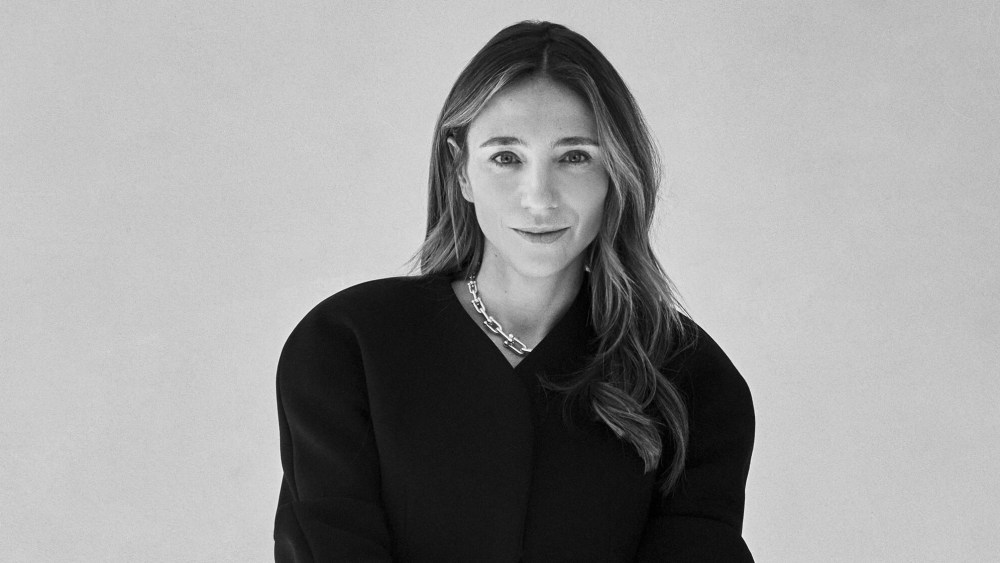
Sarah Benady, chief executive officer of Jacquemus, just returned from a 10-day swing through Asia, where the founding designer Simon Porte Jacquemus was mobbed by fans from the minute he touched down in cities including Shanghai and Seoul.
The enthusiastic reception — you might call it a J-wave — is auspicious for the Paris-based fashion house as it readies a push into a vast market it has so far barely scratched.
Benady told WWD she’s in the throes of recruiting a general manager for the Asia-Pacific region, and the goal is to launch a digital platform in China in 2026.
“And I hope a store is in the pipeline for next year, most likely in Shanghai,” she said. “We all came back so energized.”
You May Also Like
It’s been a busy and fruitful year for Benady, who assumed the management helm in March 2025, joining Jacquemus from Celine North America, and with experiences at Ba&sh, The Kooples and Printemps under her woven-leather belt.
During an exclusive interview in her bright office — appointed with a small citrus tree, sheaths of wheat and a few rustic, sun-bleached orange armchairs — she unpacked the company’s transition away from a see now, buy now model; described the staffing and supply-chain changes made in tandem with a brand elevation strategy; explained the reasons behind a culling of its wholesale accounts, and led a tour of its upgraded leather goods atelier, where staffers were in the throes of developing a bucket version of its hit Turismo bag.
In addition to some internal promotions of longtime staffers, Jacquemus recently brought in a chief operating officer with extensive experience in Asia; a new head of the accessories business unit who previously worked with The Row and Bottega Veneta; a new chief digital officer with experience across fashion and beauty, and seasoned tailors and dressmakers recruited from the couture departments of Schiaparelli and Dior.

Also under construction is a new retail clienteling department.
“With the growth of our retail network, it’s something that is becoming super central and key. We have an amazing leader joining next month,” she said. “We’ve been very lucky to attract senior talents and experts.”
Benady also revealed that Ken Suslow, founder and managing partner of Sandbridge Capital, has joined the board of Jacquemus following a minority investment in the company, which occurred nearly in tandem with the headline deal last year with French beauty giant L’Oréal, which came on board as a new minority investor, and long-term licensee.
Benady declined to give many details around the previously undisclosed transaction, saying only that the Sandbridge stake is smaller than L’Oréal’s and that the rationale was access to Sandbridge’s expertise, rather than any urgent need for additional funding.
“We are lucky to have him around the table…to have his perspective, his expertise,” she said, lauding Sandbridge’s investments in the likes of fashion house Thom Browne, and beauty brands Ilia, Peaches & Lily and Youth to the People, which L’Oréal acquired in 2021.
“So they knew him,” Benady commented. “L’Oréal and Sandbridge are giving very different perspectives on the business, so we have an extremely strong board.”
A warm, energetic executive with a big smile ever at the ready, Benady stressed the importance of her team, and creating an environment that echos the brand’s upbeat, solar spirit — and honors the founder’s ambitions, too.
“We’re all here for Simon, supporting his vision, building a house at the size of his talent and working collectively to anchor it in the long term,” she said. “Being part of that story — and helping shape something that will last — is truly the most exciting journey I could hope to experience.”
Over an hourlong conversation, Benady elaborated on the brand’s unique blend of pop culture and high-end fashion, her vivid complicity with the founder and their shared obsessions with product quality, innovation and newness.
WWD: In your first year on the job, what struck you the most about the brand, the founding designer and the company?
Sarah Benady: First, a confirmation of the strength of the partnership and a harmonious, very natural rapport with Simon. When you start a CEO role, it’s always the most important component — how you develop that relationship between the business side and the creative side.
Long before I was hired, a lot of people told us that we should meet each other, that they could picture us partnering together. And the day we met, we were supposed to meet for an hour and it ended up being an entire day of discussion, of sharing the vision.
On paper, we are very different, since I was a Parisian living in New York and having more of a structured background, coming out of business school. [Simon] is much more an entrepreneur, extremely creative — so a bit South of France meets New York. Still, we immediately clicked and it’s exactly this contrast that makes the partnership work.
So even though we are coming from very different backgrounds, we share a lot of common values, and a common vision on how to build Jacquemus for the long run. Jacquemus enjoyed a tremendous, very rapid success and the next chapter for the maison is to build a very strong foundation for the long term.
WWD: So what’s your assessment of the brand health?
S.B.: I was amazed by the consistency and the strength of the brand. For me, it’s more than a fashion house, but more a way of living.
The vision of Simon from the beginning was to have this interesting balance between something close to pop culture and something very high end. This is how he is, and how he lives. The brand is linked with Simon’s story and his lifestyle. The audience feels that and makes them feel very, very close to the brand.
People want to be part of that universe, this very warm, solar, South of France feeling. I feel this desire from an entire generation to slow down a bit, to take more time, to value more than ever a very positive mindset. And definitely the brain is resonating for that.
WWD: What have been your proudest achievements so far, and why?
S.B.: All the work we’ve done together with the team and with Simon on the quality, across the supply chain, starting from the work we’re doing with our ateliers here in house. We’ve strengthened the level of the ateliers in both ready-to-wear and leather goods.
Another focus on product was around suppliers. Now 100 percent of our leather goods are made in Italy. For ready-to-wear today, the majority of our fabrics are coming from Italian mills and everything is made in Europe. It took a lot of time and effort from the team to really focus on the entire chain from the suppliers to an emphasis on quality at every level, from the fabric research to the finished product. Also an important change: Now the production and quality departments are reporting to me.
Something we’re also very proud of is reducing our wholesale distribution. We have very high expectations of where we want to see the products over the long term and so we reduced about a third of our wholesale distribution in one year. This is definitely a courageous decision, because it’s a decision that will have a long-term impact, but we’re very convinced it was the right thing to do.
We now have around 250 partners across the globe that we see ourselves growing with over the long term, aligned with us on the brand positioning, on the strategy for full price, on newness.

WWD: Have you done any other retooling to prepare the company for its next phase?
S.B.: One important change is that we used to run the business with commercial verticals, retail and wholesale, and now we created regions. So we are opening headquarters in New York and Shanghai. We already appointed our Americas general manager and our EMEA general manager, and we are finalizing the recruitment for APAC. It’s a new way of thinking to to support international growth.
WWD: How far have you come with retail?
S.B.: Today, we have around 25 stores if you count resort activations. We have our flagship doors in Paris, London, New York and L.A., and we are starting to convert some department store shops-in-shop to concessions, such as in Galeries Lafayette Haussmann and Selfridges in London. This year, we are opening two more summer resort stores, in Forte dei Marme in Italy and also the Mandarin Oriental in Bodrum, Turkey. This concept has been working extremely well for us.
I think definitely a flagship in Italy is missing from the picture when we consider the traction of the brand there.
We have a presence in [South] Korea, six shops-in-shop with a local partner, but we don’t have a proper store in the region yet. So that’s the main focus for the next year.
Last year, direct-to-consumer revenues came to represent already half of the business, and this share will continue to increase going forward given our very strict approach to wholesale and the growth of DTC overall.
WWD: You recently aligned with the calendar for Paris Fashion Week. Was that a heavy lift?
S.B.: It was something of a revolution for the product team. And more than that, we also evolved from having two main moments for the showroom to four. We have a winter we capsule showed during fashion week in early March called Sapin (pine). And our Plage (beach) capsule is dropping in stores right now. It’s a way to implement newness on a very regular basis, and newness is what is driving the business right now. The goal is that those capsules expand into pre-collections in the future.
WWD: How have collaborations with the likes of Nike and Veuve Clicquot affected business and brand perception?
S.B.: The vision of Simon to always have a balance between pop culture and the very high end, and I think those two partnerships represent that super well.
WWD: What’s been the reaction to the brand elevation strategy?
S.B.: What is driving the business is newness, and very interestingly, the most high-end products of the collection, especially leather ready-to-wear. This sold out extremely quickly. We’ve also seen a very, very good reaction to our latest bag launch, Le Valérie. It’s at a slightly higher price point than the bags we used to have before, and we saw zero price resistance. In the meantime, all the luxury maisons increased so much that our prices are still considered very accessible, especially for leather goods.

WWD: Simon recently told me men’s rtw is now as big as women’s rtw. How do you account for this?
S.B.: There are very few maisons that have an even share of the ready-to-wear business. Women still represent two-thirds of our clients, because leather goods are mostly bought by women, but menswear ready-to-wear is very strong. I think it’s because Simon embodies the menswear. He’s envisioning himself, and this is resonating with the clients who are looking for his full lifestyle.
Today, leather goods are almost half of the business, and the ready-to-wear is around 40 percent. The rest is accessories, which include shoes — a very fast-growing category for us, especially Les Tennis.
WWD: How is business right now?
S.B.: The 2026 business is growing. Obviously, we are opening a few doors, but we are also growing in like-for-like terms. We had the launch of Le Valérie at the end of the year and it had a very positive impact on our leather goods business. Ready-to-wear, both men’s and women’s, is resonating very well with our elevation strategy.
For example, in the past, our men’s business was very much driven by jersey, and now it’s extending to a very complete wardrobe. We’re extremely well with suitings, knitwear and outerwear.
WWD: I understand your Miami store in the Design District should open later this year. Why is it so important?
S.B.: It’s super important for the U.S. market, as Miami is developing quickly. But more than that, it’s a window for the Latin American customer. On our social media, we already have a big audience from Brazil and Mexico.
WWD: What are the timelines to unveil your first beauty products with L’Oréal?
S.B.: It will be the first half of 2027. We are dedicating a lot of energy to our beauty launch.
We can feel today that we speak to two different audiences. The very high-end clients come to us for the show looks, and mainly for the ready-to-wear.
Our Nike partnership is definitely answering to the pop component, and offering something accessible. We know beauty will be extremely important for us to answer to those more aspirational audience. I’m sure that for some of them, even Nike can sometimes be a significant investment. So with beauty, we’ll be able to fulfill that need.
Simon already built a fashion house that is very much impacting his generation and since we started harmoniously working together, we are building the future and the long term. This is just the beginning of the journey.