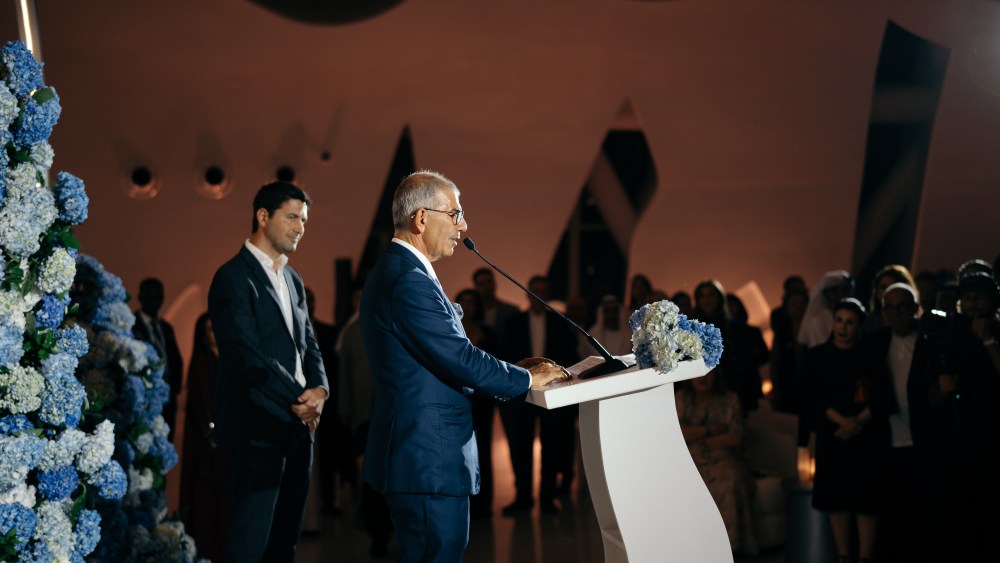
DUBAI — In the gleaming halls of Dubai’s Museum of the Future, amid an event aptly titled “Symphony of the Future,” two generations of Chalhoub leadership stood side by side — a tableau that captured both the weight of a 70-year legacy and the promise of what lies ahead.
Patrick Chalhoub, 67, who has guided the family enterprise for more than two decades, now serves as executive chairman. Beside him stood his son Michael, 38, who assumed the role of chief executive officer on Jan. 1, becoming the third generation to lead the Middle East’s largest luxury retail group.
The enterprise they steward has grown far beyond what Michel and Widad Chalhoub could have imagined when they opened a modest Christofle boutique in Damascus, Syria, seven decades ago. Today Chalhoub Group operates more than 950 retail stores across 14 countries, 65-plus e-commerce platforms, partnerships with more than 400 international luxury brands and a workforce of 16,000 employees from 119 nationalities. The group represents the critical bridge between Western luxury houses and a Gulf Cooperation Council personal luxury market that reached $12.8 billion in 2024 — growing 6 percent year-over-year while the global luxury industry contracted.
The milestone has not gone unnoticed by the UAE’s leadership. “Our nation is committed to evolving beyond resource-based growth into an era driven by open, diversified trade and investment, where companies like Chalhoub Group, rooted in our region, become ambassadors of that ambition,” said H.E. Dr. Thani bin Ahmed Al Zeyoudi, UAE minister of foreign trade, who attended the anniversary celebration.
You May Also Like
But behind these figures lies a more remarkable narrative: a family business displaced four times by war and political upheaval, yet emerging stronger from each crisis.
Forged Through Adversity
The Chalhoub story began in 1955 when Michel and Widad Chalhoub opened a modest Christofle boutique in Damascus. What followed reads less like a corporate history and more like a testament to human adaptability.
“Every time we had to move from place to place, it was a new beginning,” Patrick Chalhoub reflected on his parents’ journey. “Which was great, because you reassess yourself, and how are you going to build the future with some foundation.”
The family relocated from Damascus to Beirut in 1965, fleeing rising political tensions. A decade later, when civil war erupted in Lebanon, they moved again — this time to Kuwait, where Patrick joined the company in 1979. That same year, the family launched Tanagra, their first owned concept store, marking a decisive entry into retail.
Then came 1990 and the Gulf War, forcing yet another displacement, this time to Dubai. What could have been a devastating setback became a strategic pivot point.
“Our path was not always easy, but we turned every challenge into an opportunity,” Chalhoub said at the anniversary celebration. “From Damascus to Beirut, to Kuwait, and finally to Dubai, every step carried the spirit of perseverance.”
“We really focused on keeping the people and the values,” he further explained to WWD. “At the same time, it helped us to get more united with each other in face of adversity.”
Michael Chalhoub, who has witnessed this resilience firsthand, offered his own perspective. “One thing that we’ve learned through these new beginnings is that resilience, that perseverance — words like that are easy to speak but not easy to act.”

The Art of Partnership
The Chalhoub Group’s business model rests on a distinctive partnership philosophy that has attracted the world’s most prestigious luxury brands. The company operates through joint ventures, franchises and its own retail concepts — but underlying all three is what Patrick Chalhoub describes as a “round table” approach.
“The most key element for us is building a relationship of trust between us and our suppliers. With this trust, we can absolutely conquer our markets or customer in a much easier way. We don’t like sitting on two sides of the table — we focus really on how are we going to delight our customer,” he said.
The joint venture portfolio reads like a who’s who of global luxury: Louis Vuitton, Dior Couture, Sephora, Fendi, Celine, Givenchy, Christian Louboutin and Tiffany & Co., among others. Each partnership is structured around what Patrick calls “alignment” — a concept his son has embraced as foundational.
“The alignment doesn’t always exist in a partnership,” Michael acknowledged, “but through open communication, you can get an alignment of values, an alignment of objectives, alignment of goals. That’s really important to understand that everybody is shooting in the same direction.”
This approach has occasionally meant walking away from opportunities. “The world’s biggest company came knocking on our door a few years ago, and we said no to them,” Michael revealed. “Even though we had alignment on values, we didn’t have full alignment on margins and things that are more technical. They were pleased that we said no, rather than going into a partnership that we imagined was going to fail.”
When Partnership Means Patience
Perhaps no partnership better illustrates the Chalhoub approach than Sephora. Today, the Sephora Dubai Mall location is reportedly the top-grossing Sephora store globally, and the brand commands an estimated market share exceeding 50 percent in Saudi Arabia. But it nearly didn’t happen.
“Two years after we opened the first store in Festival City, LVMH [Moët Hennessy Louis Vuitton] considered that we should close the market because it wasn’t getting the traction they were expecting,” Patrick recalled. “They said, ‘We better pull out like we pulled out from England.’ We negotiated with them to say, ‘Give us two more years.’ We even said, ‘If you want to give us those two years, we could pay the losses.’ But they said, ‘No, our partnership is a partnership, so we will give you two years.’”
The turnaround required “persistence, understanding, adjusting” — making the human connection with customers and building teams with the right elements to penetrate the market. Sephora Middle East now operates across all six GCC countries, and prestige beauty remains the fastest-growing luxury category in the region, up 12 percent in 2024.
A Region Defying Global Trends
Chalhoub’s 70th anniversary coincides with a moment of notable strength for the GCC luxury market. While the global luxury industry contracted in 2024, the Gulf region bucked the trend entirely.
According to the group’s latest market intelligence report, luxury fashion drove the region’s performance, accounting for 43 percent of the $12.8 billion market and growing 6 percent. Prestige beauty surged 12 percent, with fragrance commanding 49 percent of the beauty category and skin care posting the highest growth at 17 percent.
The momentum has accelerated in 2025. The report projects the market will reach $15 billion by 2027.
E-commerce represents another significant opportunity. While online sales account for 20 percent of global luxury purchases, the GCC’s penetration stands at just 13 percent — but it’s growing at 13 percent annually, far outpacing the global average. Chalhoub has responded with innovations including Layla AI, a generative beauty assistant built in-house that has increased customer session time by 7.4 minutes and improved conversion rates by 2.5 times.
Passing the Torch
The transition from Patrick to his son Michael represents more than a generational handover — it marks a strategic inflection point. Patrick, who took over from his own father, Michel, in 2001, prepared for this moment through a rigorous three-year planning process involving internal and external candidates, including non-family members.
“There is a cycle in the lifetime of a business plan,” he explained. “The period where you learn, the period where you do, and the period where you teach.”
His advice to his son was characteristically direct. “First, that he is totally involved and has to take responsibility. Listening is important — listening to his peers, to his team, listening to some of our advisers, listening to me. Listening doesn’t mean that he does what each one was going to say. He has to take his own decision, totally empowered.”
Nearly a year into his tenure, Michael humbly reports results that have exceeded expectations. “To be honest, it’s been better than what I expected,” he said. “We’ve overcome our budgets by more than 8 percent.” The company recorded its strongest performance in March 2025, with Saudi Arabia growing at double-digit rates.
Does he feel the weight of his family’s legacy?
“There’s been big shoes to fill,” Michael acknowledged. “But it also feels like I’m standing on the shoulders of giants. I’m capable of lifting that weight because I’m lifting it with thousands of colleagues and not alone.”
When Patrick joined the company in 1979, there were 100 employees. Today, that number has grown to 16,000 officially, but Michael shared the most recent figures suggesting it may actually exceed 19,000 if Latin American operations are included.
It’s a fitting measure of a company that began with a single boutique in Damascus and became the preeminent luxury retail group in the Middle East — a symphony composed across seven decades, four countries, and three generations.