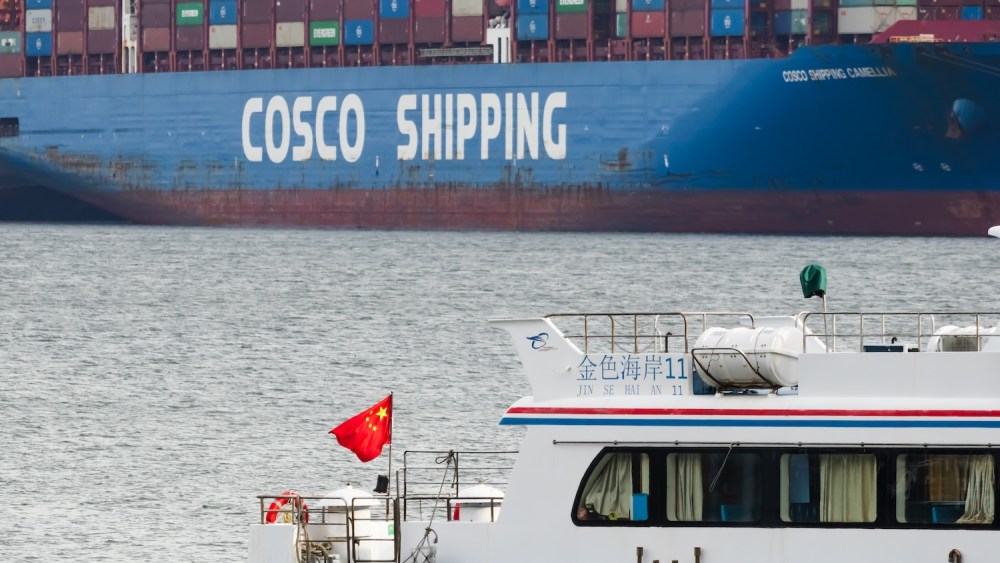
The Trump administration is accusing China’s largest ocean carrier of spying on military communications near the coastlines of nations including the United States.
State-owned Cosco Shipping uses concealed equipment on board its vessels to conduct the operation, according to a Monday report from Reuters.
Cosco Shipping is the fourth-largest ocean carrier in the world by tonnage capacity, at more than 3.6 million 20-foot equivalent units (TEUs), according to data from container shipping consultancy Alphaliner. That represents 10.6 percent of global container shipping capacity. The company operates 565 ships in total, but the report did not indicate how many vessels could be carrying the equipment.
Two senior administration officials told Reuters that Cosco has a decades-long intelligence-collection partnership with Beijing, which allows China to collect communication signals from vessels and aircraft operating across Europe, North America and Asia.
The equipment is reportedly intended to enable China to gather information about military communications technologies and encryption developments, but also enables Beijing to monitor key shipping lanes and maritime routes crucial for trade and military navigation.
The officials did not detail the type of equipment Cosco ships were allegedly using, but said they were “sophisticated signals intelligence collection” platforms, rather than routine communications hardware. Beijing allegedly uses the information to further its position in territorial disputes and provide maritime reconnaissance and early-warning indications of foreign military targets.
China’s embassy in Washington flatly denied the allegations.
“We oppose vilifying China by peddling the so-called ‘intelligence collection’ narrative, which is totally baseless,” embassy spokesperson Liu Chang told Reuters.
Chang said the Chinese government would never ask any company or individual to “collect or provide data, information or intelligence located abroad against local laws.”
However, a broadly defined Chinese law requires the country’s firms to support government intelligence work upon request.
It is unclear if there are any additional steps U.S. officials have taken or may be planning to either track or take more active countermeasures against Chinese-flagged ships being used for intelligence gathering.
The ocean carrier was labeled a military company by the Department of Defense in January 2025 less than two weeks before President Donald Trump’s inauguration, as it transports military cargo for the People’s Liberation Army (PLA).
Other logistics companies listed at the time including air cargo company China Cargo Airlines Co., Ltd., container manufacturer China International Marine Containers and two of the country’s biggest shipbuilders China State Shipbuilding Corp. and China Shipbuilding Trading Co.
The designation bars U.S. military operations from shipping cargo on Cosco vessels and those of its subsidiary, Orient Overseas Container Line (OOCL). It does not stop the Chinese companies from docking at or using U.S. ports.
Last April, a report published by the U.S. Naval War College said it was likely that the PLA was leveraging China’s fishing and commercial shipping fleets for intelligence and surveillance gathering.
The accusation precedes an expected meeting in late September between Trump and his Chinese counterpart, President Xi Jinping, in Washington. Tensions between the countries escalated early last year amid their trade war under the Trump administration, which briefly included tariffs that reached 145 percent last spring. But meetings held between the two heads of state last September and this May have appeared to quell some of the wider geopolitical concerns in the short term.
Amid the uncertainty, Cosco Shipping also must keep an eye out for the potential return of docking fees at U.S. ports, which had been implemented for two weeks last year before they were postponed for one full year.
In the first week after the fees were imposed last October, Cosco and OOCL reportedly incurred a combined nearly $43 million in fees. The carriers were projected to pay more than $2.1 billion in surcharges over a full year’s worth of port calls.
If the U.S. and China don’t come to an agreement or extension in September’s Trump-Xi meeting, the fees would be set to return on Nov. 9.